
The reach machine is the one a superintendent never worries about. It sets steel, lands roof material, carries a pallet across ground that would swallow a truck, and does it so reliably that the crew stops watching — which is the state the machine is in on the day it goes wrong.
Oklahoma is unusual less for what it enforces than for where it declines to. There is a state construction board here and it was never pointed at your company, and there is no state safety plan above it either. For the mechanics that hold everywhere — rated capacity against reach, boom geometry, ground bearing, the forward-tip pattern — read the forklift insurance pillar.
What forklift insurance costs in Oklahoma
Any premium printed on a page for this class would be fiction, because the rating follows operators and conditions rather than the machine. What moves it in this state is how many people are qualified on the unit and whether the evaluation names that model, whether you run a fixed-mast truck or a telehandler placing at extension, how exposed your sites are to wind and how far they sit from the yard, where the machine is kept, and the record behind you. What the unit is worth barely registers next to the rest.
Oklahoma forklift regulations: who enforces operator safety
Oklahoma is under federal OSHA for private-sector employers, so the powered-industrial-truck operator training and evaluation requirements are the federal standard applied directly.
The unusual part is that the absence is not for want of a construction regulator. This state runs a Construction Industries Board, and on any given job it is plainly visible — the electricians, the plumbers and the mechanical contractors around your machine hold its licenses, and the roofers are registered with it. General contracting is not licensed at state level, so the company operating the telehandler passes through the whole system untouched, and above it there is no state safety plan either. Being outside two regimes at once is a specific position rather than a comfortable one, because it means nobody official will ever tell you your documentation is thin. What replaces them is a set of private gatekeepers with real power: prime contractors who prequalify, energy and utility owners running site standards stricter than anything a state writes, and an adjuster who will want the operator evaluation the week after a load comes down rather than the week before. The practical conclusion is not that the rules are lighter here. It is that the feedback loop is missing, so a habit that has quietly slipped will not be corrected until it is expensive.
Common forklift risks in Oklahoma
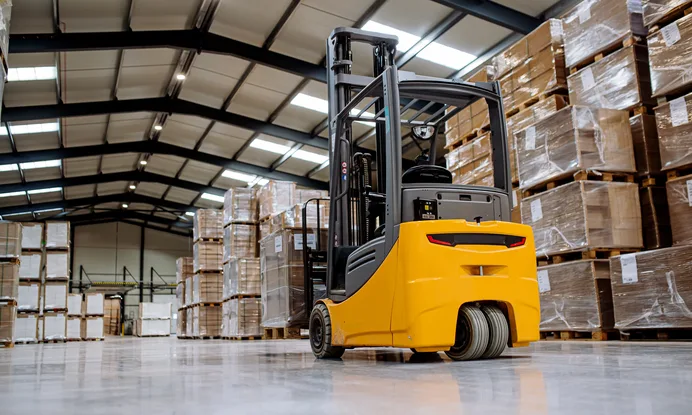
The losses in this class land on people and on other people’s property. A tip or a released load usually leaves a machine that can be inspected and returned to work, while the material, the structure it was reaching into and anyone standing beneath carry the claim. Extension is the mechanical constant, quietly spending the capacity the operator started with. Oklahoma supplies two more of its own: wind that is strong enough and steady enough to move a suspended load the operator cannot steady, and hail and severe weather that both damage parked equipment and stack up rebuild work faster than crews can absorb it, which is when placements start being rushed.
Common Oklahoma forklift claims we see
- Suspended load pushed off line by wind. The weight was within the chart; the movement at the boom tip was not.
- Material released during placement. The bundle and whatever it strikes determine the loss.
- Forward tip on a drainage-graded pad. Energy and rural site pads are built to shed water, not to stand a load on.
- Struck-by injury on the ground. The costliest event this machine produces, and no floater responds to it.
- Hail and wind damage to a parked unit. Attachments and glass more often than the machine, and easily left off a schedule.
Why Oklahoma forklift owners choose Equipment Guard Insurance
Most brokers will schedule a telehandler and call the account handled. We prefer to say the awkward thing first: the floater is the cheap half, and the year that hurts is decided by the operator and by whoever was under the load, which lives in liability and workers compensation. Equipment monoline lets us schedule the machine correctly without pulling apart a program built around this state’s work, and we place through markets — named on our homepage — that will underwrite lifting on open, wind-exposed ground as the exposure it actually is.
Major Oklahoma forklift markets
- Oklahoma City. The broadest commercial, civic and healthcare build-out in the state, with placements over occupied ground.
- Tulsa. Industrial and refinery-adjacent site work with lifts alongside live plant operations.
- Norman. University and research construction on sites that stay in use throughout the project.
- Broken Arrow. Fast suburban and light-industrial growth on open pads with long panel and truss placements.
- Edmond. Residential and institutional expansion where machines work close to finished neighboring construction.
- Lawton. Southwest military-adjacent and civil projects with formal gate documentation and long approach roads.
Related
- Forklift insurance — the machine physics that hold in every state.
- Excavator insurance in Oklahoma — the machine that has to make a phone call before it is allowed to start.
- All equipment insurance in Oklahoma — the state hub.
- Equipment floater · Rented & leased equipment
Primary sources
- State Plans — Occupational Safety and Health Administration (operator safety)
Oklahoma forklift insurance FAQs
Is there an Oklahoma agency enforcing forklift operator rules?
No. No approved state plan reaches private-sector employers here, so the training and evaluation requirements for powered industrial trucks are federal and applied directly, and the inspector, the citation and the appeal are federal too. A contractor looking for a state safety office to notify after an incident will not find one.
But the state does license construction contractors, doesn’t it?
Some of them. The Construction Industries Board licenses electrical, plumbing and mechanical contractors and registers roofing contractors, while general contracting is not licensed at state level at all. That produces an odd position on a jobsite: several of the trades working around your machine hold a state credential, and the company running the machine holds none, because the state never asked for one.
Does being outside both systems reduce what I need to keep?
It changes who reads it, not whether it exists. With no state board and no state safety program, the demand for operator documentation comes from prime contractors, from energy and utility owners with their own site standards, and from the adjuster reconstructing an incident. Those parties ask later and with more consequence attached, so the record has to be made before the lift rather than assembled afterward.
How much does wind matter to a telehandler here?
It is the environmental factor most worth planning around. Sustained wind on open ground turns a panel, a bundle of sheeting or anything with surface area into a sail, and the movement starts at the top of the boom where the operator has the least control. The machine is often rated for the weight it is holding; what ends the placement badly is the load swinging, and there is rarely anything on an Oklahoma site to break the wind.
Does energy-sector site work change the exposure?
It changes access and supervision more than the lifting itself. Pad construction, gathering-line work and wind-farm build-out put machines a long way down county roads, on ground built for drainage and truck traffic rather than for standing a concentrated load, with crews working to schedules that do not pause for weather. Add summer heat that shortens attention across an afternoon and the margin around each placement gets thin.
Can you schedule the machine on its own?
Yes. Equipment Guard Insurance writes equipment monoline in Oklahoma, so the telehandler and its attachments go on their own schedule and nothing else has to move. Where no state office is asking about operators, we would rather help you build the documentation other people will demand than let you discover the gap during a claim.