
Most of what an Oregon telehandler lifts is wood, and most of it goes up a structure that is also wood. Framing packages, sheathing, glulam, truss bundles — material that arrives in flat stacks and has to be placed onto a deck by a machine reaching from ground that spent the winter wet.
The regulatory story here is one of density rather than difference. Oregon is a state that shows up twice: once to decide whether your business may contract at all, and again to run the safety program the operator answers to. For the machine physics underneath all of that — the capacity curve, the load chart, ground bearing, what attachments do to both — see the forklift insurance pillar.
What forklift insurance costs in Oregon
There is no premium to publish, and in Oregon there is a particular reason to distrust one: a lot of what a carrier is pricing is the contracting entity rather than the machine. The inputs that move it are the operator count and the quality of the evaluation record, whether the unit is a fixed-mast truck or a telescopic machine placing loads at reach, which side of the mountains the work happens on and therefore what the setup ground does, the attachment schedule, whether the machine winters under cover, your license endorsements and the work they let you take, and your own loss record. Two identical machines at two differently structured contractors are not the same submission.
Oregon forklift regulations: who enforces operator safety
Oregon operates its own OSHA-approved State Plan covering private-sector employers, so powered-industrial-truck operator training, evaluation and enforcement run through the state program rather than federal OSHA directly.
That is one of two state credentials touching the same crew, and the pair is what makes this state distinctive rather than either one alone. Take the safety half first, and take it seriously: an approved plan must be at least as effective as the federal standard, so nothing about operator training, machine-specific evaluation or refreshers is softened by being administered locally — what changes is that the authority is close by, reachable, and correspondingly more present in the working life of a contractor. The other half is the licensing regime. Working for compensation on real-property improvements requires a Construction Contractors Board license here, endorsed separately for residential and commercial work at tiered levels, and every endorsement carries its own bond and its own insurance requirement. The practical consequence is worth stating plainly: before a telehandler turns a wheel on an Oregon site, this state has already formed a view about your financial backing and your coverage, and it separately holds a view about whether the person in the cab was qualified. Most states hold one of those or neither. Owners who arrange the license once and never revisit it are the ones who find out at renewal that the two views have drifted apart.
Common forklift risks in Oregon
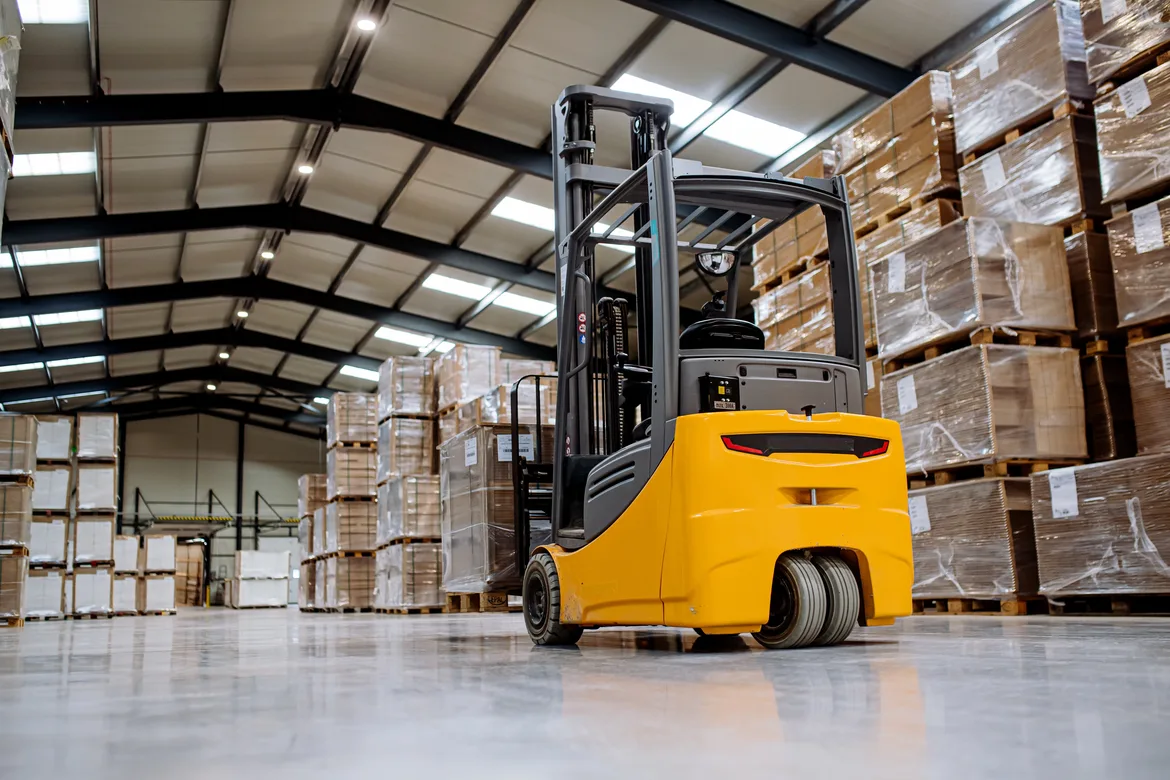
The load and the people around it carry this class, as they do everywhere — capacity falls away with reach, and the ground under an outrigger is graded rather than engineered. What Oregon supplies is a ground problem with two opposite faces. West of the Cascades the wet season is long enough that setup ground does not really dry between jobs, so a pad that held in September is soft in February and a machine working saturated soil leaves damage behind it that becomes a separate claim in its own right. East of the mountains the soil is dry, coarse and loose, and it fails by shifting sideways under a point load rather than by swallowing it. Layer on the material: wood packages are large, flat and light for their volume, which means they are placed at long reach and they catch wind on an exposed deck.
Common Oregon forklift claims we see
- Framing package dropped onto a deck. Material and structure both, on a build where the two are the same thing.
- Forward tip at long reach. Wood packages invite the reach that spends the capacity, and the chart is consulted before the boom goes out rather than at full extension.
- Struck-by injury on the ground. The severe outcome, and the one that brings the state safety program onto the site.
- Outrigger into saturated valley ground. The wet-season claim — soil that has not drained since autumn giving way under a point load.
- Site and access damage from a working machine. Rutting, drainage and surface damage on soft ground, which lands as third-party property rather than as machine repair.
Why Oregon forklift owners choose Equipment Guard Insurance
Anyone can rate the iron on a telehandler; the harder and more useful work is the exposure that is not on the equipment schedule at all — the operator, the person under the load, and the material that was never worth less than the machine. Oregon adds a second thing worth doing properly, which is making sure the coverage attached to your license endorsements and the coverage attached to your machines are describing the same business. We write the equipment monoline so the telehandler and its attachments can be scheduled cleanly without disturbing that structure, and we place through markets — named on our homepage — that will read a wood-frame lifting exposure on soft ground rather than treating a telehandler as a loader with a boom.
Major Oregon forklift markets
- Portland. The deepest commercial and multi-family market in the state, with infill sites where the boom works close to occupied buildings and public frontage.
- Hillsboro. Technology-campus and industrial construction where site access and operator documentation are controlled by the owner as well as the state.
- Salem. State institutional and agricultural-industrial work on valley ground that stays wet well into the building season.
- Eugene. University and wood-products construction, with heavy timber and framing packages placed at long reach.
- Bend. High-desert growth on dry, loose ground that fails by shifting rather than sinking, and a compressed building season.
- Medford. Southern Oregon commercial and agricultural work on sloping sites, with long hauls between jobs.
Related
- Forklift insurance — the machine physics that hold in every state.
- Excavator insurance in Oregon — the machine whose state obligation arrives days before the work does instead of after it.
- All equipment insurance in Oregon — the state hub.
- Equipment floater · Rented & leased equipment
Primary sources
- State Plans — Occupational Safety and Health Administration (operator safety)
- CCB License — Oregon Construction Contractors Board (contractor licensing)
Oregon forklift insurance FAQs
Who enforces operator safety on an Oregon jobsite?
The state does. Oregon runs an approved occupational safety program that reaches private-sector employers, so the compliance officer who arrives after a lifting incident is a state employee, the citation is a state citation, and the appeal runs through a state process. A contractor coming from a federal-posture state finds a different office, different contacts and a different rhythm to the whole thing.
Does a state-run program mean an easier standard?
It cannot. An approved state plan has to be at least as effective as the federal standard it displaces, so the operator training, machine-specific evaluation and refresher requirements are not a place to find relief. The realistic expectation is a program that is closer at hand and correspondingly more present, not one that asks less of you.
How does the contractor license interact with any of this?
It sits alongside it, and it is unusually demanding. Anyone working for compensation on real-property improvements needs a Construction Contractors Board license, with separate residential and commercial endorsements at tiered levels, and each endorsement carries its own bond and its own insurance requirement. So the state has already formed a view about what coverage you carry before a telehandler leaves the yard, and it maintains a second, independent view about how your operators are trained.
Does that insurance requirement change how I should schedule the machine?
It changes what has to line up. The endorsement requirement is about the contracting entity rather than about a specific machine, so scheduling equipment monoline does not disturb it — but the two need to be consistent, and they are frequently arranged years apart by different people. Equipment Guard Insurance would rather look at both at once than place a machine into a structure nobody has checked recently.
Is ground condition really different on the two sides of the Cascades?
Different enough that the same telehandler is effectively two submissions. West of the mountains the wet season is long and the ground stays saturated for months, so an outrigger pad is working against soil that never fully dries and a machine leaves ruts that become somebody else’s problem. East of them the ground is dry, coarse and loose, which fails by shifting rather than by sinking. A crew that works both sides sets up the same way twice and gets two different results.
Can you write the telehandler on its own here?
Yes. Equipment Guard Insurance places equipment monoline in Oregon, so the machine and its attachments go on their own schedule. Given how much of this state’s regulation attaches to the contracting entity rather than the equipment, keeping the machine schedule clean and separate usually makes the rest easier rather than harder.