
A contractor in this state meets the government twice on the same job, at opposite ends of it. Once before there is a job at all, when a state board decides what class and scale of work you are permitted to bid. Once afterward, if a load comes down, when a state program looks at how the machine was being run.
Almost everything a lifting machine can do wrong sits between those two moments, and this page is about that stretch — what the state expects while the work is actually happening, and what Tennessee ground and Tennessee seasons do to a telescopic handler in the meantime. For the physics that hold anywhere, including how reach spends rated capacity and what the carriage does to the front axle, see the forklift insurance pillar.
What forklift insurance costs in Tennessee
Anyone publishing a premium for this class is inventing it. The submission turns on how many named operators run the unit and whether an evaluation exists for each on that specific machine, the reach and rated capacity, what mounts to the carriage, the balance between congested urban placement and open site work, how many hours the machine puts on across a season that barely pauses, where it sleeps, and the loss record — read for injuries first and repairs second. The value of the iron is one input among many and rarely the one that decides the outcome.
Tennessee forklift regulations: who enforces operator safety
Tennessee operates its own OSHA-approved State Plan covering private-sector employers, so powered-industrial-truck operator training, evaluation and enforcement run through the state program rather than federal OSHA directly.
Put that next to the licensing regime and the state’s posture becomes coherent rather than piecemeal. Tennessee requires a statewide contractor license before you may bid or contract on work above a statutory value threshold, issued by classification through a state board — a building classification, a commercial classification, and so on down the list. That is the state making a judgment about you in advance. The safety program is the state making a judgment about you afterward. Both judgments belong to the same government, which is a different situation from the one a contractor faces in the many states where the license is local or absent and the inspector is federal. The practical lesson is not that a citation costs you a license, because that is not how the two processes work. It is that the credential you needed to win the job and the record you need to survive an incident are held by the same state, and that a contractor who is meticulous about the first and careless about the second has misread which one is actually being examined once a machine has put a load somewhere it should not have.
Common forklift risks in Tennessee
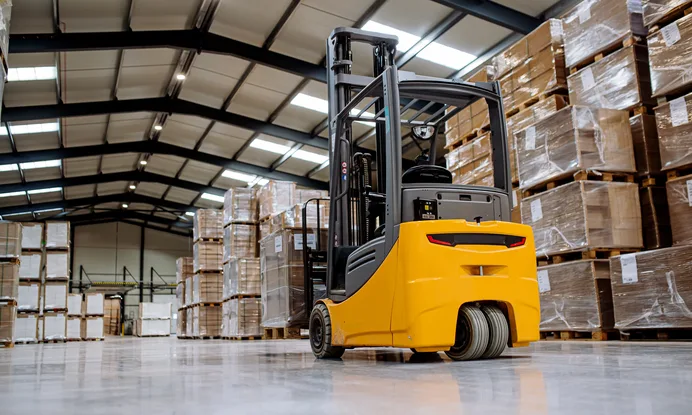
The season is the quiet risk here. Across most of the state a telescopic handler works nearly every month of the year, which sounds like productivity and reads to an underwriter as accumulated hours without a scheduled pause — hoses, cylinder seals, tires and the carriage all age on a clock that never stops. Then there is what the machine is asked to do in the growth corridors: place material onto and into structures on lots with no spare ground, where the boom passes over completed work and other trades on every cycle. And the ground itself refuses to be one thing. Eastern sites put the machine on and across grade, western sites put it on deep, heavy soil that turns after a summer storm, and the middle of the state combines tight urban placement with both. A load whose weight was assumed rather than known is dangerous everywhere; on a slope or on softened ground it stops being recoverable.
Common Tennessee forklift claims we see
- Placement damage on a no-room infill lot. The boom reaches over completed work every cycle, and one of those cycles eventually touches it.
- Forward tip on an assumed load weight. Nobody weighed the bundle; the chart was read for a number that was never accurate.
- Component failure mid-lift after a skipped interval. The maintenance that was going to happen during a slow month the calendar never provided.
- Carriage or attachment not fully engaged. A quick change between tasks, an incomplete lock, and the load leaves the machine at height.
- Struck-by injury on a busy site. The most expensive outcome this machine produces, and it is not an equipment claim at all.
Why Tennessee forklift owners choose Equipment Guard Insurance
Plenty of brokers will schedule the machine at its value and consider the job done. That covers the cheapest thing in the picture. The costly outcomes on a telescopic handler are an injured person and finished work destroyed during placement, and both of them sit outside the equipment policy in lines that need arranging on purpose. We write the iron monoline in Tennessee so the machine and its attachments can be scheduled accurately without anything else being reopened, and we work with markets named on our homepage that price a construction lifting exposure rather than guessing at it.
Major Tennessee forklift markets
- Nashville. The busiest and tightest sites in the state, where placement happens over completed work, live streets and other trades continuously.
- Memphis. River-corridor industrial and heavy commercial construction on deep, slow-draining ground with year-round machine hours.
- Knoxville. Ridge-and-valley work where the machine is regularly operating across grade rather than on it.
- Chattanooga. Riverfront and industrial redevelopment squeezed between the water and the mountain, with constrained approaches to every lift.
- Murfreesboro. Fast subdivision and commercial build-out on freshly graded fill that has not been through a wet season yet.
- Clarksville. Institutional and residential growth with long hauls between dispersed jobs and machines that stay on site between phases.
Related
- Forklift insurance — the machine physics that hold in every state.
- Excavator insurance in Tennessee — the machine whose state clock starts days before the work does, in front of its own damage-enforcement board.
- All equipment insurance in Tennessee — the state hub.
- Equipment floater · Rented & leased equipment
Primary sources
- State Plans — Occupational Safety and Health Administration (operator safety)
- Contractor (Tennessee Board for Licensing Contractors, Dept. of Commerce & Insurance) - raw <title> is 'Contractor' — Tennessee Board for Licensing Contractors, Department of Commerce and Insurance (contractor licensing)
Tennessee forklift insurance FAQs
Does a safety citation put my Tennessee contractor license at risk?
These are separate processes and one does not automatically trigger the other, so nobody should tell you a citation costs you the license. What is worth understanding is the structure: the license is a state-issued credential held by a state board, and the safety program is also the state’s. A contractor here is dealing with one government on both fronts rather than with a state on one and a federal agency on the other, and files kept badly enough to matter tend to be visible in more than one place.
I need the license before bidding — does the safety obligation start then too?
No, and the mismatch trips people. The license requirement attaches to bidding and contracting above a statutory project-value threshold. The operator obligation attaches to employing people and putting a powered industrial truck to work, so it is live from the first day a machine turns a wheel on your job, regardless of the size of the contract or whether a license was needed to win it.
My license classification says what I can build. Does it say anything about equipment?
Nothing at all. The classification system — a building classification, a commercial classification and the rest — describes the kind and scale of construction you are permitted to contract for. It makes no statement about which machines you may operate or who may operate them. Contractors sometimes read a broad classification as general competence approved by the state; it is a scope of work, not a qualification to lift.
Our machines never get a winter off. Does that change anything?
It changes the maintenance picture more than most owners allow for. A long building season across most of the state means a telescopic handler runs close to continuously, and the interval that gets skipped is the one that was supposed to happen during a slow month that never arrived. Hoses, cylinder seals and the carriage take that quietly, and the failure arrives with a load in the air.
Does ground vary that much across the state?
Enough to change the submission. A crew working the eastern ridges is placing loads on and across grade, on cut benches and sloping approaches, while the same machine in the west is on flat, deep, heavy ground that drains slowly and turns soft after summer storms. Middle Tennessee splits the difference and adds the tightest urban sites in the state. A fleet that covers all three is genuinely three risks.
Can I insure the telehandler by itself?
Yes. Equipment Guard Insurance writes equipment monoline in Tennessee, so the machine, the carriage and the attachments sit on their own schedule without touching anything else you have in place. The operator exposure lives in liability and workers compensation, and we will say plainly where the equipment policy stops.