
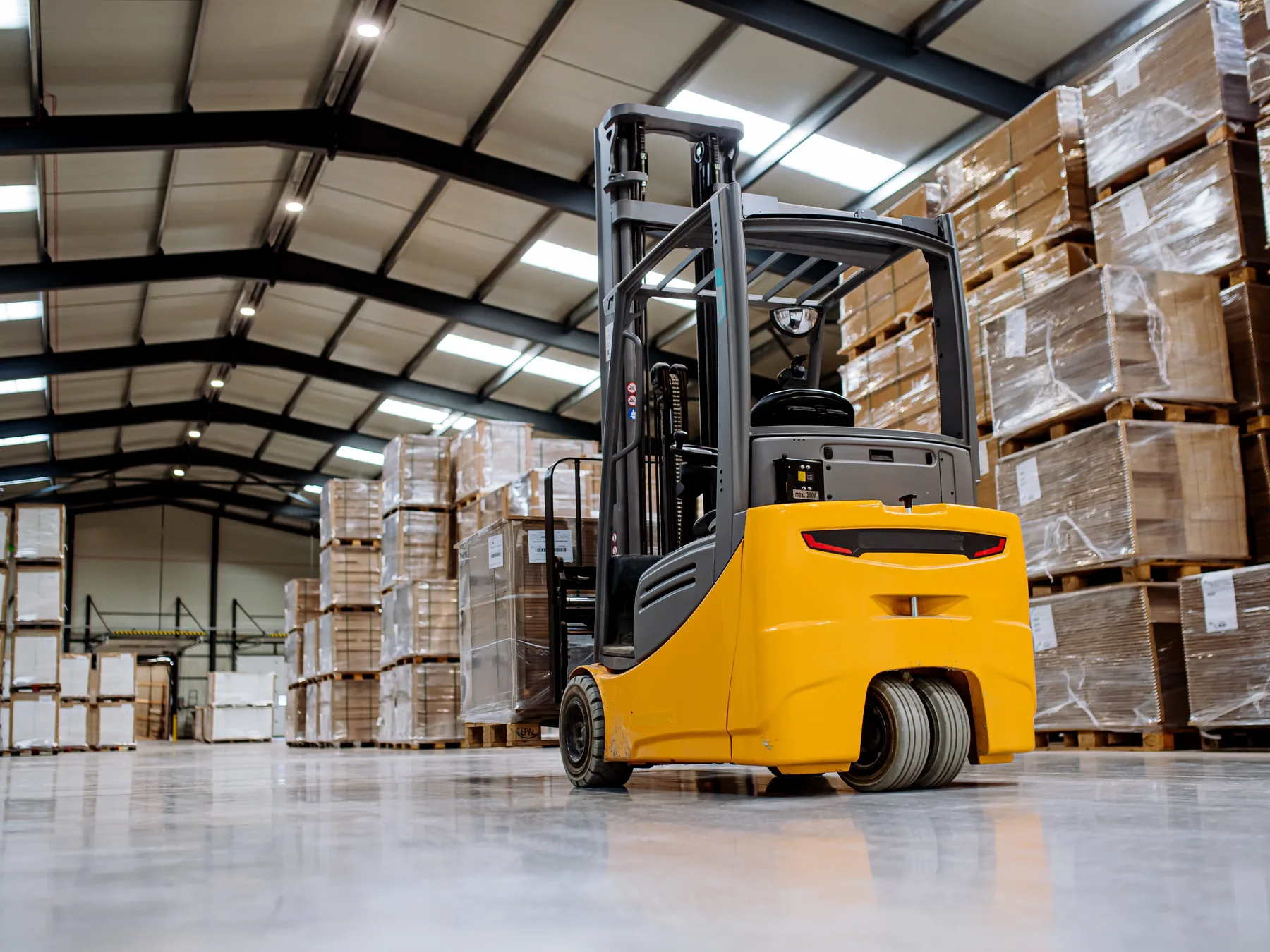
A rough-terrain forklift is the quietest expensive decision on a jobsite. It picks up whatever is heaviest, carries it wherever the crew points, and rewards nobody for thinking about it — until a placement goes long and the machine finds the edge of its own chart.
The Utah-specific part is who owns the aftermath and how far away they are. This state runs its own approved safety program, so enforcement is local in identity even where the work is remote in fact. For the mechanics that do not vary by state — reach against rated capacity, boom geometry, ground bearing and the forward-tip pattern — see the forklift insurance pillar.
What forklift insurance costs in Utah
A page cannot quote this class honestly, because the number is built out of operators and records rather than out of the machine. In Utah what moves it is how many people run the unit and whether each has a written evaluation on that specific model, whether it is a fixed-mast truck or a telehandler placing at extension, how much of your work sits on benched or filled pads, how far the machine travels between jobs and where it sleeps, and your loss record. The purchase price of the unit is a small term in a calculation dominated by everything around it.
Utah forklift regulations: who enforces operator safety
Utah operates its own OSHA-approved State Plan covering private-sector employers, so powered-industrial-truck operator training, evaluation and enforcement run through the state program rather than federal OSHA directly.
The useful consequence is geographic rather than legal. One authority covers everything from a valley infill site to a pad in the southwest desert, which is genuinely simpler than the patchwork a multi-state contractor deals with — but it also means the same expectations follow a machine to places where nobody is watching day to day. Utah work spreads out. A telehandler can spend a month on a canyon access job, get trailered to a subdivision on the bench and finish the quarter in the far south of the state, and at no point does the office holding the standard move closer. So the qualification evidence has to travel with the unit: the evaluation on that model, signed and dated, in the same folder as the service record, not filed at a yard three hours behind it. This state already asks contractors to prove competence on paper for their own licensing, through coursework and examination rather than by assertion, so the discipline exists — it just has to be pointed at the machine rather than at the company. When an inspector does arrive, the difference between a documented crew and a confident one is the whole conversation.
Common forklift risks in Utah
What breaks in this class is rarely the machine. A tip or a released load leaves a unit that can usually be inspected and put back to work, while the material, the structure and the person on the ground carry the claim. Two forces do most of the damage: extension quietly consumes rated capacity, and the surface an outrigger sits on is often placed fill rather than native ground. Utah adds a daily freeze-and-thaw swing that changes bearing between the morning and the afternoon on the same pad, plus altitude that slows every lift enough to make an operator impatient with the last few feet of a placement.
Common Utah forklift claims we see
- Load dropped during a long placement. The material and whatever sits beneath it decide the size of the loss.
- Forward tip at full reach. Rated capacity falls off with extension, and nobody rereads the chart mid-shift.
- Struck-by injury under a suspended load. The most expensive event this machine causes, and no floater answers for it.
- Outrigger punching into placed fill on a cut bench. A hillside-development problem this state produces constantly.
- Contact damage while reaching into finished construction. The work being damaged is already complete and already paid for.
Why Utah forklift owners choose Equipment Guard Insurance
We will not pretend the equipment policy is the interesting half of this account. The floater fixes a machine that usually did not need much fixing; the year that hurts is decided by an operator and the person standing under a load, which lives in liability and workers compensation. Writing equipment monoline lets us schedule the unit properly without pulling apart a program built around Utah work, and we place through markets — named on our homepage — that will underwrite lifting on graded ground for what it is rather than discounting it as light equipment.
Major Utah forklift markets
- Salt Lake City. Downtown and transit-adjacent construction where placements happen above occupied streets.
- West Valley City. Industrial and freight-corridor build-out on large open pads with long steel and panel lifts.
- Ogden. Northern industrial and rail-adjacent work with older structures and constrained approaches.
- Provo. Campus and institutional projects staged around buildings that stay in use throughout.
- Lehi. Fast-moving technology-corridor construction where several trades share one pad at once.
- St. George. Desert residential and resort work with long trailer moves, high summer heat and thin operator margins.
Related
- Forklift insurance — the machine physics that hold in every state.
- Skid Steer insurance in Utah — the machine that leaves a Utah yard easiest and comes back least often.
- All equipment insurance in Utah — the state hub.
- Equipment floater · Rented & leased equipment
Primary sources
- State Plans — Occupational Safety and Health Administration (operator safety)
- Utah Code Chapter 55, Utah Construction Trades Licensing Act (58-55-301 License required) — Utah Department of Commerce, Division of Professional Licensing (DOPL) (contractor licensing)
Utah forklift insurance FAQs
Who enforces powered-industrial-truck rules on a Utah jobsite?
A state program does. Utah operates its own approved plan covering private-sector employers, so training, evaluation and enforcement run through the state rather than through federal OSHA directly. The inspector is a state inspector and the citation is a state citation, which for a contractor working several regions of this state means one authority across all of them rather than one per jurisdiction.
Does having a state plan mean lighter requirements?
No, and planning around that idea is how contractors get caught. Approval is not extended to a weaker scheme, so the substance of what an operator must be trained and evaluated on is not where relief lives. What genuinely changes is that the office holding the outcome is inside this state, close enough that the response after an incident tends to be quicker than contractors moving here from elsewhere expect.
How does DOPL licensing relate to running a telehandler?
It does not license the operator, but it sets the culture. Utah licenses contractors through its Division of Professional Licensing using classifications such as general building and general engineering, with pre-license coursework, examinations and insurance requirements attached. A company already accustomed to proving competence on paper to obtain its license is a company that finds the operator evaluation record easy to keep. The ones who struggle are usually the ones treating both as formalities.
Does altitude or the temperature swing actually matter to this machine?
Both matter, in different ways. Thin air costs a diesel engine power, so a lift that feels routine near sea level takes longer and tempts an operator to rush the last part of the placement. The daily temperature swing is the bigger issue underfoot: ground that is frozen firm at seven in the morning can be soft mud by mid-afternoon on the same pad, and an outrigger set on the first condition is standing on the second by the time the load goes up.
What is different about lifting on benched and cut sites here?
Nothing about the machine and everything about where it stands. Hillside development along the valley benches means cut-and-fill pads, and fill is exactly the material least willing to hold a concentrated point load. A machine parked on the cut side of a pad is on native ground; the same machine ten feet over is on placed material with a different history. Operators who know a site by its address rather than by its grading plan miss that line entirely.
Can you schedule the machine without touching my other lines?
Yes. Equipment Guard Insurance writes equipment monoline in Utah, so the telehandler and its attachments sit on their own schedule and nothing else has to move. If the operator exposure needs work we will say so, but it is a separate conversation rather than a condition attached to the iron.