

Utah keeps a compact loader busy on some of the most varied ground in the region: bench and hillside residential lots, tight infill in an urban corridor with no room to spare, large flat pads for technology and distribution buildings, and desert work in the south where the soil is abrasive and the heat is real. One machine and a rack of heads covers it, which is why the loader is usually the busiest asset on the schedule and the one an owner can least afford to lose.
Two features of this state actually shape the account. Utah makes insurance a condition of the contractor license rather than an afterthought to it, which raises the cost of any lapse; and its work is unusually concentrated into one corridor, with a single long reach to the south. For the machine physics that hold everywhere — attachment mechanics, skid steering and the forward-tip pattern — see the skid steer insurance pillar.
What skid steer insurance costs in Utah
We publish no premium here, because a number worth having is built from your own machines, your own storage and your own record. In Utah the levers that move it hardest are yard space and abrasion: secure storage in the corridor is contested and expensive, so where the loader actually sleeps is the first question; and dry, dusty, abrasive ground means wear on hydraulics, couplers and drive components shows up in both maintenance and claim history. After those come the attachment count and values, the valuation basis you choose, telematics, deductible, and how much equipment you rent in during a busy stretch.
Utah skid steer regulations: title, lien and ownership
A skid steer is special mobile equipment, not a DMV-titled vehicle; a lender perfects its lien by filing a UCC-1 financing statement with the Utah Division of Corporations and Commercial Code.
With no title anywhere in the chain, the financing filing and the serial number carry the ownership case between them. A lender on a financed loader is added to the policy as loss payee against the scheduled unit so a settlement is issued jointly, and the serial on the schedule has to be the serial in the filing — a lienholder still named against a machine long since paid off or traded is the clearest evidence a schedule needs work. Utah adds a distinct consequence at the licensing layer that is worth taking seriously: because evidence of insurance is a precondition of holding the license rather than a courtesy to a client, coverage that lapses or is canceled reaches your ability to contract at all. Keeping the schedule current is therefore doing two jobs here — protecting the iron, and protecting the credential.
Common skid steer risks in Utah
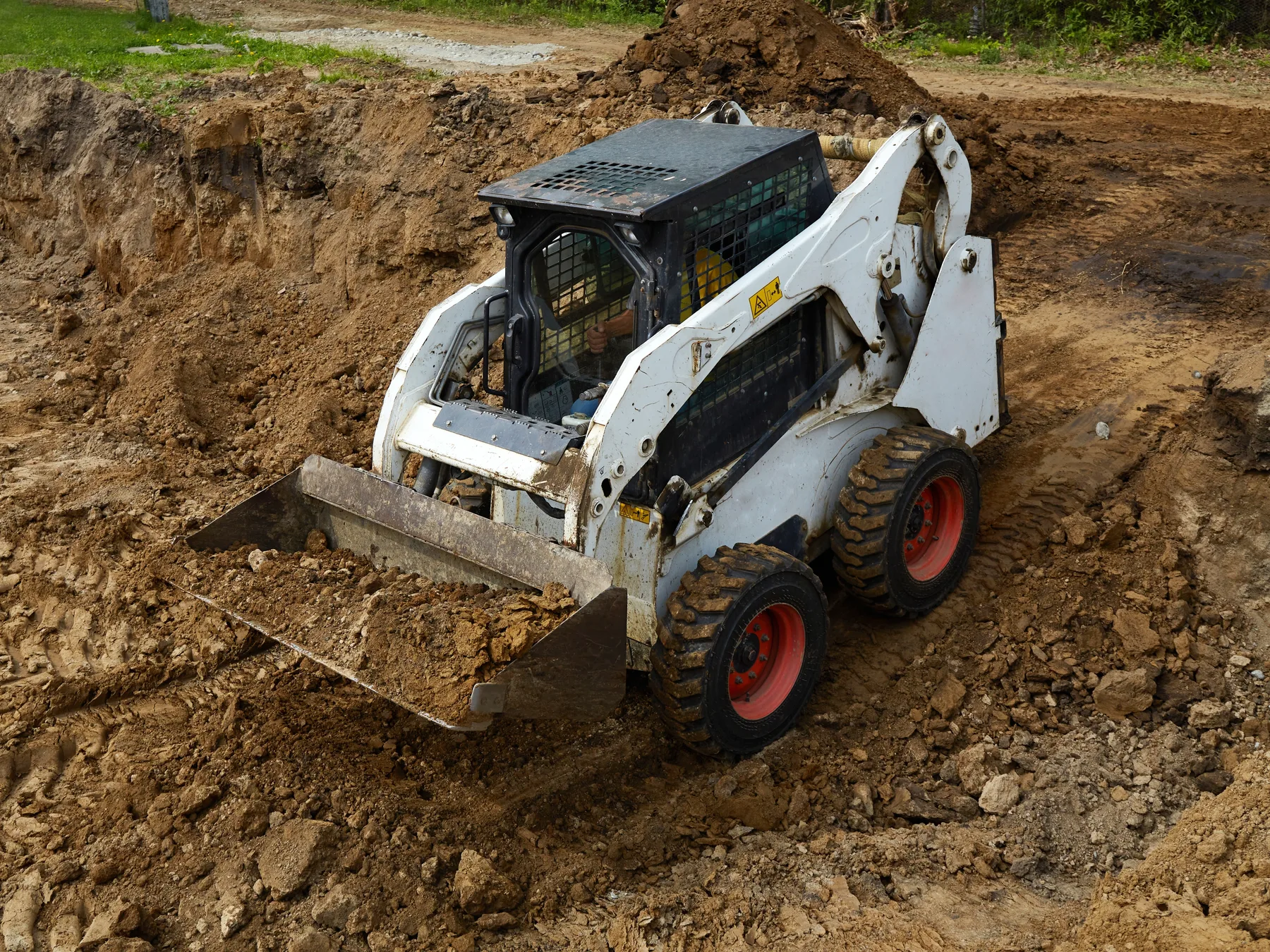
Theft leads on this class in Utah, and the concentration of the market is what drives it: a great many active sites sit within a short trailer run of one another and of the interstate that connects them, and the pressure on secure yard space means machines are left on jobs that have no fence. Environment is the second exposure and it arrives in layers — abrasive dust working into couplers, cylinders and seals; heat on hydraulics and tires in the south; snow, ice and salt in the north; and altitude keeping cooling systems near their limit through the summer. Ground is the third: bench and hillside lots mean machines operate and park on grade far more than a flat-state schedule would suggest. The remainder is the machine itself — a forward tip with the arms up and loaded, and damage taken loading a trailer several times a week.
Common Utah skid steer claims we see
- Loader taken overnight from an unfenced corridor site. The characteristic Utah loss, driven by yard space nobody could get rather than by carelessness, and settled against the serial record.
- Attachment lifted from a rack. A breaker or auger gone while the machine stayed put, and then found to be riding a blanket per-item cap instead of a named line.
- Accelerated abrasion loss on hydraulics and couplers. Dust and hard ground doing in one season what a wetter state would take several to do, and a valuation basis that did not account for it.
- Slide or tip on a bench or hillside lot. Grade that reads as level from the cab and is not, with the arms up and a load out front.
- Coverage lapse discovered as a licensing problem. Not a claim at all: a certificate that expired quietly, found by the division rather than by a client.
Why Utah skid steer owners choose Equipment Guard Insurance
Writing equipment on its own matters more than usual for a licensed Utah contractor. Your liability and workers’ compensation exist partly to satisfy the licensing division, they are arranged deliberately, and the answer to a badly scheduled loader is not to reopen all of it. So we schedule the iron by itself, name the attachments individually with their own values as standard practice, and account for rented-in units rather than assuming them away. The markets we place through — named on our homepage — will read a Utah equipment schedule as its own submission.
Major Utah skid steer markets
- Salt Lake City. The deepest jobsite market in the state and the tightest for storage, where a loader often stays on the job because there is nowhere else affordable to put it.
- West Valley City. Industrial and warehouse site work on large flat pads, with dust and long open perimeters that no temporary fence really closes.
- Provo and Orem. University-adjacent institutional and residential build-out on constrained lots, where confined loading drives the claims that are not thefts.
- Ogden. Older-fabric rehabilitation and rail-adjacent industrial work, with bench ground north of the city putting machines on grade regularly.
- Lehi. Technology-campus and data-center-scale pad construction — high machine values, deep rental supply, and rented-in loaders on most accounts.
- St. George. The outlier: desert residential growth a long haul from the corridor, with heat, abrasive soils and none of the same supervision nearby.
Related
- Skid steer insurance — the machine physics that hold in every state.
- Backhoe insurance in Utah — the machine the state vehicle code names in its own definition.
- All equipment insurance in Utah — the state hub.
- Equipment floater · Rented & leased equipment
Primary sources
- Utah Code Chapter 55, Utah Construction Trades Licensing Act (58-55-301 License required) — Utah Department of Commerce, Division of Professional Licensing (DOPL) (contractor licensing)
We do not link an Utah filing document here. The ownership and lien rules described above follow Article 9 as Utah has adopted it; where a state publishes a document that states the rule directly, this page links it.
Utah skid steer insurance FAQs
Does a Utah skid steer go through the vehicle system?
It does not. Utah treats it as special mobile equipment, so it is never titled or plated like a truck and nothing changes hands at a division counter when it sells. The serial plate and the invoice are the ownership record, supported by whatever financing filing sits behind the machine — and because there is no title to lose, there is also no title to produce when a loader goes missing.
What does Utah want before it will issue a contractor license?
More than most states in this batch, and insurance is part of it. The Division of Professional Licensing, inside the Department of Commerce, licenses by classification — general building and general engineering alongside the residential and specialty classes — and requires pre-license coursework, an examination and evidence of insurance before the license is granted. That last requirement has a consequence worth naming: your coverage is not merely a document a client asks for, it is a condition of the credential, so a lapse is a licensing problem at the same moment it is a coverage problem.
Does the concentration of work along one corridor change my risk?
It reshapes it rather than reducing it. Most of the state’s construction sits in a single north-south urban strip against the mountains, which means short trailer moves, several jobs running within an hour of one another, and intense competition for secure yard space at prices that push crews toward leaving machines on site. Then there is the outlier: work in the desert south sits a long haul away from all of it, on its own, with none of the same supply or supervision nearby.
How should attachments be scheduled here?
By name, once they are worth more than a general-purpose bucket. Blanket attachment coverage carries a per-item cap that suits ordinary tools and fails on breakers, augers, planers and grapples. Utah adds an abrasion problem on top of the value problem: the soils are dry, dusty and hard on couplers, cylinders and hydraulic seals, so attachments wear faster here and a valuation basis that ignores that wear will disappoint at claim time.
Which parts of the Utah climate actually reach the machine?
Three, and they pull in different directions. High-desert heat in the south works on hydraulic temperatures, hoses and tires. Winter in the north brings snow, ice and long stretches parked in the cold, plus salt on machines used for snow work. And altitude sits underneath both, running cooling systems and engines closer to their limits than the same machine would see at sea level. Dust is the constant that connects them all.
Can the equipment sit on its own policy?
Yes. Equipment Guard Insurance writes equipment as a monoline account, with loaders, attachments and rented-in units on one schedule, and no requirement to disturb the liability or workers’ compensation your license already relies on.