
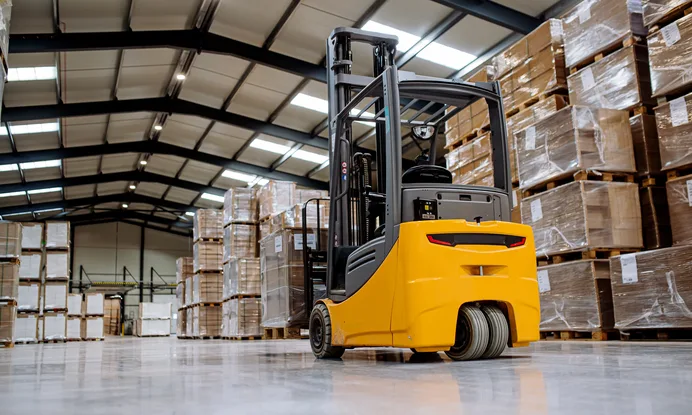
Ask a crew which machine on a West Virginia site is the risky one and nobody names the forklift. It lifts block up a bench, feeds a steel crew, moves a bundle across a cut that a truck cannot reach, and keeps doing it without complaint until the day the ground or the load chart says otherwise.
Two facts shape how that plays out in this state, and they belong to different authorities. Operator safety is federal here, with no state agency in the chain. The credential that lets the contractor be on the job at all is issued by West Virginia. For how the machine behaves independent of any of that — capacity against reach, boom geometry, what level really means — the forklift insurance pillar covers it.
What forklift insurance costs in West Virginia
A premium for this class cannot honestly be estimated from a page, because most of what moves it is not on the machine. In West Virginia the inputs that count are the size of the operator roster and how specific the evaluation record is to the actual unit, the mix between fixed-mast trucks and telehandlers working at reach, how much of the work sits on cut and benched ground rather than finished pads, the haul distances between jobs in a state where the road is rarely direct, where the machine sleeps, and the losses already on the record. The value of the iron is the least of it.
West Virginia forklift regulations: who enforces operator safety
West Virginia is under federal OSHA for private-sector employers, so the powered-industrial-truck operator training and evaluation requirements are the federal standard applied directly.
The useful part of that is what it rules out. There is no state safety agency in this picture — nobody at the state level inspects the machine, issues the citation, or hears the contest, and a contractor arriving from a state-plan jurisdiction should stop looking for one. What West Virginia does hold is the other lever, and it is a stronger one than most states have. This is one of the few states requiring a genuine statewide contractor license across general and specialty classifications, issued by the Contractor Licensing Board under the Division of Labor and grounded in the state Contractor Licensing Act. That license is a public, current, state-held record of who is permitted to do the work, and general contractors here treat it as a gate. So the state knows a lifting contractor precisely, and knows nothing about the telehandler; the federal side knows the telehandler and has no view on the license. Neither file explains the other, and the operator evaluation record — which sits with neither authority until somebody asks for it — is the document that decides how the federal half of a bad day goes.
Common forklift risks in West Virginia
Slope is the variable that separates this state from flatter markets. Very little of the ground a rough-terrain forklift works on here started out level; it was cut, benched and filled to make a working surface, and fresh fill on a grade compacts unevenly and drains toward the low side. A machine that is a few degrees out of level has already given up part of the capacity the chart promised before the boom moves, and extending that boom across the slope rather than along it spends the rest quickly. Everything that comes loose then travels downhill through whatever is below, which on a benched site is usually the crew, the material laydown and the access road.
Common West Virginia forklift claims we see
- Machine settling on freshly benched fill. The pad was built last week and has not been loaded like this before.
- Load lost while reaching across a cross-slope. Out of level plus extended equals far less capacity than the operator counted on.
- Worker struck below the machine. On sloping ground everything that gets away moves toward people, and this is the costliest outcome available.
- Material destroyed on release. Steel, block and glazing landing on a grade rarely survive to be reused.
- Contact with finished work during placement. Reaching into a structure means the damaged part is the part already paid for.
Why West Virginia forklift owners choose Equipment Guard Insurance
We will say the unhelpful thing first: the equipment policy is the least expensive part of protecting this machine, because the machine is rarely the casualty. A West Virginia telehandler year goes badly because of a person under a load or a structure the boom caught, and both of those answer to liability and workers compensation while the safety file sits with a federal office. Writing equipment monoline lets us schedule the unit and its attachments properly without disturbing what a contractor has already built around this state, and the markets we work through — named on our homepage — understand a machine that lifts from cut ground rather than from a slab.
Major West Virginia forklift markets
- Charleston. Chemical-corridor plant work and institutional projects, with lifting staged inside facilities that never fully shut down.
- Huntington. River-port industrial and medical campus expansion, where machines set loads between live rail and live traffic.
- Morgantown. University and hospital growth built into a hillside, which is the state’s clearest example of lifting from a cut bench.
- Parkersburg. Mid-valley industrial and process work, with long-standing plants and constrained yards around them.
- Wheeling. Northern panhandle industrial and bridge-adjacent projects, where access is narrow and repositioning is expensive.
- Martinsburg. Eastern panhandle build-out on the flattest ground in the state, and the one market where a level pad is normal.
Related
- Forklift insurance — the machine physics that hold in every state.
- Skid Steer insurance in West Virginia — the compact machine that cuts the pad this one has to lift from.
- All equipment insurance in West Virginia — the state hub.
- Equipment floater · Rented & leased equipment
Primary sources
- State Plans — Occupational Safety and Health Administration (operator safety)
- West Virginia Code §21-11 — West Virginia Legislature (contractor licensing)
West Virginia forklift insurance FAQs
Does West Virginia enforce its own forklift safety rules?
No. There is no approved state plan reaching private-sector employers here, so the powered-industrial-truck training, evaluation and refresher duties apply as the federal standard and the enforcement chain is federal from end to end — inspector, citation and contest. That absence is worth understanding rather than skimming, because it means the state office a contractor deals with most often has no role at all in a lifting incident.
If safety is federal, what does the state hold over a contractor here?
The license. West Virginia is one of a small number of states that requires a genuine statewide contractor license across general and specialty classifications, issued by the Contractor Licensing Board under the Division of Labor. That is a real state credential and a real gate on the work — it simply is not a safety credential, and nothing about holding it changes who inspects a telehandler after a load comes down.
How does the terrain change the way this machine should be run here?
It removes the assumption that a pad exists. Across most of this state a working surface is something a crew cuts and benches into a slope rather than something the site already has, so a rough-terrain forklift regularly sets up on fresh fill with a cross-slope under it and a drop-off on one side. Capacity charts assume a level machine, and a unit that is out of level before the boom moves has already spent part of its margin.
Does the license classification affect insurance?
Indirectly but usefully. A statewide license means the classification a contractor holds is a matter of public record with a state authority, and general contractors here tend to verify it before a subcontractor rolls a machine onto a site. Underwriters read the same signal the way they read a documented operator evaluation file: as evidence that the paperwork behind the work is kept current rather than reconstructed after a loss.
What kind of forklift loss actually happens on West Virginia work?
The ones caused by ground and reach, in that order. A machine settling on a benched pad, a load released while the boom is extended across a slope, and a worker struck below on ground that funnels everything downhill account for the claims that matter. The telehandler itself is usually recoverable; the injured worker, the destroyed material and the finished structure it was reaching into are not, and those live in workers compensation and liability.
Can the machine be insured separately from everything else I carry?
Yes. Equipment Guard Insurance writes equipment monoline in West Virginia, so the telehandler and its attachments are scheduled on their own by serial number. With enforcement federal and the license held at the state level, we would rather walk the boundary between the equipment policy and the liability and work-comp side with you before anything tests it.