
Wisconsin contractors are used to a state that has an office for everything. There is a credential for the dwelling builder, a department for the lien filing, a number to call before anyone digs. It is reasonable to assume there is an office for the machine lifting block to a second story too.
There is not. Operator safety is the one slice this state left alone, which makes the federal government the whole of the authority behind a telehandler here — and makes the rest of Wisconsin’s specialist machinery, plus a winter that stops the work outright, the things actually worth knowing. For how the machine behaves under load, wherever it happens to be working, see the forklift insurance pillar.
What forklift insurance costs in Wisconsin
There is no premium to publish for this class without inventing it, because underwriters price the people and the records rather than the steel. The Wisconsin inputs are the size of the operator group and whether each evaluation is documented against the specific unit, the mix of fixed-mast trucks and telehandlers placing loads at reach, how much of the year the fleet actually runs, where the machines stand through the shutdown and whether anyone inspects them before the first spring lift, and your loss record. Replacement value on the unit is a minor term next to any of that.
Wisconsin forklift regulations: who enforces operator safety
Wisconsin is under federal OSHA for private-sector employers, so the powered-industrial-truck operator training and evaluation requirements are the federal standard applied directly.
That absence deserves stating outright rather than glossing, because it runs against everything else a contractor experiences in this state. Wisconsin credentials the builder of a one- or two-family dwelling and nobody else; it takes the financing statement on a financed machine at its financial-institutions department rather than at the Secretary of State, which is where every neighbor files; it holds the dig-notice duty at a statewide one-call center on a window that runs longer than most of the region. Specialist agencies, each with one narrow file. Operator safety is not one of them, so when a load comes down the investigator, the citation and the appeal are federal, and there is no state office with standing to hear a word of it. The practical effect is that nothing local softens the process for you and nothing local speeds it up. It also means the one lever you fully control is documentation: a training and evaluation record built against each specific machine, kept current through the months the fleet is not running, is the entire defense you get. The federal training obligation itself is unremarkable — every state carries it — and it is not what makes this account Wisconsin-shaped.
Common forklift risks in Wisconsin
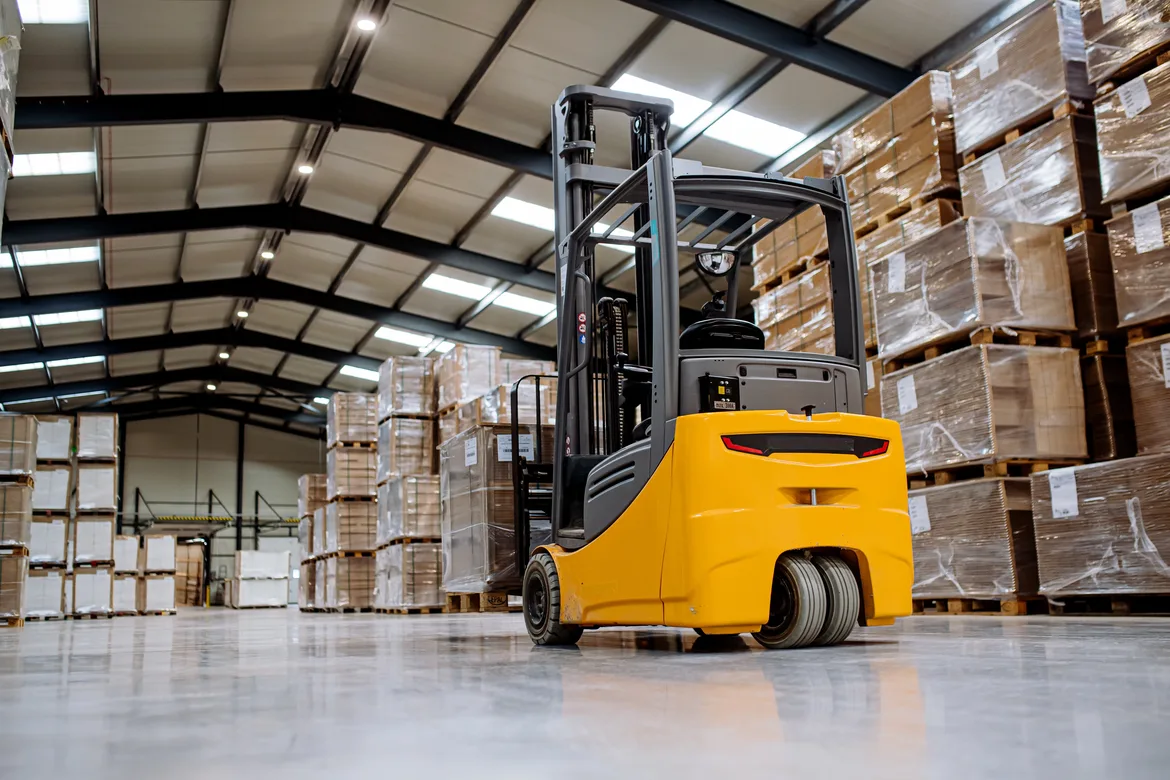
Losses on this machine are paid to people and to property, not to the machine. A telehandler that lets go of a load or noses over at extension is generally repairable; the material, the structure it was reaching into and the worker below it are the claim. Wisconsin adds a calendar problem to that. Work compresses into the months the ground allows, so more machines run at once with thinner supervision and less patience for a careful setup, and then everything stops. A unit that has stood since autumn comes back with tires down, hydraulics untested and nobody having read the chart in the cab since the last crew used it. Frost supplies the third factor: ground that held the machine solid on a cold morning gives way as the day warms, and outriggers do not get a warning.
Common Wisconsin forklift claims we see
- Load dropped during placement. The material and the finished work beneath it decide the number, not the boom repair.
- Tip forward at full extension. Reach consumes capacity steadily, and the chart is the document least likely to be reread.
- Struck-by injury under a raised load. A liability and work comp loss, and the worst outcome this machine produces.
- Outrigger dropping through thawing ground. The seasonal failure here, and it happens mid-shift rather than at setup.
- First-lift failure after the winter stand-down. Months of no inspection show up on the day the machine is asked to work again.
Why Wisconsin forklift owners choose Equipment Guard Insurance
The honest position on this account is that the floater is the easy part. What decides a bad year on a telehandler is the person standing underneath it and the finished work it was reaching into, and in a state with no safety agency of its own there is no local authority to help either of you sort it out. We write the equipment monoline so the machine and its attachments can be scheduled properly on their own terms, and we place through markets — named on our homepage — that read a seasonal jobsite lifting exposure for what it is rather than pricing it against indoor equipment.
Major Wisconsin forklift markets
- Milwaukee. Dense urban and industrial redevelopment, with loads set close to occupied buildings and live streets.
- Madison. Institutional, campus and public-sector projects where operator records are checked before a machine is allowed on site.
- Green Bay. Heavy industrial and mill-adjacent work with tight yards and material moved around ongoing operations.
- Appleton. Fox Valley commercial and plant construction, with a deep rental market for reach machines and short mobilization distances.
- Kenosha. Fast-growing corridor construction near the state line, drawing crews and fleets that work under two sets of state rules.
- Eau Claire. Western regional building with long hauls between jobs and machines that overwinter wherever the last job left them.
Related
- Forklift insurance — the machine physics that hold in every state.
- Skid Steer insurance in Wisconsin — the machine whose Wisconsin lien is filed with the financial-institutions department instead of the Secretary of State.
- All equipment insurance in Wisconsin — the state hub.
- Equipment floater · Rented & leased equipment
Primary sources
- State Plans — Occupational Safety and Health Administration (operator safety)
- Dwelling Contractor Qualifier — Wisconsin Department of Safety and Professional Services (contractor licensing)
Wisconsin forklift insurance FAQs
Which agency in Wisconsin regulates how my telehandler is operated?
None of them. Wisconsin never took over enforcement for private-sector employers, so the powered-industrial-truck rules are federal here and so is everything that follows a serious incident — the investigator, the citation, and any contest you file. It surprises owners precisely because this state has an agency for so many other parts of the same business.
Which state agencies do reach my equipment operation, then?
Several, each holding one narrow piece. The professional-services department credentials contractors who build one- and two-family dwellings, and only those. The financial-institutions department, not the Secretary of State, takes the financing statement that perfects a lender’s lien on a machine. The statewide one-call center holds the dig-notice duty on a window longer than most neighboring states run. Narrow, specific, and never the operator.
Does the lien filing office really matter to an equipment policy?
It matters when a machine is written off. The loss payee on your schedule should match the party actually of record, and Wisconsin puts that record somewhere out-of-state lenders and brokers do not think to look. A financed telehandler destroyed on a job settles faster when the filing, the schedule and the invoice all name the same party.
What does the Wisconsin winter do to this class of machine?
Two things, and they pull in opposite directions. The season compresses the work, so more machines run at once through a shorter stretch of the year with less slack for a careful setup. Then the machine stands for months, and the unit that lifts its first load in spring is one nobody has looked at since autumn — hydraulics, tires, the boom wear pads and the load chart decal all in the same untouched condition.
Does frost change where an outrigger can safely sit?
Considerably. Ground that carried the machine on a frozen morning is not the same ground once it thaws, and the transition is not gradual — a pad can be firm at the start of a shift and soft by the middle of it. Crews here learn to distrust ground that has recently been frozen, and it is the setup discipline underwriters ask about rather than the machine specification.
Can the machine be scheduled on its own policy?
Yes. Equipment Guard Insurance writes equipment monoline across Wisconsin, so a telehandler and its attachments go on their own schedule without moving anything else. With no state safety authority to appeal to, the value we add sits in the documentation and in being clear which policy answers for which half of a loss.