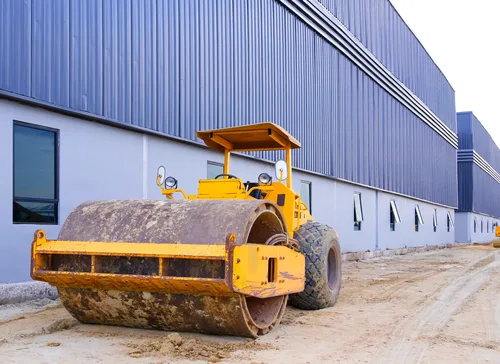

Compaction equipment exists to remove air from material — to take loose fill or fresh asphalt and turn it into something that will carry load without settling. It does that with weight, and usually with weight plus deliberate vibration.
The class runs from a plate compactor one person carries off a trailer to a tandem drum roller finishing a highway. What connects them is that they all put energy into the ground on purpose, and energy does not always stay where it is aimed.
Get a Free Quote Call 317-942-0549
Vibration is the exposure other machines do not have
Every other machine on this site tries to avoid transmitting energy into its surroundings. This one is built to do it, and ground transmits vibration further and more efficiently than intuition suggests — particularly through dense material and saturated soils.
That produces a liability category unique to the class: damage to structures the machine never touched. Cracked plaster, disturbed masonry, settlement under a neighboring foundation and damage to buried services are all claims that follow compaction work in confined settings. Older masonry buildings and structures on shallow foundations are the usual complainants.
The defense is documentary. A pre-condition survey of nearby structures before work starts, and vibration monitoring where the setting warrants it, convert an unanswerable allegation into a comparison. Without them, proving that a crack predates the work is very difficult, which is why these claims are frequently settled rather than defended.
Rollover at the edge
The severe equipment and injury exposure on this class is overturning. Compaction work concentrates at edges — embankment shoulders, fill faces, the perimeter of a pad — because edges are precisely where compaction is hardest to achieve and most necessary.
A heavy machine with a narrow footprint, working along ground that has not yet been consolidated, at the point where support falls away, is a predictable setup for a rollover. Sloped work makes it worse, as does wet material. Rollover protection and restraint use are the controls, and on older machines their absence is a genuine underwriting concern rather than a formality.
Drums, eccentrics and hot surfaces
A vibratory drum contains an eccentric assembly spinning at speed inside it. That mechanism is the machine’s working heart and it is a substantial repair when it deteriorates — and its deterioration is wear rather than loss, so the floater does not answer for it.
What is covered is sudden damage: a drum gouged on an obstruction, damage arising from an incident. Asphalt work adds its own wrinkle — drums are sprayed with water to stop hot material adhering, and a failed water system on a hot day damages the mat being laid rather than the machine, which puts it on the liability side of a paving contract.
Hot asphalt and the paving train
Rollers on asphalt work in a sequence behind a paver, in traffic-managed conditions, around a hot product with a narrow working window. That combination produces its own risk texture: burns and heat exposure for crews, machines working close together in a confined corridor, and the product itself being ruined if the sequence goes wrong.
Because the work is usually on or beside live roads, much of what goes wrong involves third parties or other trades, which is why paving accounts lean on general liability more heavily than an equivalent earthworks account.
The small machines nobody schedules
Plate compactors, rammers and walk-behind rollers are the most stolen category on this whole site, and the most under-scheduled. They are inexpensive relative to a roller, lift into the back of a pickup, sell instantly, and read as tools rather than as equipment.
A blanket tools limit with a modest per-item sublimit will usually carry an individual plate compactor. What it will not carry is a van or a yard losing six of them at once, which is a realistic event rather than an unlucky one. Schedule them.
Who runs one
Paving and road contractors, site development firms, utility contractors backfilling trenches, landscape contractors, municipal works departments and rental fleets. Nearly everyone who opens ground eventually has to close it again, which is why compaction equipment appears on more schedules than almost any other category.
What compactor insurance costs
No published figure would be honest. The inputs: the size mix from plate compactors to large rollers; storage arrangements for the portable units; proximity of work to existing structures, which drives the vibration exposure; whether the work is hot asphalt in live traffic or earthworks on a closed site; rollover protection on older machines; and loss history.
Matching the machine to the material
Compaction is not one job. Cohesive soils like clay need kneading from within, which is what a padfoot drum with its projecting feet delivers. Granular material — sand, gravel, crushed stone — responds to vibration and is a smooth-drum job. Asphalt needs weight and a smooth finish, sometimes with pneumatic tires to seal the surface.
Using the wrong machine wastes time and produces a result that fails testing, which is a contractual problem rather than an insurance one. But it also tells an underwriter something: a fleet whose machine types match the work it describes is a fleet run by people who know what they are doing, and that impression is worth more on a submission than most owners realize.
It matters practically too, because remedial work — taking out and re-doing a failed layer — is a cost that falls on the contractor and is rarely an insured loss.
Testing, specification and the claim that is not a claim
Compaction is one of the few site activities that is routinely verified by measurement. Density testing against a specification decides whether the work is accepted, and a failed test means the material comes out and goes back in.
That is worth understanding because it is the most common expensive event in this line of work and it is not an insurance matter at all. Rectifying work that did not meet specification is a contractual obligation, not damage. Where compaction failure later causes settlement that damages a structure or a surface built on top of it, the picture changes and the liability question opens — but the re-work itself sits with the contractor.
Backfill around what is already there
A great deal of compaction happens in trenches, over newly laid services. That places a vibrating machine directly above pipes and cables that were installed minutes earlier and are entirely dependent on how carefully they are bedded and covered.
Over-compaction directly above a shallow service, or compacting before adequate cover is placed, damages the very thing the trench was dug for. Those failures often surface later as leaks or faults rather than immediately, which makes them awkward to attribute and awkward to defend. It is another reason the trenching and compaction sides of a utility account are best looked at together.
Coverage breakdown
- Equipment floater — every machine, including the small ones.
- General liability — vibration damage to adjacent property, and paving-corridor exposure.
- Workers compensation — crews around hot material and moving machines.
- Rented and leased equipment — rollers are commonly hired per job.
- Transit and trailer transport — moving between jobs.
- Umbrella and excess — where a structural-damage claim goes.
Why Equipment Guard Insurance
We schedule the plate compactors, and we ask what is standing next to the work before we ask about the roller. Equipment-only placement means none of that requires moving your liability. The panel is named on our homepage.
Related
- Motor grader insurance — what prepares the surface a roller finishes.
- Trencher insurance — the work that creates most backfill compaction.
- General liability — the vibration exposure in detail.
- All equipment we cover
Primary sources
Frequently asked questions about compactor insurance
Can vibration from a roller damage nearby buildings?
It is a recognized exposure, particularly on older masonry structures, in confined urban work, and where the ground transmits energy efficiently. Claims for cracked plaster and settlement following nearby compaction are a familiar category, and they are liability claims rather than equipment ones. Where work is close to sensitive structures, monitoring and a pre-condition survey are the usual controls.
Are small plate compactors worth scheduling?
Yes. They are inexpensive individually and extremely portable, which makes them one of the most frequently stolen items on any site. They are also the items most often left off a schedule because they read as tools. If it has an engine and a serial number, list it.
What is the difference between a smooth drum and a padfoot?
A smooth drum finishes surfaces and is what you see on asphalt. A padfoot or sheepsfoot drum has projections that knead cohesive soils from within, which is what clay needs. Pneumatic rollers use tires to work a surface differently again. The type on your schedule tells an underwriter what work you actually do.
Is drum damage covered?
Sudden damage is — a drum gouged by an obstruction, or damage from an incident. What is not covered is wear, or the internal deterioration of the vibratory mechanism over time. The eccentric assembly inside a vibrating drum is a substantial repair when it fails and is usually a maintenance matter rather than a loss.
Do rollers overturn?
It is the main severe exposure. Compacting embankment edges, shoulders and fill faces means working at the point where support is weakest, and a heavy machine with a narrow footprint at an edge that gives way goes over quickly. Rollers with no rollover protection, on older units, make that considerably worse.
How much does compactor insurance cost?
No honest figure can be published. The inputs are machine sizes and values across the fleet, whether small portable units are stored securely, how close the work runs to existing structures, whether the work is hot asphalt or earthworks, and loss history.