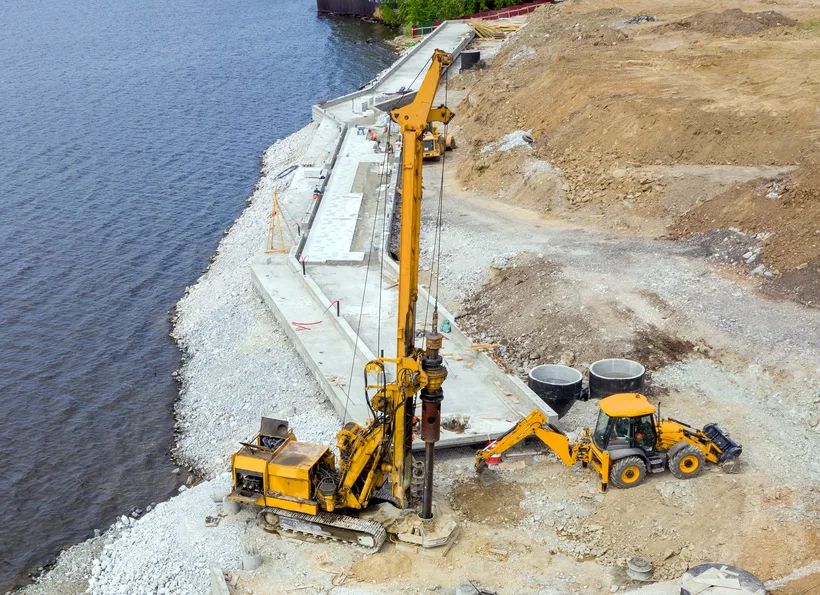

A piling rig drives structural elements into the ground to carry load that surface soils cannot. Physically it is a tall mast or set of leads on a tracked base, handling long heavy piles suspended in the air and a hammer or driver at the top of the stroke.
That description contains both of this machine’s distinguishing exposures. Above ground it behaves like lifting equipment. Below ground it puts energy into material shared with whatever is already standing nearby.
Get a Free Quote Call 317-942-0549
Crane-adjacent, and why that matters
Setting a pile means lifting a long, heavy, awkward object, positioning it vertically, and holding it while a hammer works at the top. The rig is doing lifting work whether or not anyone calls it a crane.
The consequences follow lifting rather than earthmoving. Load stability, ground bearing under the tracks, wind on a suspended pile, and the exclusion zone beneath and around the load are the controlling factors. Dropped or swinging loads are the severe events, and they are severe because of mass and height together.
Some rigs also handle their own piles from stockpile to leads, which extends the lifting exposure across the whole site rather than confining it to the driving position.
Vibration and the neighbors
Driving a pile transmits energy into the ground, and the ground carries it outward. This is the same physics as compaction at a much larger scale, and it produces the same class of claim: damage to structures the machine never touched.
Cracking, settlement and disturbed services in adjacent buildings are the recurring allegations, and piling work attracts them more than almost any other construction activity because the energy involved is so much greater. Urban and infill sites are where this concentrates, since that is where neighbors are close.
The controls are documentary and instrumental. A pre-condition survey establishes what was already cracked. Vibration monitoring establishes what levels were actually reached. Together they convert an unfalsifiable claim into a comparison, and their absence tends to mean claims are settled rather than tested.
Impact, vibratory and what the method changes
An impact hammer drives by repeated blows and is the traditional method for bearing piles. A vibratory driver shakes the pile into place, is common on sheet piling, and can extract as well as install. There are also methods that reduce ground disturbance deliberately for sensitive settings.
Method choice is frequently dictated by proximity rather than by preference, and it changes both the ground effect and the noise. Noise is worth naming as its own exposure: piling is among the loudest construction activities, and complaint, restriction and nuisance claims follow it in populated areas.
Over water
A meaningful share of piling happens at the water’s edge or in it — docks, bridges, bulkheads, moorings. That changes the account substantially.
Equipment works from barges or temporary platforms, which introduces floating plant and the real possibility that a machine or a component ends up in the water rather than merely damaged. Recovery is its own operation. Tides, current and weather windows constrain the work, and environmental sensitivity around watercourses raises the consequences of a spill or a disturbance.
Marine work is a distinct placement conversation and needs flagging at the start rather than appearing on a schedule as a line item.
Transport is a project
Piling rigs are tall, heavy and frequently exceed dimensional limits by a wide margin. Moving one means permits, route planning and substantial disassembly — leads down, hammer off, counterweights removed and shipped separately.
Assembly and disassembly are themselves lifting operations conducted outside the normal rhythm of the job, often under time pressure at the start or end of a contract. Where moves are frequent, transit and trailer transport deserves attention in its own right.
Who runs one
Specialist foundation contractors, marine and waterfront builders, bridge and infrastructure contractors, and shoring specialists installing sheet piling for excavation support. This is specialist work with specialist crews, and the accounts tend to be smaller in number and larger in individual exposure than general earthmoving.
What pile driver insurance costs
No honest figure can be published. What moves it: rig value and configuration; whether the work is land-based or over water; proximity to existing structures and whether monitoring is used; driving method; transport frequency for an oversize machine; crew experience on what is genuinely specialist work; and loss history, with third-party structural claims read separately from equipment damage.
Ground bearing and the rig that sinks
A tall machine holding a suspended load is only as stable as what it is standing on, and piling sites are frequently chosen precisely because the ground is poor. That is the reason piles are needed in the first place.
Working platforms are therefore engineered rather than assumed: a designed mat of granular material, sometimes with geogrid, sized for the loads the rig imposes. A rig that settles on one track while holding a pile is the setup for the most serious incident this machine can produce, and platform failure is a recognized cause rather than an unlucky one.
For an underwriter, whether working platforms are designed and certified is a meaningful question and a good indicator of how the rest of the operation is run.
Obstructions, refusal and what comes back up
Ground on brownfield and redevelopment sites is rarely clean. Old foundations, buried slabs, abandoned services and made ground full of debris all sit in the way of a pile that has to go straight down.
Hitting an obstruction can damage the pile, the hammer or the rig, and it can deflect a pile off line in a way that is not immediately visible. Extraction and re-driving is disruptive and expensive, and where the deflected pile has damaged something already installed, the liability question opens.
Contaminated ground adds another layer on former industrial sites, since driving through it can create a pathway for contamination to move — an environmental exposure attached to an activity most people think of as purely structural.
The hammer and the leads as separate assets
A piling spread is not one machine. The base rig, the leads, the hammer or vibratory driver, the power pack and the helmets and adapters that match hammer to pile are separate items, frequently mixed between rigs and often hired in for particular contracts.
Because hammers are expensive and are moved between machines and between contractors, they deserve to be scheduled by name and serial number rather than assumed as part of the rig they happened to be mounted on when the policy was written. Where a hammer is hired, rented and leased equipment is the line that answers, and the hire agreement usually sets obligations beyond physical damage.
Coverage breakdown
- Equipment floater — the rig, the hammer and the leads.
- General liability — vibration damage, noise and dropped loads.
- Workers compensation — crews working beneath and around suspended loads.
- Transit and trailer transport — oversize moves and disassembly.
- Rented and leased equipment — hammers and drivers are frequently hired per contract.
- Umbrella and excess — where a structural or injury claim on this work goes.
Why Equipment Guard Insurance
Piling sits awkwardly between equipment and lifting, and generalist submissions tend to treat it as neither. We ask about the neighbors and the method before the machine value, and we write the iron on its own. The panel is named on our homepage.
Related
- Excavator insurance — the base machine many rigs are built on.
- Compactor insurance — the same vibration exposure at smaller scale.
- General liability — the adjacent-structure question.
- All equipment we cover
Primary sources
Frequently asked questions about pile driver insurance
Is a piling rig insured as equipment or as a crane?
It usually sits on the equipment schedule, but the exposure is crane-adjacent because the machine handles suspended loads at height. That combination means the account needs looking at with lifting in mind rather than purely as earthmoving equipment, and it is worth being explicit about what the rig actually does.
Can pile driving damage neighboring buildings?
It is the defining liability exposure on this work. Driving energy into the ground transmits it outward, and structures nearby can suffer cracking or settlement without anything touching them. Pre-condition surveys and monitoring are the standard controls, and they are what make an allegation answerable afterwards.
What is the difference between impact and vibratory driving?
An impact hammer strikes the pile repeatedly to drive it. A vibratory driver shakes it into the ground and is often used for sheet piling and for extraction. They produce different ground effects and different noise profiles, and the choice is frequently constrained by what is standing nearby.
Does working over water change the coverage?
Considerably. Marine and near-shore work brings barges, cranes on floating plant, and equipment that can end up in the water rather than merely damaged. It is a distinct placement conversation, and it needs flagging at the outset rather than discovered on a schedule.
What happens if a pile is driven off line or refuses?
That is generally a contractual and engineering matter rather than an insured loss. Remedial piling, redesign of a cap, or extraction and re-driving are costs that sit with the contractor. Where a misplaced pile damages something already in the ground, the liability picture opens.
How much does pile driver insurance cost?
No published figure would be honest. The inputs are rig value and configuration, whether work is on land or over water, the proximity of existing structures, whether impact or vibratory methods are used, transport frequency for what is an oversize machine, and loss history.