

Most states treat a compact loader as something the motor-vehicle code simply does not see. Colorado takes the opposite approach and gives the machine a category of its own, registered and taxed as special mobile machinery. It is a small administrative difference with one large practical consequence: there is a state record of the loader, and owners routinely mistake that record for proof of ownership.
This page works through that distinction, then through the two things that decide what a Colorado equipment account looks like in practice — a hail corridor along the whole populated edge of the state, and terrain that puts real distance and elevation between jobs. The machine itself, its attachments and the way it tips forward are covered on the skid steer insurance pillar.
What skid steer insurance costs in Colorado
No number is published here, because the honest one is assembled from the machine, the schedule and the storage. In Colorado two levers do most of the work and they point the same direction: whether the loader is under cover when it is not being used, which answers hail and theft in one sentence, and how far the machine travels between jobs. Then attachment values and count, the valuation basis, telematics, deductible and the loss record behind the account. Work at altitude and long grades on the haul add wear that surfaces in the history rather than in a rate.
Colorado skid steer regulations: title, lien and ownership
A skid steer is ‘special mobile machinery,’ not a DMV-titled highway vehicle; a lender perfects its lien by filing a UCC-1 financing statement with the Colorado Secretary of State.
Two records exist in Colorado and they answer different questions. The registration puts the machine in its own class for tax and road-use purposes, which is more than most states do — but it says nothing about who owns the loader or what is owed on it. Encumbrance lives in the central financing record, and the lender that filed there is added to the policy as loss payee against the scheduled unit so any settlement is issued jointly. A used-machine purchase that checks the registration and stops has checked the wrong document. Above all of this, general-contractor credentials are issued locally rather than by the state, so on a Front Range account the license folder is municipal even though the equipment rules are statewide.
Common skid steer risks in Colorado
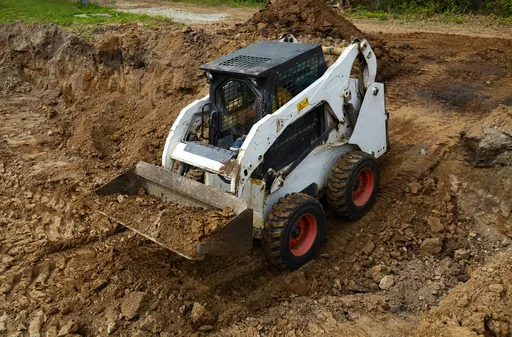
Hail is the exposure that makes this state distinctive on a compact machine. The populated corridor takes severe storms often enough that glass, lights, hood and cab damage on machines parked in the open is a recurring cost rather than a rare event, and none of it happens while anyone is operating the loader. Theft is the other half: portable machines are taken far more often than large tracked ones, and along a growth corridor with open sites and easy highway access they are taken overnight and moved quickly. Beyond those two, altitude and terrain do their own damage — long grades on the haul, cold and thin air on engines and hydraulics, frozen and rocky ground on buckets and drive components — and the forward tip with the arms up remains a property of the machine rather than of the state.
Common Colorado skid steer claims we see
- Hail damage to a loader parked in the open. The most predictable Colorado claim on this class, repeated across a single storm track in one afternoon.
- Overnight theft from a growth-corridor site. Loader and trailer together, worked from the serial plate and the financing record because no title exists.
- Attachment stolen from a rack. A breaker, auger or set of forks, then found to sit inside a blanket per-item cap rather than scheduled at its own value.
- Rock and frozen-ground damage. Cutting edges, bucket structure and final drives on ground the bid treated as dirt.
- Transit damage on a mountain haul. Tie-down, ramp and deck damage on long descents and switchbacks that a flat-state route never produces.
Why Colorado skid steer owners choose Equipment Guard Insurance
We write equipment monoline, which in Colorado means the loader can be valued and scheduled properly without disturbing a liability policy built around several municipal registrations. A crew that has done that paperwork once has no appetite for doing it again, and the answer to an underinsured machine should never be a new program. Attachments go on by name as standard, since on a skid steer that is where the value sits, and we place through markets — named on our homepage — that will underwrite a Colorado equipment schedule as an account rather than as an accessory to one.
Major Colorado skid steer markets
- Denver. The largest and densest market in the state, with infill, demolition and transit work, high machine values and the sharpest combination of hail and open-site theft.
- Colorado Springs. Sustained residential and military-adjacent build-out, where machines follow subdivisions and spend more nights on site than in a yard.
- Aurora. Large-lot suburban and commercial development on the eastern plains edge of the metro, with wide-open sites and little shelter for anything left out.
- Fort Collins. Northern growth and university work with a deep rental counter, so rented-in loaders and the certificates rental houses require are routine on an account here.
- Lakewood. Established-suburb renovation and utility work on tight lots, where damage to finished surfaces outnumbers theft on many schedules.
- Pueblo and Grand Junction. The southern and western markets, long hauls over grades, and machines working days from the nearest dealer or spare part.
Related
- Skid steer insurance — the machine physics that hold in every state.
- Excavator insurance in Colorado — the machine the dig-notice window and the positive-response rule reach.
- All equipment insurance in Colorado — the state hub.
- Equipment floater · Rented & leased equipment
Primary sources
We do not link a Colorado filing document here. The ownership and lien rules described above follow Article 9 as Colorado has adopted it; where a state publishes a document that states the rule directly, this page links it.
Colorado skid steer insurance FAQs
Is a skid steer registered in Colorado?
In its own way, yes, and this is where Colorado differs from most of the country. Rather than simply exempting construction machinery from motor-vehicle rules, the state puts it in a separate class — special mobile machinery — that is registered and taxed as its own category. So a compact loader that carries no certificate of title may still appear in a state record, which surprises owners arriving from states where the machine is invisible to government entirely.
Does that registration prove I own the machine?
No, and treating it as proof is the mistake worth avoiding. The registration puts the machine in a class for tax and road-use purposes; it is not a certificate of title and it is not an ownership record. Ownership is still evidenced the ordinary way — the bill of sale, the serial plate and the financing record — so a Colorado theft or dispute is resolved from those documents rather than from the registration paperwork in the cab.
Where does a lender perfect its interest in a financed loader?
Centrally, with the Colorado Secretary of State, where UCC financing statements against equipment are filed and searched. Note the split this creates: the machine may be registered in one state system while the lien against it lives in a different one, so a buyer who checks only the registration has not checked anything about encumbrance. On the policy, the lender goes on as loss payee against the scheduled unit and settlements are issued jointly.
Do I need a state contractor license to run equipment in Colorado?
Not a general one. Colorado licenses electricians and plumbers statewide through boards under the Department of Regulatory Agencies, but general contracting is licensed by local jurisdictions, so a crew working the Front Range can hold registrations in several municipalities at once. The rules reaching the machine are statewide even where the paperwork is not, and the entity named on each local credential should be the entity named on your certificate of insurance.
How much does hail really matter on a compact loader?
Enough that it changes the shape of a Colorado account. The state’s Front Range corridor takes severe hail with regularity, and a loader parked in the open takes it on glass, lights, hood and cab rather than on anything mechanical — expensive, repeatedly, and to a machine that was not being operated at the time. Combined with the theft question, it makes covered storage the single most useful thing most Colorado owners can change about their risk.
Can the loader be insured on its own?
Yes. Equipment Guard Insurance writes equipment monoline in Colorado, so the machine and its attachments can be scheduled without touching a liability policy arranged around your local registrations. The equipment gets underwritten as equipment, which is the only way its value ever gets checked properly.