

A compact loader is the machine that lets a Virginia crew self-perform across a state that runs from a tidewater port complex to the ridges of the Blue Ridge: it grades, loads, breaks, clears and lifts, gets through a residential gate, and rides to the next job behind the truck already in the yard. It is also the single easiest serious machine to remove from a site without anybody noticing.
What follows is specific to Virginia: a central filing office that is not a Secretary of State at all, a statewide license issued in classes that cap the size of project you may hold, and a coastal metro area where storm, tide and salt air stack on top of the theft picture. The state-independent half of the subject — attachment couplers, skid steering, why a loaded arm tips forward — is on the skid steer insurance pillar.
What skid steer insurance costs in Virginia
Quoting a premium sight unseen would be inventing one, so this page does not. In Virginia the levers that move it most are storage, elevation and proximity to tidal water: a loader kept behind a gate in a Richmond yard, one staged inside port perimeter control, and one parked on low ground near the water are three separate risks. After that come the number and value of attachments, the valuation basis you choose, whether a tracking unit is fitted, how far the machine travels, and your own loss history. The license class you hold shapes the schedule too, because it decides the scale of work the machine is put to.
Virginia skid steer regulations: title, lien and ownership
A skid steer is untitled construction equipment, and a lender perfects a security interest by filing a UCC-1 financing statement with the Virginia State Corporation Commission — the central filing office in the Commonwealth, not the Secretary of State.
This is the part that catches lenders and brokers from outside the Commonwealth, and it is worth being exact about. A financed loader is perfected by a UCC-1 filed with the central filing office at the Virginia State Corporation Commission — there is no Secretary of State here doing that work — and the lender is then added to the policy as a loss payee against the scheduled unit, so a loss payment is issued jointly. A financing statement lodged in the wrong office does not accomplish what it was meant to, and that comes to light at a sale or a loss rather than at signing. After a theft, settlement and recovery turn on the serial number and the bill of sale, because no certificate of title was ever created. One layer up, the Commonwealth licenses contractors in Class A, B and C tiers whose ceilings are set by project value, so the licensed entity, the insured entity and the contracting entity all need to be the same one, holding a class that covers the job.
Common skid steer risks in Virginia
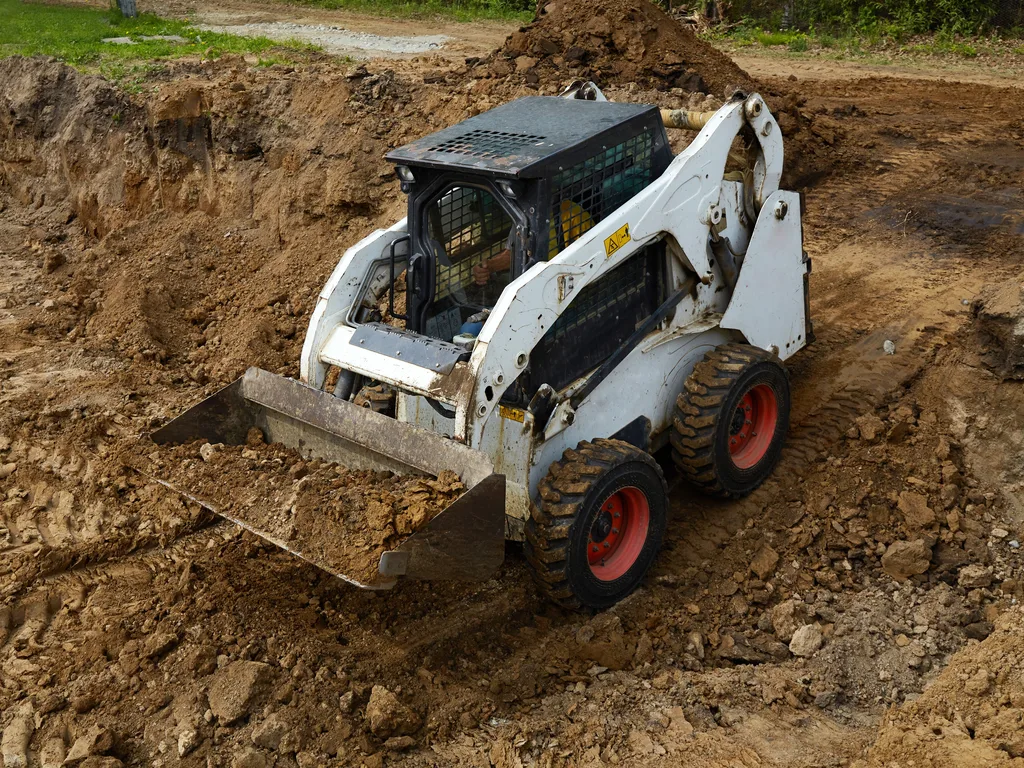
Theft leads this class in Virginia, helped along by an interstate network that reaches other jurisdictions and a major out-of-state metro area within a short haul, and by growth-fringe sites that stand open overnight. Water is second and it comes in three forms: named-storm wind and surge on the coast, recurrent tidal flooding on low ground that floods without a storm at all, and inland flash flooding in the river valleys after heavy rain. Salt air runs underneath all of it for machines kept near tidewater, producing corrosion and electrical failures that are gradual rather than datable. What remains belongs to the machine and the ground: struck utilities on tight lots, damage during loading, rutting on soft coastal soils, and the forward tip.
Common Virginia skid steer claims we see
- Overnight theft from an open growth-fringe site. The defining claim, argued on the serial number and the Commission filing record.
- Tidal or storm water reaching a machine left on low ground. Engine and hydraulic contamination on a site that was dry when the crew went home.
- Corrosion and electrical failure on a tidewater machine. Gradual, which puts the maintenance record at the center of the settlement.
- Attachment missing from a staging area. A breaker or grapple left inside a job perimeter overnight, then found to sit under a blanket per-item sublimit.
- Forward tip placing a load at height. Usually on soft or uneven ground, on a machine that carries its load ahead of the front axle.
Why Virginia skid steer owners choose Equipment Guard Insurance
We write equipment monoline, which matters in a licensed state: a Virginia contractor has usually arranged its liability program to satisfy a license class and a set of general contractors, and moving that program to schedule a loader properly is not a reasonable ask. We schedule attachments by name as a matter of course — including the ones that live in a staging area rather than a yard — we check that a lender is named against the right unit and filed in the right office, and we place through markets named on our homepage that will read the schedule on its own merits.
Major Virginia skid steer markets
- Virginia Beach. Coastal residential and resort build-out on low, sandy ground, where storm exposure and open overnight storage arrive together.
- Norfolk. Port, naval and marine-adjacent site work with uneven security block to block, and the heaviest salt-air corrosion exposure in the Commonwealth.
- Chesapeake. Wide, low-lying territory with drainage and utility work on ground that floods on a tide rather than on a forecast.
- Richmond. The most varied inland market — institutional, commercial and infill work — where secured yard storage is genuinely available.
- Newport News. Industrial and shipyard-adjacent ground work with staging-area attachment storage and high machine hours.
- Roanoke. Mountain and valley work with long hauls between dispersed jobs, and steeper ground under the machine.
Related
- Skid steer insurance — the machine physics that hold in every state.
- Forklift insurance in Virginia — the machine whose operator training runs through the Commonwealth’s own OSHA program.
- All equipment insurance in Virginia — the state hub.
- Equipment floater · Rented & leased equipment
Primary sources
- Uniform Commercial Code — Virginia State Corporation Commission (title, lien and filing)
- Board for Contractors — Virginia Department of Professional and Occupational Regulation (contractor licensing)
Virginia skid steer insurance FAQs
Where is a lien on a financed Virginia skid steer actually filed?
With the State Corporation Commission. The Commonwealth has no Secretary of State performing the central filing function, so UCC-1 financing statements on equipment are filed with the Commission instead — a genuine exception rather than a naming difference, and one that out-of-state lenders filing from habit get wrong. Once filed, the lender is named on the policy as a loss payee against the scheduled unit, so a loss payment is issued jointly and the filing and the schedule must describe the same machine by serial number.
Is a skid steer titled or registered in Virginia?
No. It is untitled construction equipment, so nothing is issued or surrendered at a DMV office when the loader changes hands, and there is no title to produce after a loss. Identification runs through the serial number, the bill of sale and that Commission filing record. With a title you would have one authoritative document; without one you need three ordinary ones to agree.
Which Virginia contractor license class do I need to run this work?
That depends on the size of the projects you intend to take, not on the machine. The Board for Contractors at the Department of Professional and Occupational Regulation licenses contractors statewide in three classes — A, B and C — and each class sets the monetary ceiling on the contracts and projects the holder may perform. The loader needs no credential of its own, but the class you hold determines the jobs it can be put on, and therefore which attachments are worth owning rather than renting.
How does Hampton Roads change the exposure on a compact loader?
It concentrates several problems into one market. Port, naval and marine-adjacent site work sits on low, flat, tidal ground, so a loader faces named-storm wind, surge and recurrent tidal flooding on sites that are dry in ordinary weather. Salt air then works on cylinders, connectors and cab electronics year round, producing gradual losses rather than datable ones. Security is uneven too: some of this work happens behind serious perimeter control and some on open ground a block away. Where the loader spends the night varies more inside this one metro area than across most states.
Are attachments covered on a Virginia skid steer policy?
Only where they appear on the schedule by name. Blanket attachment limits carry a per-item sublimit that buckets and forks fit within and that breakers, augers, grapples, mulching heads and cold planers commonly exceed. There is a Virginia-specific wrinkle worth knowing: on port-adjacent and institutional jobs an attachment is often left in a staging area rather than taken home, because moving it daily through gate control is impractical — and a staging area is precisely where an unscheduled attachment goes missing.
Can I insure the loader on its own, without a package?
Yes. Equipment Guard Insurance writes equipment monoline in Virginia, so a loader and its attachments sit on a schedule of their own. If your general liability was arranged around your license class and the contractors you serve, it stays exactly as it is — we would rather write the iron correctly than rearrange something that already satisfies the people asking for certificates.