
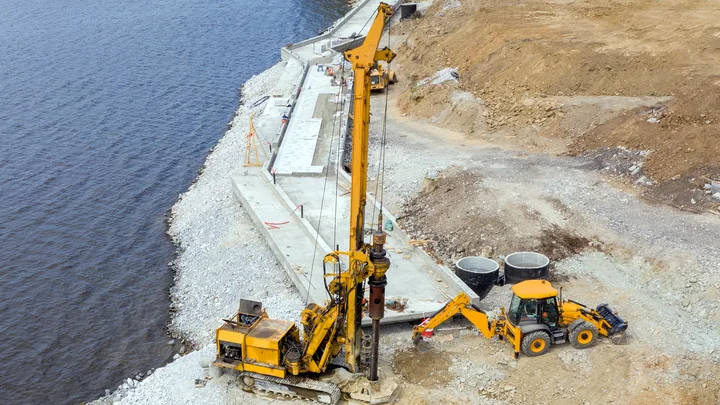

If you haul your own machine, you are operating under a federal securement standard rather than under your own judgment about whether the load feels tight. The rules are specific, they are published, and they are enforced at roadside. What follows is the sequence a haul actually runs through and who sets the standard at each step.
Who writes the rules you are actually following
The Federal Motor Carrier Safety Administration sets the cargo securement standard for commercial motor vehicles, and heavy machinery is addressed in its own right rather than folded into general freight. States overwhelmingly adopt the same standard for hauling that stays inside their borders, which means the practical answer is the federal one almost everywhere.
Two things follow from that. First, the standard is written down, so “it held last time” is not a defense — the requirements speak to specific devices, specific strength and specific placement, and they are checkable. Second, they are not the only rules in play: a yard’s rental agreement or a lessor’s schedule can impose its own conditions on transport, and those sit on top of the federal ones rather than replacing them.
This article deliberately states no securement figures. The ones that matter belong to the rule text and to the markings on your own equipment, and a figure repeated secondhand is exactly the kind of thing that gets remembered wrong. Read the current rule, and read your own tags.
Before the trailer leaves the yard
The haul begins before anything is loaded, and the checks are unglamorous. Look at every strap, chain, binder and hook you intend to use, and look at them in daylight rather than by feel.
Damage disqualifies a device. Cuts, abrasion, broken stitching, corrosion, deformed hooks, knots tied in webbing to take up slack — each of those takes the device out of service, and none of them is a judgment call. Markings matter as much as condition, because the marking is how a rating is proven to anybody who asks. An unmarked or unreadable device is a device you cannot demonstrate anything about.
Then look at the trailer itself: deck condition, anchor points, ramps, lights, tires and the coupling. The rating side of that inspection — what the trailer and the truck are actually permitted to carry — is its own subject, and trailer ratings and what your truck can tow works through where each of those numbers is recorded.
Loading, which is where a lot of the damage happens
Loading and unloading account for a meaningful share of equipment damage, and almost none of it involves the road. The common causes are a trailer that is not level, ramps that are not seated, a machine approached at an angle, and an operator working from the wrong side of the machine to see what matters.
Position the truck and trailer on firm level ground, chock or brake the trailer, and load with the machine oriented as the operating manual for that unit directs. Where the deck is wet, muddy or frosted, the traction problem is on the ramps and the deck rather than on the ground you drove across.
Keep everyone off the trailer and out of the pinch points during loading. Injury during loading runs through workers compensation and the liability layer at the same time, and it happens in the moments when the machine is moving and nobody is watching the people.
Securing the machine itself
Once the machine is positioned, restraint takes over. The federal rules for heavy machinery speak to restraining the machine against movement in every direction and to the devices used to do it, and they set requirements about how many and how strong. Those specifics live in the rule text.
What is worth carrying in your head is the reasoning. Restraint has to hold against forward, rearward and lateral movement, and the arrangement has to keep holding when the machine settles or the suspension works. Attachment points are used because they are engineered for it, not because a chain reaches conveniently. Devices are tensioned rather than merely fitted.
The other half of the machinery provisions concerns the machine’s own moving parts. Booms, arms, buckets, blades and cab doors do not stay where they were left unless something holds them there. Lowering and securing them is part of securing the load, not an afterthought.
Securing what is riding with it
A carrier tied down correctly with loose items around it is still an unsecured load. Buckets, forks, breakers, spare cutting edges, fuel cans, toolboxes and the pallet of whatever the job needs are each cargo in their own right.
This is the most commonly skipped step on a short haul, because the items are small relative to the machine and the trip is across town. Small items are exactly the ones that leave a trailer, and a loose object in the roadway is a liability problem rather than an equipment one — it becomes a question for general liability and, where the vehicle is at issue, for commercial auto.
Real-World Scenario: A contractor loads a compact loader for a haul of a few miles between two sites, chains it down properly, and drops the bucket that came off it into the front of the trailer alongside a fuel can. The bucket walks forward under braking, catches the fuel can, and the can goes over the side on a curve. Nobody is hurt and the machine is untouched. What follows is a conversation about a vehicle behind him, a cleanup, and a load that was secured in every respect except the part that was not the machine.
The first stop, and why it matters more than the rest
Loads settle. Tension that was correct in the yard is often loose after the first few miles, as the machine seats, the chains find their bearing and the trailer flexes.
The federal rules address inspection during transit, and the practical version is simpler than the citation: stop early, walk the load, and re-tension. Do it again at intervals through the trip and after anything unusual — a rough crossing, a hard stop, a section of broken pavement.
Nothing about this is optional in the sense that matters. A load that was compliant when it left and loose when it arrived was non-compliant somewhere in between, and the miles in between are where the consequences live.
The short haul is where this gets skipped most reliably, and the reasoning is understandable: a trip across town does not feel long enough for anything to move. Settling is a function of the first few miles rather than of the total distance, so the short haul gets the same walk-around as the long one — it just gets it once instead of several times.
What an inspection is looking for
Roadside enforcement is not an impression of tidiness. An inspector is working from the same written standard you are, checking the devices for damage and marking, checking the arrangement against what the rule requires for what is on the trailer, and checking whether the load has moved.
Equipment with unreadable markings is a routine finding, and it is avoidable — devices are replaced rather than repaired, and the ones that are still legible are the ones that can be defended. So is a load whose machine is beautifully chained and whose movable parts are still up.
The registration and rating side of an inspection is a separate matter from securement, and it is the part that turns a load into a weight question rather than a tie-down one.
Unloading, and the paperwork that closes the trip
Unloading reverses the sequence and repeats its hazards, on ground that is usually worse. Release tension only after the machine is chocked or braked, keep people clear, and treat the ramps with the same suspicion as at the start.
Then close the file. Photograph the machine on arrival, note anything new, and keep the record with the rental or job paperwork. A transit and trailer transport claim turns on what the machine looked like at each end of the trip, and a photograph taken in ninety seconds settles arguments that otherwise run for weeks. Machines that are not yours make this more important rather than less, which is why rented, leased or borrowed equipment coverage treats documentation as part of the coverage question and the rented and leased page sets out the part itself.
The machine class changes the difficulty but not the discipline. A compact loader and an excavator are the same problem at different scales, as the skid steer cost guide works through from the rating side. To have the transit side of a program read against how far and how often you actually haul, send the detail through the quote form.