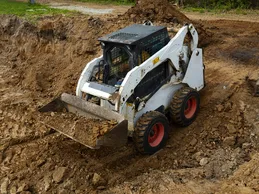

A rental yard will not release a compact loader on a promise. The requirements it names are specific, they are written into the rental agreement rather than negotiated at the counter, and almost every one of them traces back to a physical fact about this particular machine class rather than to a preference of the yard.
Why this machine class draws requirements a larger machine does not
Start with the machine rather than the paperwork. A compact loader is the most portable serious machine on a jobsite. It loads onto an ordinary tandem trailer, it starts without specialist knowledge, and it is common enough to resell without attracting attention. Yards know their own loss records, and on this class the record is dominated by theft.
That is why a skid steer rental routinely carries conditions a larger and more valuable machine does not. A yard sending out a mid-size tracked excavator is fairly confident the machine will be where it left it. A yard sending out a compact loader is not, and the agreement is written accordingly.
Read the requirement list in that light and it stops looking arbitrary. Each item is the yard buying back a piece of a loss it has already absorbed. The skid steer overview covers the machine class itself; what follows is the paperwork the class produces.
The limit rides on the largest unit, not the usual one
The first requirement is almost always a limit for physical damage to the machine while it is in your care, and it is the requirement most often satisfied on paper and missed in practice.
Your owned-machine schedule does not answer here. An equipment floater responds for the units listed on it, and a rental is not one of them. What responds is a rented and leased equipment part, carrying its own limit — and that limit has to anticipate a machine you have not chosen yet.
Contractors set that limit against the loader they take most weeks. The trouble is that the busy month is when the bigger unit gets rented, so the limit meets its test on the one occasion it was not built for. Set it against the largest machine you might reasonably collect, and revisit it when your work changes rather than when the policy renews.
The tool on the coupler is part of the rental
A compact loader is a carrier. The value on the ticket is frequently split between the machine and whatever is mounted to the quick-attach plate, and the agreement makes you responsible for all of it from the moment it leaves.
Coverage discussions rarely follow. Limits get set by looking at loader values, because those are the numbers a renter can picture, while a mulching head, a cold planer or a hydraulic breaker sits in a separate line nobody read. On a compact rental that omission can remove a large share of the package from the calculation.
The fix takes one question at booking: ask for the replacement value of everything being delivered, attachments included, and treat that total as the number your limit has to reach. Where the loader arrives with one tool and comes back with another, the swap belongs on the same conversation.
Named on the paperwork, and in what capacity
Yards ask to appear on your coverage, and they ask for it in language that blurs two very different things. Being listed as the recipient of a certificate means the yard gets a copy of a document. Being named as an additional insured, or as a loss payee on the machine, changes who holds rights under the policy.
Only the second requires anything to happen to the policy itself, and only the second takes time. An agreement that asks for additional insured status on your general liability and gets a certificate naming the yard as holder has not been satisfied, and the discovery usually happens at the counter.
Read the clause and identify which capacity is being demanded for which coverage part. Then request it in those words. The mechanics of the document, and the reasons yards send them back, are worked through in the certificate a rental yard will accept.
The operator clause nobody reads
Buried near the responsibility language is a definition of who may run the machine. It is a requirement in every practical sense, and it is the one crews breach without noticing.
Definitions vary. Some agreements restrict operation to individuals named on the contract. Some extend it to employees of the renting business but no further. Some require documented training on the class of machine. A loss caused by somebody outside that definition can fall outside whatever the yard agreed to waive, and it makes your own claim harder at the same moment.
Real-World Scenario: A landscape contractor rents a compact loader for a Friday and a Saturday. On the second morning his crew is short, so a longtime friend who runs the same machine at his own company steps in for two hours to finish grading a pad. The machine clips a gate post. The friend is a competent operator with years on the class — and he is not an employee of the renting business, which is how the agreement defines an authorized operator. The conversation that follows is not about whether anyone was careless. It is about a sentence nobody read on a Friday afternoon.
Injury adds a second layer. Anyone hurt around the machine runs through workers compensation and the liability layer, and an operator who does not fit either category sits awkwardly in both.
Where the machine sleeps is part of the agreement
Yards on this class write storage conditions into the contract, and they read as housekeeping rather than as requirements. Secured storage overnight. Keys removed and kept away from the machine. Limits on how long a unit may sit unattended.
They are conditions, and they matter twice. They can affect what the yard agreed to give up if a machine disappears, and they describe controls your own coverage was priced against. An application that says the yard is fenced and a job where the loader sleeps on an open pad between phases are two different risks wearing the same paperwork.
The practical discipline is to answer the storage question honestly at booking, and to tell the crew what the answer was. A weekend hold on an open site is the single most common shape of a compact-loader theft, and it is also the arrangement most likely to have gone unmentioned.
Where the honest answer is that the machine will sit out, say so and plan for it rather than describing an arrangement that does not exist. Yards will usually still rent, and the conditions they attach — a longer minimum term, a requirement that the machine be immobilized, sometimes a tracking unit fitted before it leaves — are things you can price and schedule around. What cannot be planned around is a clause that was answered optimistically and a machine that vanished on the night the answer stopped being true.
The leg the yard stops caring about
Yard requirements end at the yard gate in one specific respect: many agreements say very little about the machine while you are hauling it. If you take delivery, the loading leg is the yard’s. If you collect, it is yours.
That is a real gap rather than a technicality, because loading and unloading is where a meaningful share of equipment damage happens. Transit and trailer transport is the part written for the machine in motion, and it is worth confirming before the trailer is hitched rather than after.
Where the yard offers delivery, taking it removes the exposure for that leg entirely. Where the delivery charge is the reason you are collecting, price the two against each other honestly.
Getting this settled a week before the booking
Everything above is easier on a Tuesday than at a counter on Friday. Ask the yard for its insurance requirements in writing, once, and keep the reply — the same yard will ask for the same thing next season. All of this is written from the renter’s side of the counter; a yard looking at its own fleet has a different question, taken up on equipment dealer insurance.
Then check three things against it: that a not-owned part is actually on your policy with a limit that reaches the biggest unit you might take, that anything requiring policy action has been requested rather than assumed, and that the operator and storage clauses match how the job will really run.
If you are still weighing the yard’s own damage waiver against carrying this yourself, the damage waiver comparison takes that decision apart, and rented, leased or borrowed equipment coverage works through the three not-owned modes. For why this class rates as it does, the skid steer cost guide covers it, and the quote form is the place to have the not-owned side read against how you actually rent.