

In Massachusetts the backhoe survives because nothing else does its job in the space available. It digs, lifts, loads and backfills without a second machine on the ticket, and it repositions itself along the street rather than waiting for a lowbed that has nowhere to park.
This page is about what that costs here. The state gives self-propelled construction machinery a place outside ordinary registration, splits contractor credentials down two separate tracks, and then puts the work in the oldest built environment in the country. Boom geometry, hydraulic behavior and the loader end do not change at the state line — those belong to the backhoe insurance pillar, not to this page.
What backhoe insurance costs in Massachusetts
A price printed here would be a number with no input behind it, which is worse than no number at all. What genuinely sets a Massachusetts backhoe rate is trip frequency rather than trip length — how often the machine pulls onto a public way in an average week — plus how close it works to finished surfaces and occupied structures, where it is stored overnight in a market with very little secure yard space, the valuation basis you choose and your own loss history. A machine that lives on one fenced site is not the same risk as one that repositions itself across a dozen small jobs.
Massachusetts backhoe regulations: road operation
Self-propelled construction equipment such as a backhoe is generally treated as special mobile equipment not registered as an ordinary motor vehicle and only incidentally operated on public roads.
The consequence owners miss is that this is a registration answer, not a liability answer. Being outside the ordinary vehicle scheme keeps the machine off a plate; it does nothing to change what happens when a loader bucket meets a parked car on a narrow street, when a tire climbs a granite curb and takes the stone with it, or when a machine crossing a way is hit by traffic that never expected it. Damage to the backhoe itself is the floater’s work; damage the backhoe does on the road is liability, and the two are not interchangeable. The credential layer sits above all of it: a Construction Supervisor License governs structural supervision and a Home Improvement Contractor registration governs work on smaller homes, so a crew moving between both kinds of job answers to two different authorities in the same week — and the equipment schedule should look like a business that does both.
Common backhoe risks in Massachusetts
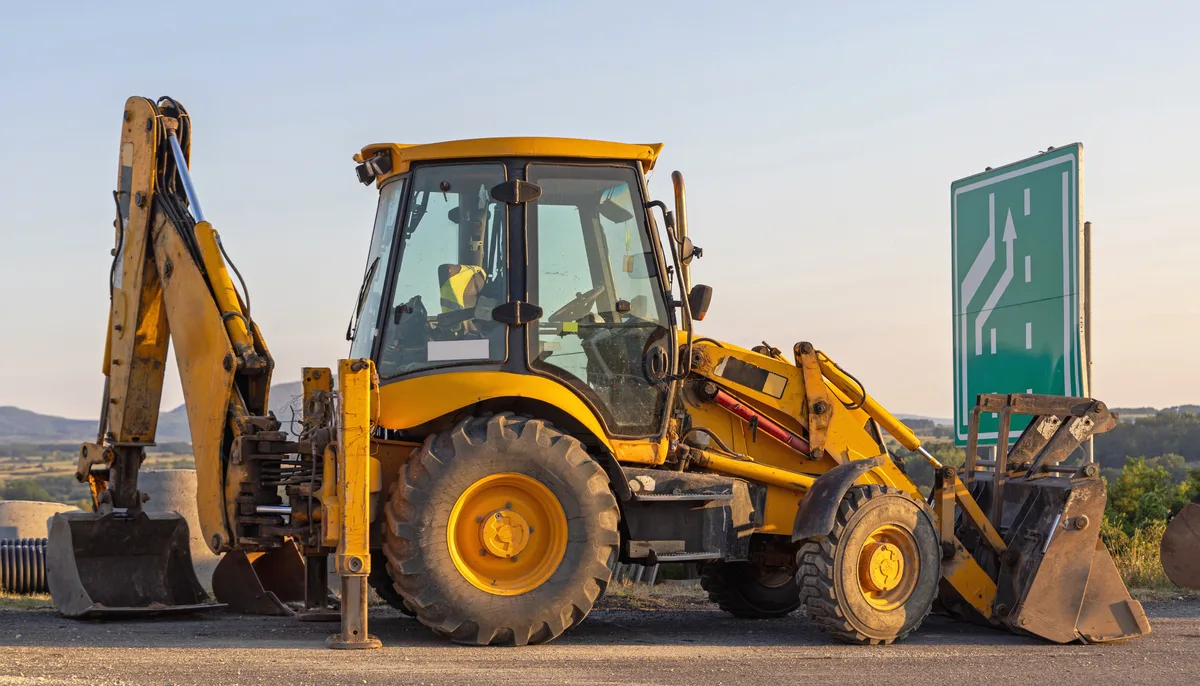
Third-party damage dominates here, which is unusual for this class. The machine is rarely far from something that belongs to somebody else — a wall, a fence, a parked vehicle, a granite curb, a service box under an old sidewalk — so the swing radius and the stabilizer footprint generate more claims than anything mechanical does. Behind that sits the transit picture, compressed rather than absent: short moves made often, on ways not laid out for the machine. Then the season, which does its damage twice — frost and salt while the work is happening, and neglect while the machine sits waiting for spring.
Common Massachusetts backhoe claims we see
- Contact with a parked vehicle or street furniture on a road move. The signature loss in a market where the working lane and the parking lane are the same width.
- Stabilizer pad through an old sidewalk or service cover. Established rights of way hide their history, and the pad finds it.
- Boom or counterweight contact with a structure on the swing. Zero setback is normal on infill work here, so the margin for a misjudged arc is nil.
- Curb and surface damage under the tires. Small individually, persistent in aggregate, and almost always a liability claim rather than a repair.
- Corrosion and seal failure presented as sudden damage. A salt-belt argument worth settling early, because deterioration is not a peril and the line decides the outcome.
Why Massachusetts backhoe owners choose Equipment Guard Insurance
Equipment-only placement fits the way Massachusetts contractors are actually put together. A licensed supervisor who also holds a home-improvement registration has a program built around those credentials and no appetite to unpick it because one machine needs scheduling properly — so we do not ask for it. We price the road exposure on how often the machine goes out rather than how far, we ask where it sleeps in a market where secure storage is genuinely scarce, and we place through markets — named on our homepage — that will read an equipment schedule on its own merits.
Major Massachusetts backhoe markets
- Boston. Infill, utility and streetscape work on the tightest ground in the state, where almost every job is a liability exposure before it is an equipment one.
- Cambridge. Institutional and laboratory build-out on constrained blocks, with finished surfaces and pedestrian traffic inches from the swing.
- Worcester. A large inland market with steep grades and a mix of reconstruction and new site work, hard on undercarriage and stabilizer setup alike.
- Springfield. River-valley site work and municipal replacement, where the machine spends much of its week in the public right of way.
- Lowell. Dense former mill fabric and utility replacement under streets whose records rarely match what is actually down there.
- New Bedford. Coastal and waterfront work, where salt air shortens component life and soft fill punishes an unplanned stabilizer set.
Related
- Backhoe insurance — the machine physics that hold in every state.
- Skid Steer insurance in Massachusetts — the machine that fits where a backhoe cannot, on lots this tight.
- All equipment insurance in Massachusetts — the state hub.
- Equipment floater · Rented & leased equipment
Primary sources
- Construction Supervisor Licensing | Mass.gov — Massachusetts Board of Building Regulations and Standards / Office of Public Safety and Inspections (CSL); Office of Consumer Affairs and Business Regulation (HIC) (contractor licensing)
We do not link a Massachusetts vehicle-code section here. The road-use treatment described above follows how Massachusetts classifies self-propelled construction equipment; where the state publishes a section that states it directly, this page links it.
Massachusetts backhoe insurance FAQs
Does a Massachusetts backhoe have to be registered to use a public way?
Not in the way a truck does. Self-propelled construction machinery falls outside ordinary vehicle registration because it is built to work rather than to carry people or goods, and the road time it puts in is incidental to that work. What the exemption never does is settle who answers for damage while the machine is out there — and on a crowded Massachusetts street there is a great deal for it to damage.
Which credential matters here, the supervisor license or the home-improvement registration?
Both, and which one governs depends on the job rather than on the machine. Massachusetts requires a Construction Supervisor License to supervise structural work, and a separate Home Improvement Contractor registration to work on one-to-four-family homes. A site outfit that does both is carrying two credentials from two different authorities, and an equipment schedule that reflects only half of that work will look thinner to an underwriter than the business actually is.
How much does the density of eastern Massachusetts really change the exposure?
It moves the whole risk toward third-party damage. The road moves are short, so mileage stays low and owners assume the highway exposure is small — but frequency, not distance, is what generates claims here. A machine that pulls onto a narrow way a dozen times a week, past parked cars, granite curbing and street furniture set well before anyone imagined a loader passing, is exposed on every one of those trips.
What does a Massachusetts winter do to this machine specifically?
Three things worth pricing. Deep frost makes the ground fight the bucket and pushes the load back into the boom and the stabilizer feet. Road salt and the wash cycle that follows a thaw attack pins, rams and exposed cylinder rod far faster than a dry climate does. And the season compresses the work into fewer usable months, so utilization spikes and deferred service piles up exactly when the machine is being asked for most.
The streets here are old. Does that show up in claims?
Constantly, and it is the most Massachusetts thing on this list. Working in an established right of way means setting stabilizers over surfaces and services that predate any record anyone can produce, next to structures with no setback at all. When a pad drops through, or a boom finds a cornice on the swing, the loss is somebody else’s property and it is a liability question rather than a repair to the machine.
Can you schedule just the backhoe and leave the rest of my program alone?
Yes. Equipment Guard Insurance places equipment on its own in Massachusetts, so the machine gets underwritten properly without disturbing the liability and workers compensation a licensed supervisor has already arranged. Nothing about the credential file has to be reopened to get the iron scheduled correctly.