

In Massachusetts a compact loader earns its keep by being the only machine that fits. Streets laid out before anything had wheels, lots with no lay-down space, basements being dug under buildings already standing — the work is retrofit rather than greenfield, and a skid steer with the right attachment does most of it.
What follows is specific to this state rather than to the machine: a two-credential licensing system that can send one crew to two different agencies, a central filing office that carries a different name here than anywhere else, and an urban geography that decides where the loader sleeps for you. If what you need is the mechanical picture — attachments, skid steering, why the tip goes forward — that lives on the skid steer insurance pillar.
What skid steer insurance costs in Massachusetts
No premium is published here, because the number is assembled from the machine and the way it is kept rather than looked up. The levers that move it most in this state are the ones the geography chooses: whether the loader has a secured off-site yard or lives on the trailer, how far it travels between addresses in a normal week, and how many attachments ride with it. Then the ordinary ones — the valuation basis, telematics, deductible and loss history. A crew serving three cities from one leased yard prices very differently from one that parks in whatever driveway the job has.
Massachusetts skid steer regulations: title, lien and ownership
A skid steer is untitled construction equipment, not an RMV-titled motor vehicle; a security interest is perfected by filing a UCC-1 financing statement under Massachusetts’ UCC Article 9 with the Secretary of the Commonwealth.
The consequence is administrative rather than dramatic. With no certificate in existence, the financing statement and the serial plate are what prove the machine is yours, and a lender that has filed sits on the policy as loss payee against the scheduled unit so that settlements are issued jointly. Where Massachusetts adds work of its own is one level up, in credentials rather than collateral: a Construction Supervisor License covers supervision of structural construction, a Home Improvement Contractor registration covers one-to-four family homes, and they come from two different parts of state government. A general contractor checking your file before the loader comes through the gate is looking for consistency across all three documents — both credentials and the certificate — and inconsistency there stops work faster than any coverage question does.
Common skid steer risks in Massachusetts
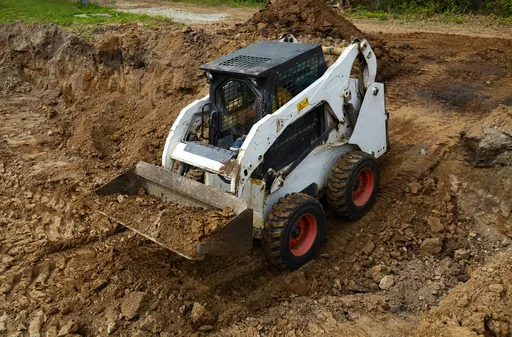
The theft exposure here is unusual in shape rather than in size. There is often no site to steal from, so losses cluster at the two ends of the day: the machine going onto or off the trailer, and the yard it returns to after dark. Trailer theft with the loader still strapped down is a live pattern in this market. The rest of the picture is physical damage caused by working inside standing buildings and narrow streets — clipped door frames, cracked finished surfaces, curb and bollard contact on a street with no turning room — plus salt air on machines kept near the water, and the freeze-thaw and road-brine wear that follow a New England winter into every hydraulic seal on the unit.
Common Massachusetts skid steer claims we see
- Loader and trailer taken together from a residential street. Nothing was fenced because there was nothing to fence, and the recovery file rests on the serial plate rather than a title.
- Breaker or shear lifted from a rack. The attachment goes and the machine stays, then turns out to fall under a blanket per-item cap rather than being listed by name.
- Finished-surface damage inside a retrofit. Floors, thresholds and stair treads on a job where the machine had to work indoors to work at all.
- Contact damage in a street with no turning room. Curbs, granite steps, parked vehicles and bollards, all closer than they were on the last job.
- Forward tip while placing a load. Backfill, soft ground and a bucket carried out in front of the wheels.
Why Massachusetts skid steer owners choose Equipment Guard Insurance
Equipment monoline is the whole point of what we do, and here it solves a paperwork problem as much as an insurance one. A Massachusetts crew usually has liability written around the credentials it already holds and a certificate already sitting in a general contractor file; being told to unwind that so a loader can be scheduled correctly is how machines end up underinsured. We schedule the iron on its own and leave the rest alone. Attachments go on by name because on this machine they are the value, and we place through markets — named on our homepage — willing to read an equipment schedule without a package attached to it.
Major Massachusetts skid steer markets
- Boston. Retrofit, underpinning and infill on lots with no storage, where the loader arrives and leaves by trailer every working day.
- Cambridge. Laboratory and institutional build-out with high machine values and unusually tight access, so damage claims outnumber theft claims on many accounts.
- Worcester. The central hub for crews serving the whole state from one yard, and the deepest rental counter outside the coast.
- Springfield. Western-end site work with longer hauls, where a machine can be a full day away from the yard it belongs to.
- Lowell and Brockton. Older mill-city housing stock and small commercial work, where the same loader alternates between residential and commercial jobs in one week.
- Quincy and New Bedford. Harbor-side work with salt air on everything, plus coastal storm exposure on any machine left outside.
Related
- Skid steer insurance — the machine physics that hold in every state.
- Excavator insurance in Massachusetts — the machine the premarking and dig-notice rules reach first.
- All equipment insurance in Massachusetts — the state hub.
- Equipment floater · Rented & leased equipment
Primary sources
- Construction Supervisor Licensing | Mass.gov — Massachusetts Board of Building Regulations and Standards / Office of Public Safety and Inspections (CSL); Office of Consumer Affairs and Business Regulation (HIC) (contractor licensing)
We do not link a Massachusetts filing document here. The ownership and lien rules described above follow Article 9 as Massachusetts has adopted it; where a state publishes a document that states the rule directly, this page links it.
Massachusetts skid steer insurance FAQs
Is a skid steer registered with the Registry of Motor Vehicles?
No. A compact loader is off-road equipment rather than a road vehicle, so no registration is issued and no title exists to hand over at resale or produce after a loss. The serial plate, the invoice and the lien record carry the whole identity of the machine — and on an urban account where the same loader is trailered between three addresses in a week, that record is the only thing tying a recovered machine back to you.
Which credential do I need — a supervisor license or a home improvement registration?
Possibly both, and they are not alternatives. Massachusetts runs a two-track system: a Construction Supervisor License to supervise structural construction, issued through the building-regulations side of state government, and a separate Home Improvement Contractor registration for work on one-to-four family homes, administered by the consumer-affairs side. A crew doing residential additions and small commercial work in the same month touches both. The insurance consequence is a naming one — the entity holding each credential and the entity named on the certificate of insurance should match.
Where is a lien on financed equipment recorded in Massachusetts?
With the Secretary of the Commonwealth — this state’s name for the central filing office most others call the Secretary of State. Out-of-state lenders and brokers occasionally lose time looking for the wrong office. Once the filing exists, that lender goes onto the policy as loss payee against the scheduled unit and any settlement is issued jointly, so a schedule still naming a lienholder on a machine you have paid off is a schedule due for review.
My sites have no room for a yard. Does storage still drive the price?
It drives it more, not less. On a Boston or Cambridge lot there is often nowhere to leave a loader that is not the sidewalk or the trailer, so the honest answer is usually a rented yard some distance from the work, or the machine goes home on the trailer every night. Underwriters read that answer closely: a fenced and lit off-site yard, keys out, and a tracker fitted to the loader rather than the trailer are what separate two otherwise identical accounts here.
Are demolition attachments covered if they are not listed?
Only up to the blanket attachment limit, and the per-item cap inside it is where accounts get hurt. Breakers, concrete shears and grapples do the work on a retrofit or a slab removal in this state, they are the most valuable things bolted to the loader, and they are stolen on their own from a rack far more often than the machine is. Anything worth more than the cap belongs on the schedule under its own serial number.
Do I have to move my liability policy to insure the loader properly?
No. Equipment Guard Insurance writes equipment monoline in Massachusetts, so the loader and its attachments can be scheduled on their own while liability arranged around your existing credentials stays exactly where it is. That matters in a state where the general liability policy is often bound up with the paperwork a general contractor already has on file for you.