

A Rhode Island crew that owns one serious machine almost always owns this one. The backhoe covers the digging, the loading and the lifting on the kind of small municipal, utility and residential work that makes up most of the state’s ticket, and it gets itself there without help.
Everything below concerns the state rather than the iron. Rhode Island registers every contractor and subcontractor building or repairing structures, treats self-propelled machinery as something other than an ordinary vehicle on the road, and is compact enough that those two facts collide several times a week. For the parts of the machine that behave identically everywhere, the backhoe insurance pillar is the better read.
What backhoe insurance costs in Rhode Island
There is no number worth printing here without your details behind it. What moves a Rhode Island backhoe rate is how many separate jobs it sets up on in a typical week rather than how many miles it covers, how close the work sits to finished surfaces and occupied buildings, where the machine is stored in a state with limited secure yard space, exposure to salt air and the winter cycle, the valuation basis and your own loss record. Frequency is the variable that carries the weight here, and it is the one owners most often understate because the odometer looks reassuring.
Rhode Island backhoe regulations: road operation
Self-propelled construction equipment such as a backhoe is generally treated as special mobile equipment not registered as an ordinary motor vehicle and only incidentally operated on public roads.
No vehicle-code section is linked beneath this. The document in the sources block is the contractor registration authority, which supports the licensing statement on this page and not the road-use one; we would rather show that gap than borrow a citation to cover it. On the substance, the point to hold onto is that an exemption from registration is not a grant of immunity. A backhoe using a public road is sharing it, and if it clips a vehicle, mounts a curb or damages a surface, the answer comes from liability coverage while the floater stays with the machine. Above that sits registration itself, which here reaches subcontractors too: with no competency examination anywhere in the path, the certificates attached to your registration are most of what a general contractor can actually check.
Common backhoe risks in Rhode Island
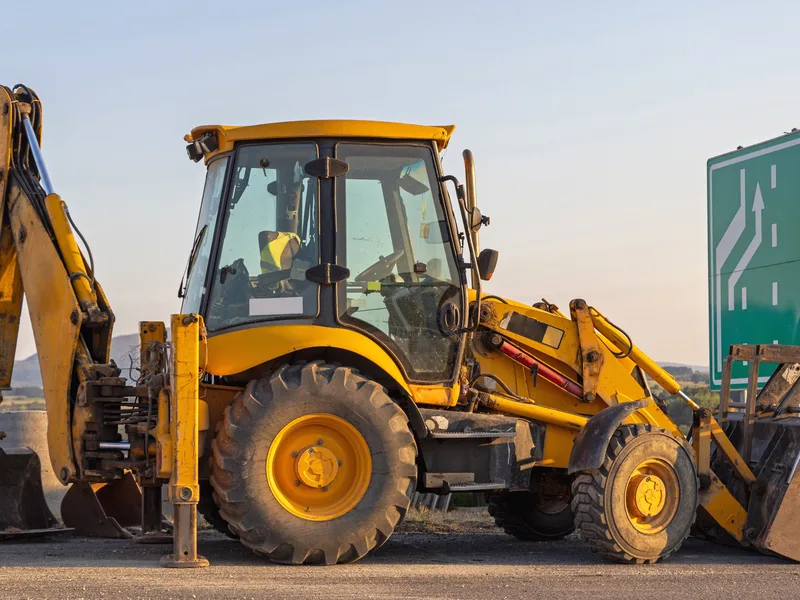
Repetition is the risk here. A machine that positions itself on new ground several times a week is running the most dangerous ninety seconds of its working life more often than a machine on one long job, and set-up is when pads go through sidewalks, booms find gutters and cornices, and tires meet curbing. The road legs between those jobs are short but numerous, which keeps collision exposure live without ever showing up as mileage. Geography narrows it further: a state divided by a bay funnels most east-west movement onto a handful of fixed crossings, so the same restricted routes carry the machine again and again, and a closure or a posted limit reroutes a whole week of work at once. Underneath all of it, the coast does its slow work on rams and pins, and the winter cycle finishes what the salt starts.
Common Rhode Island backhoe claims we see
- Stabilizer pad through a sidewalk, apron or service cover. The most common set-up loss on tight urban lots with old surfacing.
- Boom or counterweight contact during the first swing on a new set. The arc is judged before the operator has learned the site, and something is always close.
- Curb, apron and surface damage while repositioning. Individually minor, collectively the largest liability line on this class in this state.
- Collision on a short road move. Low mileage, ordinary traffic, and an exemption that decides nothing about fault.
- Corrosion-driven component failure argued as sudden loss. Salt air makes this line worth agreeing before a claim rather than during one.
Why Rhode Island backhoe owners choose Equipment Guard Insurance
Placing equipment on its own matches how registered Rhode Island outfits work. Registration is carried by certificates, and no owner wants to disturb the liability and workers compensation those certificates come from in order to get one machine valued correctly — so that is not what we propose. We rate the road exposure on trip count rather than distance, we ask about set-up frequency because it is where the losses are, we look at the crossing routes the machine actually uses rather than an average mile figure, and we place through markets — named on our homepage — prepared to read a single scheduled machine on its own record.
Major Rhode Island backhoe markets
- Providence. The state’s densest work, on old streets where the set-up and the swing arc are the whole exposure.
- Warwick. Commercial, airport-adjacent and roadway work that keeps the machine in the public right of way on most days.
- Cranston. Steady residential and municipal replacement work spread across many small tickets rather than a few large ones.
- Pawtucket. Older industrial fabric and utility renewal, where what is under the street rarely matches what is on the plan.
- East Providence. Waterfront and redevelopment ground, with soft fill and salt exposure in the same jobs.
- Woonsocket. Northern mill-town reconstruction on steeper grades, hard on the undercarriage and unforgiving on an uneven stabilizer set.
Related
- Backhoe insurance — the machine physics that hold in every state.
- Skid Steer insurance in Rhode Island — the smaller machine most Rhode Island crews own alongside this one.
- All equipment insurance in Rhode Island — the state hub.
- Equipment floater · Rented & leased equipment
Primary sources
- General Contractor Registration — Rhode Island Contractors’ Registration and Licensing Board (contractor licensing)
We do not link a Rhode Island vehicle-code section here. The road-use treatment described above follows how Rhode Island classifies self-propelled construction equipment; where the state publishes a section that states it directly, this page links it.
Rhode Island backhoe insurance FAQs
Does a backhoe need Rhode Island registration to travel a public road?
Not as an ordinary vehicle. Self-propelled construction machinery sits outside the standard registration scheme because its highway time is incidental to work it was built to do somewhere else. What that leaves untouched is responsibility. The machine is still in traffic, still capable of causing real damage, and the exemption has no view at all about who answers for it.
Who has to be registered here — just the general contractor?
Everyone building or repairing structures, which is unusual even by Northeast standards. Rhode Island runs mandatory statewide registration through its contractors’ board covering general contractors and subcontractors alike, and there is no competency examination in that path. The consequence for an equipment account is that what a general contractor or an owner can actually verify about a smaller outfit is its registration status and its certificates — so the insurance file carries more of the credibility than it would in a licensing state.
How does the size of the state change the exposure on this machine?
It makes road use constant instead of occasional. In a big state a backhoe is trailered because the next job is far away; here the next job is close enough that driving it is always the cheaper choice, so the machine touches a public road on most working days. Low mileage reads as low exposure on an application and is nothing of the kind — it is the same road risk, taken in small doses, very often.
What kind of claim does that pattern actually produce?
Set-up claims. More jobs per week means more times the machine is positioned, leveled and stabilized in a new spot, and that moment is where this class does its damage — a pad on a sidewalk or a service cover, a boom swung before the operator has read the arc, a tire against a curb while repositioning. None of it is dramatic and all of it is third-party property, which is why the liability side deserves as much attention as the machine itself.
Does the coastal weather here reach a backhoe?
It reaches everything with a cylinder rod. Salt air over a compact, largely coastal state accelerates corrosion on pins, rams and exposed steel, and the freeze-thaw cycle works on the same surfaces from the other direction through the winter. Neither is an insured peril by itself, but both shape the condition of the machine an adjuster inspects after a loss, and they shape which valuation basis is worth paying for.
Can you write the backhoe by itself?
Yes. Equipment Guard Insurance places equipment monoline in Rhode Island, so the machine can be scheduled at a sensible value without disturbing the liability and workers compensation certificates your registration file depends on.