
A skid steer earns its keep on a Rhode Island crew by fitting where nothing larger will — a mill-block infill parcel, a driveway between two triple-deckers, a bay door with inches either side. It grades, loads, breaks and lifts inside the footprint of a parking space, and that is why it books more days than anything else a small outfit owns.
What follows is about this state rather than about the machine: a registration regime that reaches subcontractors and not just the general contractor above them, a market compact enough to behave as one metro, and a road network that keeps both state lines within an easy drive of every jobsite. The material that belongs to the loader itself — how it steers, why it goes over the front, what a quick coupler does to a schedule — sits on the skid steer insurance pillar.
What skid steer insurance costs in Rhode Island
No premium is printed here, because a figure that means anything is assembled from one machine, one yard and one loss record. In Rhode Island the strongest levers are where the unit spends the night and how much of the schedule is attachments rather than loader: a machine locked behind a gate in a Cranston yard rates differently from the same machine standing on an open East Providence parcel for a three-week job. After that come the valuation basis you pick, whether a tracking unit is fitted, how often you rent iron in to fill a gap, and your own claim history. Two crews with identical loaders can end up a long way apart on every one of those.
Rhode Island skid steer regulations: title, lien and ownership
A skid steer is untitled construction equipment, not a DMV-titled motor vehicle; a security interest is perfected by filing a UCC-1 financing statement under Rhode Island’s UCC Article 9 with the Department of State (Secretary of State).
Which means the paperwork is the ownership. With no certificate to hand over, the serial plate and the bill of sale are what establish the loader is yours, and a financed unit puts the lender on the policy as loss payee against that specific scheduled machine, so any loss payment is issued to both names together. The two records have to stay aligned — a lender still named against a loader you paid off two seasons ago is the clearest sign a schedule has gone stale. Rhode Island then adds something one layer above the machine. Because the Contractors’ Registration and Licensing Board registers subcontractors as well as general contractors, the outfit that arrives with nothing but a loader and a rack of attachments holds a registration of its own, and the entity on that registration, the entity on the certificate of insurance and the entity on the equipment schedule all need to be the same one. In a market where the same handful of generals hire the same handful of site subs, a mismatch surfaces quickly.
Common skid steer risks in Rhode Island
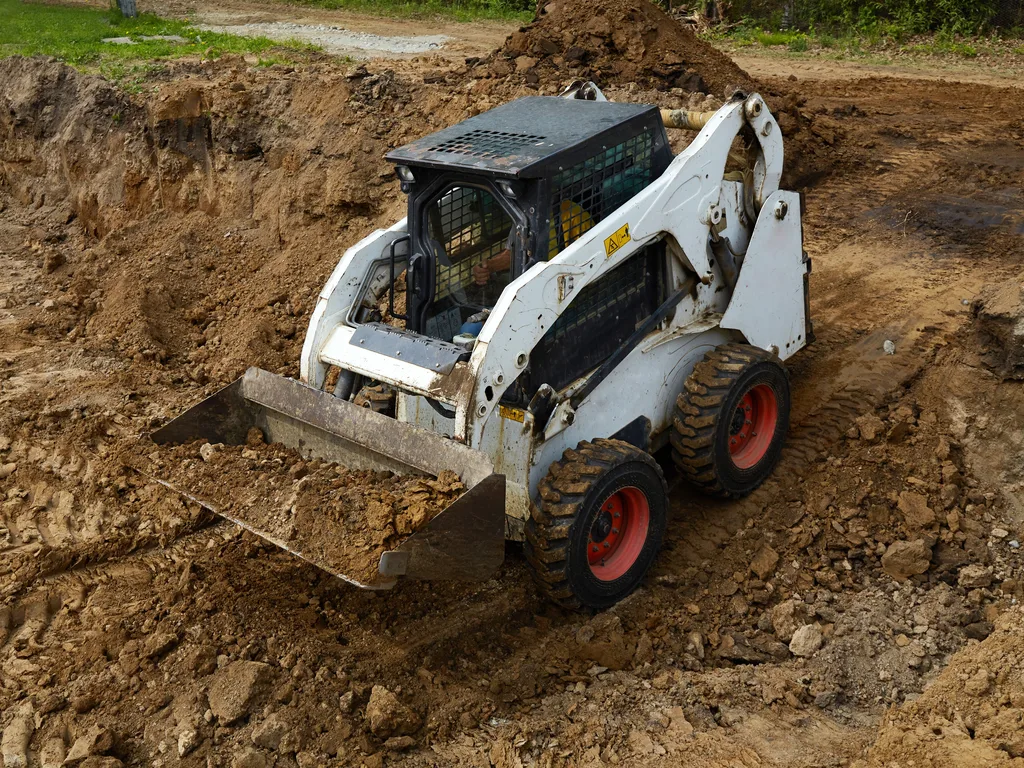
Theft sets the terms on this class, and Rhode Island compresses it. Every jobsite in the state sits minutes from a limited-access highway, and a compact loader on a trailer is unremarkable traffic well before a crew turns up to find an empty pad. Density does the rest: urban infill work keeps machines on site because there is nowhere better to put them, and staging along a public street is frequently the only option available. The second exposure here is environmental rather than meteorological — salt air off Narragansett Bay and winter road treatment reach pins, bushings, cylinder rods and electrical connections faster than an inland machine ever sees, and a loader that lives outdoors year-round in Warwick shows it in the service record. Beyond those two, going over the front with the arms up and damage during loading account for most of what is left, and neither of them has anything to do with this state.
Common Rhode Island skid steer claims we see
- Overnight loss from an urban infill site. The claim we see most often — no fence to cut, the trailer taken along with the loader, and a settlement resting on the serial record because no certificate of title ever existed.
- Attachment gone on its own. A breaker or grapple lifted off a rack while the machine stands untouched, then found to be riding a blanket limit with a per-item cap well below what the head cost.
- Corrosion and connector failure on a machine kept outdoors. Salt-laden air and winter road treatment reaching wiring, pins, bushings and rods on a unit that never sleeps indoors.
- Registration and certificate mismatch stopping a crew at the gate. Not an insured loss, but the local paperwork failure we see most: the registered entity and the insured entity turn out not to be the same name.
- Going over the front while placing a load at height. Almost always on ground that looked flatter than it was, on a machine that carries its weight out ahead of the wheels.
Why Rhode Island skid steer owners choose Equipment Guard Insurance
Equipment monoline is the whole of what we do, and in a market this small it removes a real obstacle. A Rhode Island site sub usually holds a general liability policy arranged through a relationship it has no intention of disturbing, and being told to move the entire program to get one loader scheduled properly ends the conversation on the spot. We do not ask for that. Attachments go onto the schedule by name, because on this machine the value quietly accumulates in front of the coupler, and we place through markets — named on our homepage — that will underwrite an equipment schedule as a risk in its own right rather than as a line hanging off somebody else’s package.
Major Rhode Island skid steer markets
- Providence. The core jobsite market: mill-block redevelopment, hospital and university work, and parcels tight enough that a compact loader is the only practical machine — with the densest overnight exposure in the state on top.
- Warwick. Airport-adjacent commercial work and coastal residential jobs, where units stand outside all year within easy reach of salt air.
- Cranston. Yard-and-shop country for much of the state’s site trade, so this is where secured overnight storage genuinely exists and where the rating credit for it gets earned.
- Pawtucket. Older industrial parcels and rehab work on constrained frontage, where staging happens in the street and finished-surface damage drives the claims that are not thefts.
- East Providence. Waterfront and highway-adjacent redevelopment with immediate interstate access — convenient for hauling a machine to work, and equally convenient for anyone hauling it away.
- Woonsocket and the Blackstone valley. The northern end of the market, close enough to the Massachusetts line that an ordinary week means working in two states.
Related
- Skid steer insurance — the machine physics that hold in every state.
- Excavator insurance in Rhode Island — where the dig-notice clock, not the theft ledger, sets the rules.
- All equipment insurance in Rhode Island — the state hub.
- Equipment floater · Rented & leased equipment
Primary sources
- General Contractor Registration — Rhode Island Contractors’ Registration and Licensing Board (contractor licensing)
We do not link a Rhode Island filing document here. The ownership and lien rules described above follow Article 9 as Rhode Island has adopted it; where a state publishes a document that states the rule directly, this page links it.
Rhode Island skid steer insurance FAQs
Is a skid steer titled or registered in Rhode Island?
No. It is untitled construction equipment rather than a DMV vehicle, so nothing is transferred at a registry counter when it changes hands and there is no certificate to produce after a loss. The serial plate, the bill of sale and the financing record carry that weight instead, which is why a schedule listing a loader by description with no serial number is the weakest page in a claim file.
Does Rhode Island contractor registration reach a crew that only runs a loader?
Generally yes. Registration with the Contractors’ Registration and Licensing Board is required of subcontractors as well as general contractors doing work on structures, which is unusual in this part of the country and means a small site outfit is a registered entity rather than an extension of whoever hired it. That puts three names in one place where they can be compared — the registered entity, the insured entity and the entity named on the equipment schedule — so it is worth making sure they agree before a general contractor compares them for you.
Does the policy follow my loader when I work into Massachusetts or Connecticut?
On a properly written equipment floater it does. The form attaches to the machine rather than to a fixed address, and in a state this narrow a job across the line is routine rather than exceptional. What changes at the border is the paperwork, not the coverage: registration and licensing obligations belong to the state where the work is. Tell us the normal working radius when the policy is set up, because a loader that leaves the state most weeks should be underwritten as one that does.
How are loaders I rent in for a week handled?
Separately from the ones you own. Rental houses around Providence will want a certificate naming them and will hold you to the terms of the rental agreement, which usually makes you responsible for the machine on a broader basis than your own units are. Rented and leased equipment coverage sits alongside the owned schedule for exactly that reason, and the limit has to be sized for the largest machine you might plausibly rent rather than the one parked in the yard today.
Are buckets and attachments included automatically?
Only up to a point. Most schedules carry a blanket attachment limit with a per-item cap, and the heads that cost real money — breakers, mulchers, augers, grapples — sit above the cap. They also go missing independently of the loader, off a rack or a trailer, while the machine itself is never touched. Anything valuable belongs on the schedule under its own line, with its own serial number.
Can I insure the loader on its own without moving my other policies?
Yes. Equipment Guard Insurance writes equipment monoline, so a loader and its attachments can stand on a schedule of their own. A general liability policy you are happy with stays exactly where it is.