
On most South Dakota crews the backhoe is not one machine among several — it is the machine. It digs the service, sets the culvert, loads the truck and lifts what needs lifting, and then it takes itself to the next address rather than waiting for transport that may be an hour away.
This page is about what that means here: a state that registers contractors for tax rather than credentialing them for skill, a road-use rule recorded in two places and linked in neither, and country wide enough that a breakdown is measured in days. The parts of the machine that behave identically in every state — boom reach, stabilizer geometry, the loader end — belong to the backhoe insurance pillar.
What backhoe insurance costs in South Dakota
We do not quote from a page, and a number here would be a guess dressed as an answer. What moves a South Dakota backhoe premium is the shape of your year: how many miles the machine covers between jobs and how many of those are under its own power, how far the furthest job sits from support, whether it winters inside or on open ground, the age and attachment list, the valuation basis and your loss record. A machine working municipal contracts inside one city and one running section-line jobs across three counties are different propositions, and the price should say so.
South Dakota backhoe regulations: road operation
Self-propelled construction equipment is ‘special mobile equipment’ (not designed or used primarily to transport persons or property and only incidentally moved over a highway) and is not subject to the vehicle title and registration provisions of SDCL chapters 32-3 and 32-5.
Two observations sit on top of that. The first is about the record rather than the rule: this build holds the definition at ARSD 64:28:01 and the registration exemption in the codified laws at chapter 32-5, and it links neither — a citation on this site is a claim that we opened the document, and these were not opened. The second is about what the exemption does not touch. Keeping the machine outside the title and registration provisions settles a paperwork question; it settles nothing about who answers when a backhoe meets a pickup, a mailbox or a fence at a section-line intersection, and that is the part that costs money. Then there is the credential layer, which in South Dakota is unusually thin. There is no statewide competency credential for general contractors at all. A construction business opens a contractor’s excise-tax account with the Department of Revenue — a revenue registration, not an examination — and only the specialty trades answer to licensing boards. The consequence is practical: the strongest verifiable statement most crews here can make about themselves is their insurance file.
Common backhoe risks in South Dakota
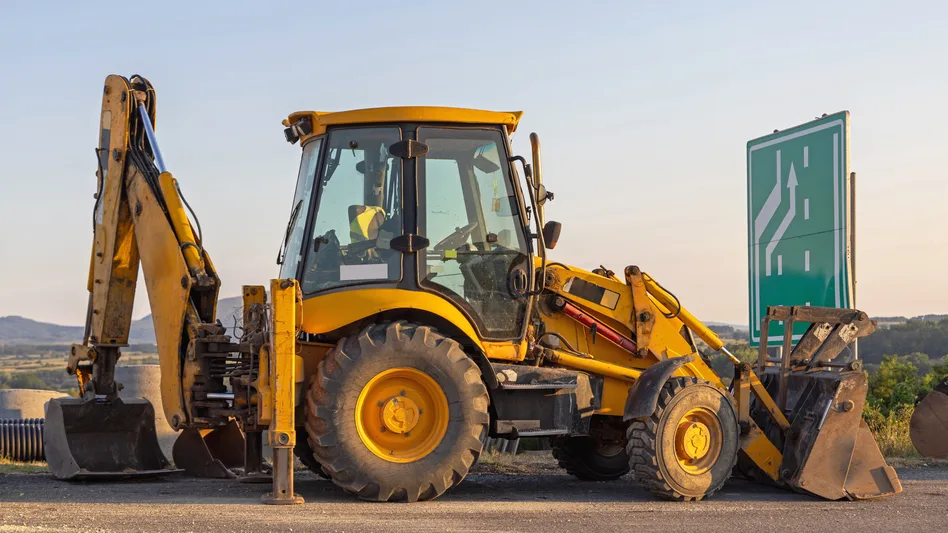
The dominant South Dakota risk is time-to-help rather than frequency of event. Jobs sit a long way from the two population centers and further still from parts, so the cost of a loss here is dominated by what happens after it — a stalled crew, a rented substitute brought a long way, a recovery vehicle billed for the distance. On top of that, the state’s two markets sit at opposite ends of it with the Missouri between, so any crew working both is running real trailer mileage. Wind and open ground do the rest: dust into seals and bearings, loading that is genuinely harder on an exposed site, and a machine that stands unwatched between visits.
Common South Dakota backhoe claims we see
- Collision at a rural intersection during a self-propelled move. Sight lines and closing speeds on open highway are unforgiving of a slow machine.
- Tie-down or load-shift damage on an east-to-west haul. The single most concentrated transit loss for any crew working both ends of the state.
- Stabilizer subsidence in loose or expansive soil. Ground that carried the machine in August does not necessarily carry it in May.
- Boom or bucket contact behind the operator. Swing radius against a structure, a fence line or a parked vehicle on a constrained yard.
- Loss discovered days late on a remote job. The delay, not the event, is what turns it into an expensive claim.
Why South Dakota backhoe owners choose Equipment Guard Insurance
Equipment-only placement earns its keep in a state with no competency credential behind it. If the public record of your business is a tax account, the documents that describe your capacity are the ones you buy from an insurance market — and they should be built deliberately rather than bolted onto whatever package renewed last spring. We ask how far the machine travels and how far it is from help before we price the road exposure, we treat the trailer as part of the risk rather than an afterthought, and we place through markets — named on our homepage — that will underwrite a single South Dakota machine on its own facts.
Major South Dakota backhoe markets
- Sioux Falls. The largest construction market in the state and the base for most crews whose jobs are nowhere near it.
- Rapid City. The western center, separated from the eastern market by the width of the state — the other end of every long haul a crew makes.
- Aberdeen. Agricultural and municipal site work across a wide catchment, with long approaches and thin local support.
- Brookings. Institutional and residential build-out at a steadier pace than the rural counties around it.
- Watertown. Industrial and utility work in the northeast, where the machine spends much of its week in the public right of way.
- Mitchell and Yankton. River-corridor and highway work, with ground conditions that change sharply between the terrace and the bottom.
Related
- Backhoe insurance — the machine physics that hold in every state.
- Skid Steer insurance in South Dakota — the machine a South Dakota yard is likeliest to lose overnight rather than in traffic.
- All equipment insurance in South Dakota — the state hub.
- Equipment floater · Rented & leased equipment
Primary sources
We do not link a South Dakota vehicle-code section here. The road-use treatment described above follows how South Dakota classifies self-propelled construction equipment; where the state publishes a section that states it directly, this page links it.
South Dakota backhoe insurance FAQs
Does South Dakota issue a general-contractor competency credential?
It does not. There is no statewide body that examines general contractors here. What a construction business takes out is a contractor’s excise-tax account with the Department of Revenue, which is a revenue registration and says nothing about skill, experience or capacity. Only the specialty trades — electrical and plumbing among them — are separately licensed by their own boards.
So what does a project owner actually verify about a crew?
Whatever the crew can document. With no competency credential to point at, the verifiable record is a tax account number, references, and the insurance certificates behind them — which means the equipment schedule is doing public-facing work whether or not the owner thinks of it that way. A schedule that is vague about serial numbers and attachments is a weaker document than it needs to be.
Is a backhoe registered as a highway vehicle in South Dakota?
No. Self-propelled construction machinery whose highway use is incidental sits outside the title and registration provisions that govern ordinary vehicles. The record here is slightly unusual in its shape: the definition is carried in an administrative rule while the registration exemption sits in the codified laws. We name both without linking either, because neither document has been fetched and read to the standard our citations require.
Which sections are those, and why is nothing linked?
This state’s datum records the definition at ARSD 64:28:01 and the registration exemption in the codified laws at chapter 32-5. Naming them is a statement about our record; linking them would be a statement about a document we had opened, and we have not opened these. Where the state later publishes a version that survives a probe, this page grows the citation without changing a word of the prose.
What does working in open country do to this machine?
It stretches every recovery. A backhoe on a job in the western half of the state is a long way from a dealer, a mechanic and a replacement, so a failure that would cost a day near Sioux Falls can cost a week. Wind is the other under-appreciated factor: open ground with sustained wind makes loading and covering a trailer harder, moves dust into everything with a seal on it, and is unkind to anything raised.
Can the backhoe be scheduled on its own?
Yes. Equipment Guard Insurance writes equipment monoline in South Dakota, so the machine can be placed without moving the liability or workers compensation already in force. In a state whose contractor paperwork is a tax file rather than a credential, keeping the equipment schedule clean and separately underwritten is worth more than it looks.