
A compact loader is the machine that lets a two-person South Dakota outfit take on work that would otherwise need a subcontractor: pads, driveways, footings, feedlot cleanup, snow, and everything that needs lifting or moving on a site where nothing else fits. In a state with this much ground and this few people, the loader is also frequently the most valuable thing standing anywhere nearby.
What follows is specific to South Dakota: a state that registers contractors for tax rather than licensing them for competence, two economies split by a river, and distances that change how a theft is discovered rather than only how it is investigated. The physics do not change at a county line: attachment mechanics, skid steering and the forward tip are all on the skid steer insurance pillar.
What skid steer insurance costs in South Dakota
Nothing here is a price, because a real one is put together from the machine, the attachments and the miles it covers. In South Dakota the levers that move it most are travel, storage and season: a loader working close to a gated yard prices differently from one living on a ranch or highway job hours out, and a machine wintered inside prices differently from one wintered in the open wind. After that come the number and value of attachments, the valuation basis you choose, whether a tracking unit is fitted, and your own loss history. Because the ground closes for months, the same annual hours land in a shorter stretch of calendar.
South Dakota skid steer regulations: title, lien and ownership
A skid steer is untitled construction equipment; a security interest is perfected by filing a UCC-1 financing statement with the South Dakota Secretary of State.
The consequence is procedural, and in this state it carries more weight than usual. Since no title exists, the financing statement and the serial number are the ownership record; a lender on a financed loader is named on the policy as a loss payee against the scheduled unit, so a loss payment is issued jointly and the filing and the schedule have to describe the same machine. What South Dakota does not add is any competency gate above that: with no statewide general-contractor license and only a Department of Revenue excise tax registration standing between a business and a jobsite, the paperwork a general contractor or a rental house reads is your certificate of insurance and the equipment schedule behind it. Elsewhere those documents are a formality. Here they are the whole of what anyone outside your own crew knows about you.
Common skid steer risks in South Dakota
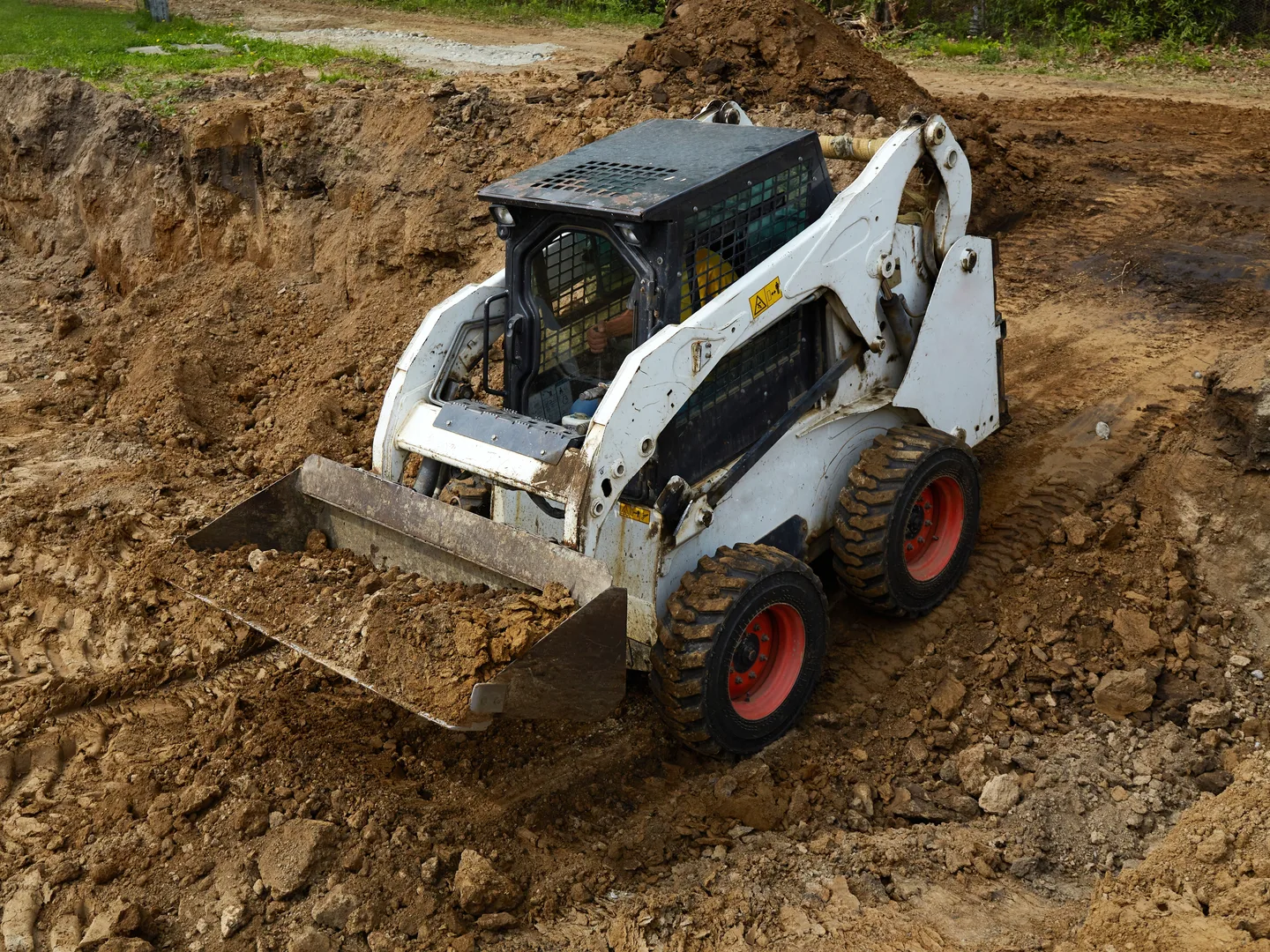
Theft leads the class, and here the defining variable is how long it takes to notice. Compact loaders are stolen far more often than large tracked machines, sites go unvisited for days, and an interstate crosses the full width of the state with several borders inside a day’s haul. Winter is second and the wind is the part people underestimate: drifting buries machines, grit gets driven into cylinders and pivot points, and glass and doors take damage on units left facing open country. Ground conditions supply the third — soft spring ground, frost heave and uneven pads produce sinking, rutting and the forward tip. Loading damage rounds it out, and on these distances a loader spends more time on a trailer than most.
Common South Dakota skid steer claims we see
- Theft discovered days late at an unattended site. The characteristic South Dakota claim: the serial number and the bill of sale are the whole case, because there is no title behind them.
- Wind-driven grit and drifting damage. Cylinder, pivot and seal wear plus door and glass damage on a machine left facing open country through a winter.
- Damage in transit between distant jobs. Tie-down, ramp and loading damage on a machine that travels far more highway miles than a metro loader does.
- Attachment taken from an unfenced yard. A grapple, breaker or blower found to sit under a blanket per-item sublimit rather than scheduled by name.
- Forward tip on soft or frost-heaved ground. A machine carrying its load out in front of the axles, on ground that behaved differently an hour earlier.
Why South Dakota skid steer owners choose Equipment Guard Insurance
We write equipment monoline, which suits a state where nobody is going to check your credentials but everybody is going to check your certificate. A crew here often has liability arranged years ago and no reason to move it; we schedule the iron alongside it, by serial number, with attachments named rather than lumped. We also put the travel picture on paper honestly, because pretending a machine works close to home when it does not helps nobody at claim time. We place through markets named on our homepage that will read the schedule on its merits.
Major South Dakota skid steer markets
- Sioux Falls. The deepest jobsite and rental market here, with commercial and residential build-out, secured yard storage genuinely available, and the shortest distances anywhere in the state.
- Rapid City. The western hub: tourism, highway and ranch-adjacent work, thinner rental depth so machines are owned, and the longest single hauls.
- Aberdeen. Agricultural and municipal ground work in the northeast, where feedlot and drainage jobs put hard hours on a loader in a short window.
- Brookings. University and institutional work on constrained lots, where finished-surface damage and confined loading drive the non-theft claims.
- Watertown. Industrial and distribution ground work with a genuine out-of-state pull, so a loaded trailer reaches another jurisdiction quickly.
- Mitchell and Yankton. Smaller markets covering wide rural territory, where machines sit alone between visits for days at a time.
Related
- Skid steer insurance — the machine physics that hold in every state.
- Backhoe insurance in South Dakota — the machine that arrives over the road, which matters when jobs are this far apart.
- All equipment insurance in South Dakota — the state hub.
- Equipment floater · Rented & leased equipment
Primary sources
We do not link a South Dakota filing document here. The ownership and lien rules described above follow Article 9 as South Dakota has adopted it; where a state publishes a document that states the rule directly, this page links it.
South Dakota skid steer insurance FAQs
Does South Dakota license contractors before they can run equipment?
Not on competence. There is no statewide general-contractor licensing board here, and the only registration a contracting business generally needs statewide is a contractor’s excise tax license from the Department of Revenue — which is a tax account, not an examination of ability. Only specialty trades such as electrical and plumbing are separately licensed. The practical effect is that nobody has vetted the crew ahead of you or behind you on a site, and the document a general contractor or a rental house actually leans on to judge an outfit is its certificate of insurance.
Is a skid steer titled or registered in South Dakota?
No. It is untitled construction equipment, so there is nothing to surrender at a county treasurer’s office when it sells and nothing to produce after a theft. Identification runs through the serial number, the bill of sale and the central financing record instead. Since no state agency has certified anything about the operator either, that schedule is the most authoritative description of your equipment anywhere.
Why does the east-river and west-river split matter to an equipment policy?
Because it produces two different accounts wearing one state name. East of the Missouri River the work is agricultural, municipal and residential around Sioux Falls and the eastern towns, machines are worked hard and often return to a yard, and rental depth is reasonable. West of the river the work is tourism, ranch, forestry-adjacent and highway construction around Rapid City and the Black Hills, distances are long, rental depth is thinner so machines are owned rather than hired, and a loader may be a hundred road miles from its owner for a week. Storage answers, travel exposure and how quickly a theft is even noticed all differ across that line.
What does the theft picture look like in a state this empty?
Slow to be discovered and hard to reverse. Compact loaders are the machines that get taken because one person and a trailer are enough, and an interstate crosses the entire width of the state with several state lines within reach. Sites are frequently unfenced and unstaffed for days, so the gap between a machine going missing and anybody looking for it is longer here than in a metro state — which is the strongest argument there is for fitting a tracking unit.
How hard is a South Dakota winter on this machine?
Hard in a way that is more about wind and ground than about temperature alone. Sustained cold takes batteries, hoses and seals, and cold hydraulic oil worked before it is warm damages pumps quietly. Open-country wind then adds what a sheltered state does not: drifting that buries a parked machine, grit driven into cylinders and pivots, and door and glass damage on units left facing the weather. Frost depth also closes the ground for months, putting more hours on the loader in the months that are left.
Can I insure the loader on its own, without a package?
Yes. Equipment Guard Insurance writes equipment monoline in South Dakota, so the loader and its attachments go on a schedule of their own. In a state where the certificate of insurance does the work a license would do elsewhere, having the equipment described precisely on that certificate is worth more than bundling it into something broader.