

Very little Massachusetts earthmoving happens on empty ground. The blade is usually reworking a site that has been used before, between abutters who are close by, on till that was left here by ice and packed with whatever the glacier was carrying at the time.
The regulatory picture is unusual enough to be worth stating carefully rather than assuming. This is one of only three states we serve where no state construction stormwater permit exists — the discharge permit is federal — while the approvals that decide whether ground may be disturbed remain firmly in state and municipal hands. For the machine itself, its blade and ripper loads and its transport economics, the dozer insurance pillar holds everywhere.
What dozer insurance costs in Massachusetts
We will not publish a figure, because on this class a figure without a site is decoration. The Massachusetts inputs that actually matter are what the machine is and how many hours are on it, the kind of ground you accept — boulder till and old fill are not the same risk as clean cut-and-fill — how much area you open at once and how close the nearest abutter, inlet or wetland edge sits, how the iron moves between jobs on constrained roads, whether the working year is continuous or seasonal, and the record behind you. A redevelopment crew and a highway-grading crew on identical machines are different accounts.
Massachusetts dozer regulations: stormwater and land disturbance
Massachusetts is a non-delegated state for the national discharge program. There is no state construction general permit: coverage over a land disturbance of one acre or more is obtained under the federal construction general permit, issued by the federal environmental agency’s regional office rather than by any office in Boston.
Both halves of that need saying, because the sentence is read wrongly in both directions. Non-delegated does not mean unregulated — the federal permit is a real obligation with real conditions, and the only thing the absence of delegation changes is who you correspond with. And it certainly does not mean the state stands aside. Massachusetts runs its own wetlands protection program, administered town by town through local conservation commissions, and on a great many sites here that approval, not the federal one, is what determines when a machine may first cut. So a contractor opening an acre in this state is answerable to two different governments about the same ground, for two different reasons: one asks what leaves the site in water, the other asks whether the terrain may be altered at all. Insurance sits in the same place under either. A penalty from either regime is a regulatory matter, not property damage. Material that leaves the site and reaches an abutter, a public way or a wetland is third-party damage arising from your work, and it is answered by liability and pollution wording — never by the floater that repairs the dozer.
Common dozer risks in Massachusetts
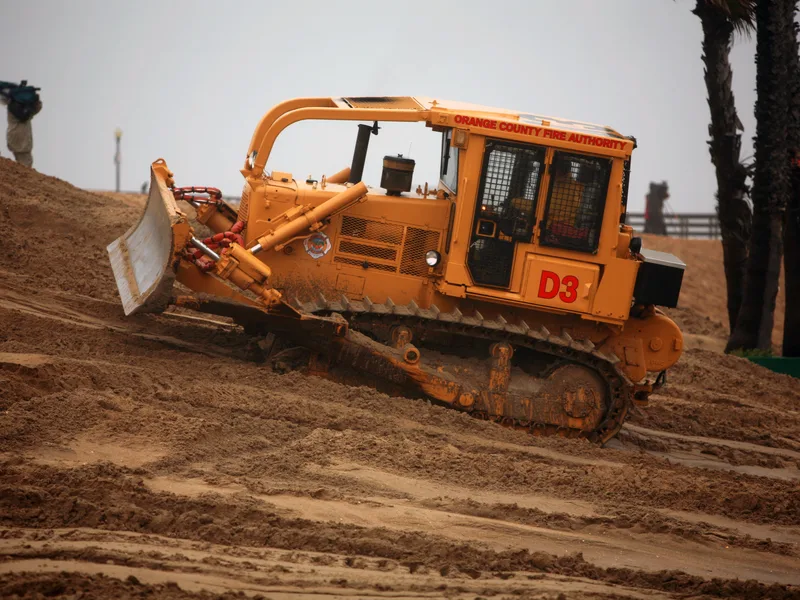
The machine’s own loss picture here is shaped by congestion and by what is buried. Boulder till and undocumented fill mean the blade meets obstructions it did not expect, which concentrates load on the undercarriage, the push-arms and the final drives. Sites are tight, so swing room, spotting and the proximity of standing structures matter more than they would on open ground. Transport is genuinely difficult — moving a tracked machine of this weight through dense street networks and across posted bridges takes planning that rural work does not require. And around all of it sits the land-disturbance exposure, which is generated by doing the job correctly and grows sharper the closer the boundary line is.
Common Massachusetts dozer claims we see
- Material carried off an open site toward an abutter or a drain. The defining third-party exposure in a state where nothing is far from something else.
- Sudden undercarriage or final-drive damage from buried obstructions. Old foundations and rubble in fill, distinct from the wear no policy pays for.
- Contact damage on a constrained urban site. Structures, parked vehicles and site services within reach of a machine that needs room.
- Transport and low-clearance incidents. Getting the iron in and out is frequently the riskiest hour of the job in eastern Massachusetts.
- Loss on a machine standing through a closed season. A winter pause leaves iron parked where the work stopped, often not where it is watched.
Why Massachusetts dozer owners choose Equipment Guard Insurance
The reason to place this machine deliberately, rather than accept whatever a package handed you, is that its exposures answer to different policies and — in this state — to different governments. We write the equipment monoline, so the dozer can be scheduled properly without reopening arrangements built around Massachusetts work. We are explicit about which obligation is federal, which is the state’s and which is decided in the town where the site sits. And we place through markets — named on our homepage — that will read a dense-site earthmoving account on its own merits.
Major Massachusetts dozer markets
- Boston. Redevelopment on ground that has already been built on more than once, with abutters, utilities and drainage inlets within a few strides of every open pad.
- Worcester. Central-hills industrial and distribution sites where real cut-and-fill volume is still available and the till is unforgiving.
- Springfield. River-valley commercial and public work on softer alluvial ground, where the water table is close and the flood story is old news locally.
- Lowell and the Merrimack corridor. Mill-city redevelopment, with buried industrial-era material a routine expectation rather than a surprise.
- Brockton and the south shore. Steady residential and municipal site work on wet, low-relief ground where wetland edges are close to almost everything.
- New Bedford and the south coast. Port, marine-industrial and energy-support earthwork, with coastal drainage and storm exposure on freshly opened ground.
Related
- Dozer insurance — the machine physics that hold in every state.
- Skid steer loader insurance in Massachusetts — the machine that finishes what the blade opened, on sites too tight for either to be comfortable.
- All equipment insurance in Massachusetts — the state hub.
- Equipment floater · Rented & leased equipment
Primary sources
- 2022 Construction General Permit (CGP) | US EPA — U.S. EPA (Region 1) — Massachusetts is a non-delegated NPDES state (stormwater and land disturbance)
- Construction Supervisor Licensing | Mass.gov — Massachusetts Board of Building Regulations and Standards / Office of Public Safety and Inspections (CSL); Office of Consumer Affairs and Business Regulation (HIC) (contractor licensing)
Massachusetts dozer insurance FAQs
Who issues the construction stormwater permit for a Massachusetts site?
The federal environmental agency issues it directly. Massachusetts never took delegation of the national discharge permit program, so there is no state construction general permit to apply for and no state office administering one. Coverage over a disturbed acre is obtained under the federal construction general permit, through a federal regional office.
So Massachusetts has no say over when we open ground?
It has a great deal of say, and treating the federal permit as the whole picture is the mistake this arrangement invites. The state runs its own wetlands protection program, and it is administered locally, commission by commission, in the town where the site sits. On a large share of Massachusetts work that local approval is the gate that actually determines whether and when a blade may start. What is federal is the discharge permit. What is not federal, at all, is the permission to disturb the terrain.
What does the local layer mean for scheduling a job?
It means the approval calendar is set in a town hall rather than in one statewide queue, so a contractor working several municipalities is working several timetables at once. Hearing schedules, site-visit practice and the conditions attached to an approval are genuinely local, and a firm that operates across a dozen towns learns each of them separately. That is a project-management fact rather than an insurance one, but it shapes how long a machine sits between jobs — which is very much an insurance fact.
What does Massachusetts ground itself do to a dozer?
It hides things. Glacial till packed with boulders is the honest condition across much of the state, so the blade is prying as often as pushing, and on redevelopment sites the material above it is frequently old fill nobody documented. The machine meets buried obstructions, former foundations and unrecorded rubble, which is hard on an undercarriage and occasionally hard on a schedule.
A storm moved material off our site onto an abutter. Which policy is that?
Not the equipment floater, which repairs the machine and nothing beyond it. Material that leaves a disturbed site and reaches an abutting property, a public way or a wetland is third-party damage arising out of your work, and it is answered in liability and pollution wording. It is worth stressing in this state because sites tend to be close to somebody: the distance from an open pad to a boundary line or a drainage inlet is usually short.
Can you place the dozer without touching the rest of our insurance?
Yes. Equipment Guard Insurance writes equipment monoline in Massachusetts, so the machine can sit on its own schedule. Given that the obligations over a single acre here are split between a federal permit and a local approval, we would rather walk that split with you than have it discovered after the site is open.