

A dozer operator learns to read where water will go. Across a great deal of Missouri that reading is incomplete, because the water goes down. This is limestone country: sinkholes take surface flow directly into the bedrock, streams lose their water partway along their own beds, and what left one property can emerge at a spring belonging to another.
That single fact reorganizes the risk on this machine. Everything a crew normally relies on to notice a problem — a visible plume, a muddy ditch, a neighbor at the fence line — can simply not be present, while the discharge is real and continuing. Below is who runs the permit here, what it reaches, and where the commercial exposure sits. The machine itself is covered in the dozer insurance pillar, which holds wherever you work.
What dozer insurance costs in Missouri
There is no premium on this page. A Missouri dozer number reflects the machine’s age, hours and undercarriage condition, but far more of it reflects the work: how much ground you have open at once, whether your sites sit on karst or on floodplain alluvium, how much of your year is metro subdivision work against rural rock excavation, how far the iron travels between jobs, and your own record. It is worth naming the imbalance on this class outright, because it is unusual: the machine is normally the least expensive thing in a bad file, and the ground it moved is the most.
Missouri dozer regulations: stormwater and land disturbance
Missouri administers the construction stormwater program itself rather than leaving it to the federal agency. The authority is Missouri Department of Natural Resources (Missouri DNR), which issues a construction and land-disturbance stormwater general permit, and the obligation attaches at a land disturbance of one acre or more. We state the rule that way, in words, and deliberately print no permit code: our record for the Missouri identifier is graded general rather than verified, and a page should not assert a designation at a confidence its own data does not carry.
The consequence paragraph writes itself here, because the geology supplies it. On karst the receiving water is frequently invisible. Sediment-laden runoff that finds a sinkhole or a losing reach enters the groundwater system with none of the filtering that a long surface path would give it, and it can surface again at a spring, a private well or a stream some way off. Three things follow. First, the ordinary early-warning signs a crew watches for may never appear, so control failures run longer before anyone acts. Second, the affected party can be someone with no connection to the project and no idea it exists — which is a difficult conversation and a serious one. Third, the commercial boundary stands exactly where it always does: a state penalty for inadequate controls is a regulatory matter your company carries alone, uninsurable by design, while contamination or sediment damage to water, land or a supply belonging to somebody else is third-party damage arising out of your work. That is liability and pollution territory, not floater territory, and on karst it is the exposure with the longest tail attached to it.
Common dozer risks in Missouri
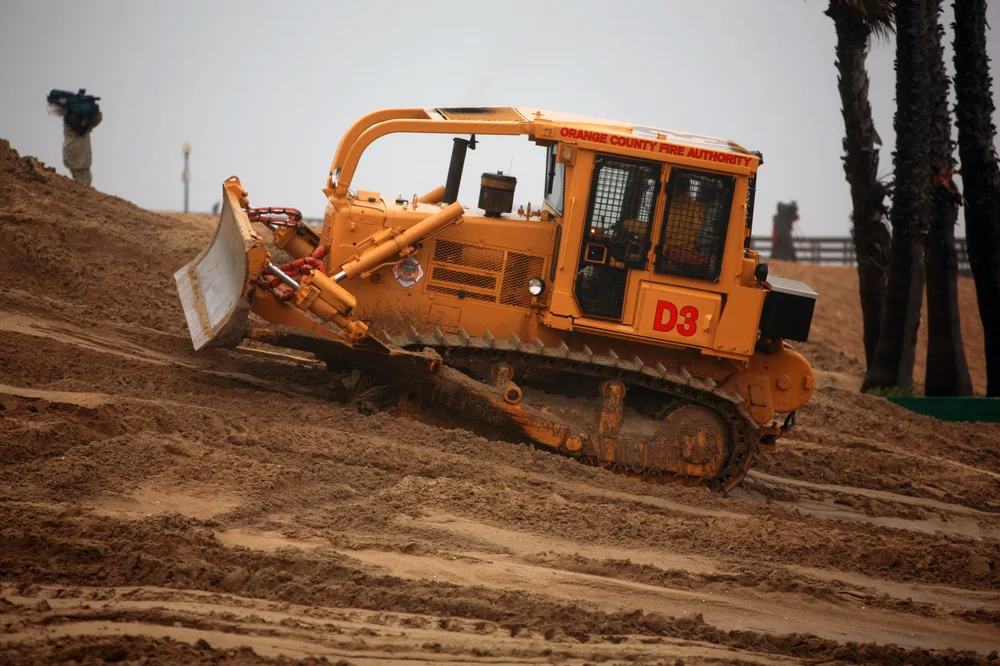
Missouri gives a dozer three quite different jobs depending on where it is standing. Ozark work means chert and shallow limestone, which is abrasive, unforgiving on undercarriage and blade edges, and prone to producing voids nobody expected under a machine that weighs what this one does. River-bottom work means deep alluvium, a high water table and soft ground that swallows tracks. Metro work means subdivision and commercial pads with abutters, inspectors and traffic. Layered across all three is the state’s weather, which delivers intense convective rainfall onto whatever was open that week. The machine’s own claim pattern is conventional enough — overturn, fire, transport damage, undercarriage wear misread as sudden loss — but the acreage exposure is not conventional at all, because in this state it can happen out of sight.
Common Missouri dozer claims we see
- Sediment entering a sinkhole or losing stream. No plume, no ditch, no obvious moment — and a third-party consequence that can surface well off the site.
- Ground failing under the machine over a void. Limestone country produces cavities that give no surface warning until weight arrives.
- Undercarriage and edge wear in Ozark chert. Abrasive rock accelerates wear, and wear is a maintenance cost rather than a peril.
- Tracks bogged in river-bottom alluvium. Recovery damage frequently exceeds whatever the original stall would have cost.
- Runoff onto a public road during a heavy convective storm. Third-party and highly visible, which makes it the fastest of these to become a demand letter.
Why Missouri dozer owners choose Equipment Guard Insurance
We would rather place this machine deliberately than see it inherited. A dozer is cheap to insure and expensive to have owned when a season goes wrong, and the reason is never the iron. Writing equipment as a standalone line lets us schedule the machine accurately for your Missouri work without reopening anything else, and it lets us be explicit about the two boundaries this state draws: between the state water program and the city that licenses you, and between a regulatory penalty and an insurable loss. Where our data will not support a detail, we say so on the page rather than filling the gap. The markets we use are listed on our homepage, and they underwrite dirt work as something other than a subset of general contracting.
Major Missouri dozer markets
- St. Louis. Redevelopment and industrial site work on the eastern side of the state, much of it over old ground with its own drainage history.
- Kansas City. Large-scale logistics and pad development, with municipal licensing rules of its own laid over the state program.
- Springfield. The heart of the karst country, where sinkhole mapping is a routine part of a site investigation rather than an exotic one.
- Columbia. Institutional and residential growth on rolling ground between the two metros, with a steady rather than seasonal workload.
- Independence. Established suburban redevelopment where sites are tight and neighbors are close to every open face.
- St. Joseph. Loess-bluff country in the northwest, where near-vertical silt banks stand up beautifully until water gets into them.
Related
- Dozer insurance — the machine physics that hold in every state.
- Backhoe insurance in Missouri — the machine whose state road-use classification is spelled out by statute here rather than left to practice.
- All equipment insurance in Missouri — the state hub.
- Equipment floater · Rented & leased equipment
Primary sources
- Electronic Permitting (ePermitting) | Missouri Department of Natural Resources — Missouri Department of Natural Resources (Missouri DNR) (stormwater and land disturbance)
Missouri dozer insurance FAQs
What does karst geology change about a dozer job?
It removes the outfall. In limestone country the surface drainage you can see is only part of the system: water disappears into sinkholes, losing streams give up their flow to the bedrock, and the same water reappears at a spring that may be a considerable distance away and belong to someone else entirely. A disturbed site can therefore discharge without producing the muddy plume that would normally tell a crew something is wrong, and the first evidence can arrive from a landowner who is nowhere near the job.
Who administers the construction stormwater program in Missouri?
The state natural resources department runs the program itself under the delegated national framework, rather than the federal agency running it here. Coverage under its construction and land-disturbance general permit attaches once a project crosses the disturbance threshold, and the notices, inspections and enforcement all sit with the state. What that means practically is that the people asking about your controls are in the same state government as the people you deal with on other environmental questions.
Why does this page not print the permit number?
Because our record for the Missouri permit identifier is graded as general rather than verified, and we hold to a simple rule: a page states a code only at the confidence its own data carries. The authority and the disturbance threshold are supportable and appear above. The identifier is not printed here, and no linked document is offered for it either. If you need the exact permit designation for a bid or a submittal, take it from the state agency directly rather than from any broker’s page, including ours.
Do I answer to anyone besides the state on a Missouri job?
Almost always. Missouri has no statewide general-contractor license, so competency licensing is handled municipally and the requirements change as you cross a city or county line. On a single project that can mean one set of obligations from the state on the water side and a different set from the local jurisdiction on the licensing and permitting side, with no particular reason for the two to line up. Contractors who work across several metros here carry that patchwork as a standing administrative cost.
Is an enforcement action against my company an insurance claim?
It is not, and karst makes the distinction unusually stark. A penalty for inadequate controls is a regulatory result, uninsured by design. The insurable event is physical damage to property that is not yours — and in this state that damage may show up at a spring, a well or a stream reach well away from the site, which makes it harder to anticipate and, once it happens, harder to contain. It is third-party damage arising out of your work, and liability and pollution wordings are where it lives.
Can the dozer sit on its own policy?
Yes. Equipment monoline is what Equipment Guard Insurance does, and a Missouri dozer can be scheduled by serial number without anyone reopening a program that is already in force elsewhere. We would rather you leave with the split clear in your head, though: the schedule answers for the machine, and the ground the machine rearranged answers to a different form. On karst ground that second exposure deserves a conversation of its own, not a footnote.