
Scale changes what a dozer means. In a large state a disturbed acre can sit a long way from anything it could damage; in Rhode Island it never does. The neighbor is close, the catch basin is closer, and the watercourse that carries whatever reaches it runs down to the same bay the whole state drains into.
So this page is less about how much ground gets opened than about how quickly the consequences of opening it arrive. It covers who administers the permit here, what the trigger reaches on small phased sites, and where the boundary between a compliance problem and an insurance claim actually falls. The machine itself is dealt with on the dozer insurance pillar.
What dozer insurance costs in Rhode Island
There is no honest published number for this class. A Rhode Island figure is driven by the machine — size, age, hours, running gear — and then by the character of the work: redevelopment of previously built ground against clean-site grading, how much area sits open at once, how near the sites are to a watercourse or a public drainage system, how often the machine moves through built-up streets, whether demolition is part of the scope, and your record. Short hauls do not mean easy hauls, and frequency has its own cost.
Rhode Island dozer regulations: stormwater and land disturbance
Rhode Island administers the construction stormwater program itself through the state environmental management department rather than leaving it with the federal agency, and the permit reaches a land disturbance of one acre or more.
The interesting part here is not the trigger, it is proximity. A delegated program means a single state department reviews your plan, inspects your site and is also answerable for the condition of the waters your site drains to — a shorter chain than most states have, and one that leaves less room between a control failure and someone official noticing it. Density does the rest. On a compact urban lot the perimeter, the sidewalk, the inlet and the abutter are all within a few paces of the machine, so material that gets away does not travel through anonymous ground on its way to becoming a problem: it is on somebody’s property or in a public drain almost immediately. That is exactly where the commercial line sits. A penalty is regulatory and belongs to the contractor, whatever it costs. Material off your site onto an abutting lot, into a catch basin, or into a river running toward the bay is third-party damage arising out of your operations, and it answers under liability and pollution wordings rather than under the floater that repairs the dozer. On this machine that second half is usually the bigger number.
Common dozer risks in Rhode Island
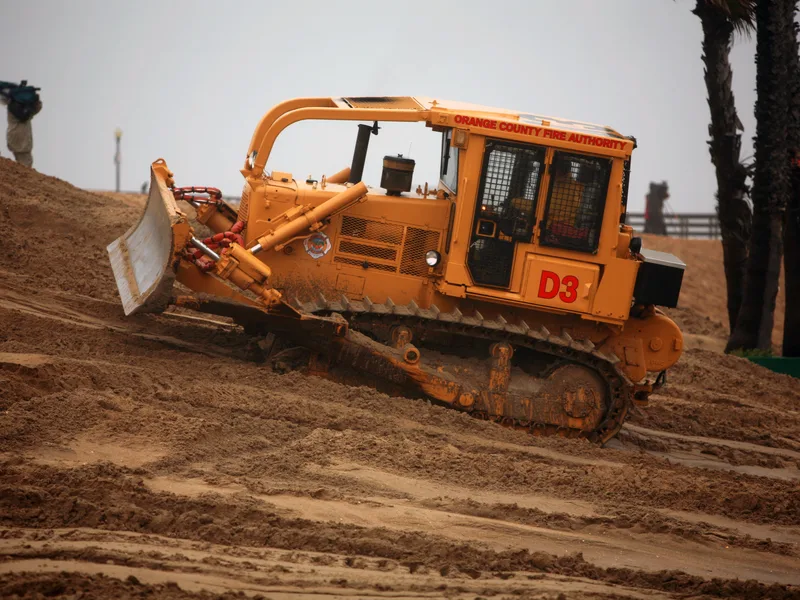
The machine’s own exposure in Rhode Island is dominated by what is already in the ground and by how often it travels. Old fill, buried structures and abandoned services damage running gear and blades and turn a straightforward strip into an excavation of somebody else’s history. Overturn risk is a confined-site and edge-of-excavation matter rather than a mountain one. Transport is frequent, short and awkward — narrow streets, tight approaches, older bridges — which concentrates loss on loading and unloading rather than on the road. Around all of it is the land-disturbance exposure, which no operator skill removes, because it is a product of the work being done rather than of anything going wrong.
Common Rhode Island dozer claims we see
- Sediment onto an abutting property or a public sidewalk. The defining Rhode Island exposure, and one that is witnessed immediately.
- Material into a catch basin or a storm inlet. A cleanup obligation and a third-party claim rather than anything the equipment form addresses.
- Blade and undercarriage damage from buried structures. The routine cost of grading ground that has been built on before.
- Loading and unloading damage on constrained streets. Frequent short moves concentrate the loss on the ramp, not the highway.
- Vandalism and component loss on an open urban site. A machine left where the whole neighborhood can reach it is a different risk from one behind a rural gate.
Why Rhode Island dozer owners choose Equipment Guard Insurance
A dozer account in a dense state deserves an underwriting conversation about sites rather than about model numbers. We write the equipment monoline, so the machine can be scheduled properly without reopening arrangements built around your Rhode Island work, and we are direct about the fact that the larger half of this exposure never touches the equipment policy at all. The markets we place through are named on our homepage, and they will look at an earthmoving schedule on its own.
Major Rhode Island dozer markets
- Providence. Institutional, hospital and mixed-use redevelopment on filled and previously built ground, with abutters on every boundary.
- Warwick. Airport-adjacent commercial and industrial work, plus shoreline neighborhoods where the water is immediately downhill.
- Cranston. The state’s steadiest run of suburban commercial pad and subdivision work, much of it phased inside larger plans.
- Pawtucket. Mill and industrial reuse along the river corridor, where demolition and grading arrive on the same job.
- East Providence. Waterfront and former industrial land being repositioned, with the shortest possible route from a disturbed slope to tidal water.
- Woonsocket and the northern towns. Older mill villages and hillside lots where grade change and perimeter control are the whole job.
Related
- Dozer insurance — the machine physics that hold in every state.
- Backhoe insurance in Rhode Island — the machine that works the same narrow lot from the street side, with road-use rules of its own.
- All equipment insurance in Rhode Island — the state hub.
- Equipment floater · Rented & leased equipment
Primary sources
- Construction Stormwater Permitting | Rhode Island Department of Environmental Management — Rhode Island Department of Environmental Management (RIDEM) (stormwater and land disturbance)
- General Contractor Registration — Rhode Island Contractors’ Registration and Licensing Board (contractor licensing)
Rhode Island dozer insurance FAQs
Does the acre trigger catch much work in a state this small?
More than the arithmetic suggests, because of the second half of the rule. A small lot on its own may sit under the threshold, but a lot that is one piece of a larger scheme of development is measured with the scheme rather than by itself. Rhode Island builds in phases inside already-developed areas, so the common-plan question comes up constantly and the honest answer is often yes.
Who administers the permit, and what else are they looking at?
The state environmental management department runs the construction stormwater program directly rather than deferring to the federal agency. The same department carries responsibility for the waters everything here eventually reaches, which is worth understanding as a matter of posture: your sediment plan is being read by people whose broader job is the condition of the bay and the rivers feeding it, not by a separate office that only handles construction paperwork.
What makes redevelopment ground different for a dozer?
You are not moving virgin material. Urban Rhode Island sites carry generations of fill, old foundations, buried slabs and services that were abandoned rather than removed, so the blade finds things and the grade behaves unpredictably. That is a machine-damage question and a schedule question at once: what looked like a two-week strip becomes a sorting exercise, and the ground stays open longer than the plan assumed.
How close is too close to an abutter?
Closer than most contractors from larger states are used to. On a typical urban lot here the property line, the sidewalk and the catch basin are all within a short distance of the work, which means a control failure does not stay on your site long enough for anyone to fix it quietly. Practically, it makes perimeter control and inlet protection the first thing to install rather than the last.
Does insurance pay a stormwater penalty?
It does not. A penalty is a regulatory outcome and belongs to the contractor. Insurance answers the physical result — material in a neighbor’s yard, across a public sidewalk, into a catch basin or into a river running down to the bay. That is damage to a third party arising out of your operations, so it is a liability and pollution question, and in a dense state it arrives faster and involves more people than it would on open land.
Can the dozer be written on its own here?
Yes. Equipment Guard Insurance places equipment monoline in Rhode Island, so the machine can be scheduled without touching whatever else you carry. Contractors here are already registered with the state board and used to being accountable to a small, well-connected market; we would rather match that with a schedule that is accurate than with a package that is convenient.