
The rule that reaches a South Dakota dozer is unremarkable. What is remarkable is how far away everything else is. A machine here can be working ground that is an hour from the nearest town, four hours from the shop that services it, and further still from the office of the department that will eventually want to know how the site was controlled.
Distance is not a footnote on this class; it is the risk multiplier. It stretches the time between a control failing and anyone seeing it, between a component letting go and a repair arriving, and between a storm and a crew getting back out to look. The sections below cover who runs the permit, what it reaches, and where the exposure sits afterward — with the machine physics themselves held in the dozer insurance pillar.
What dozer insurance costs in South Dakota
No premium is published here, because a dozer rate is assembled from the work rather than looked up. What shifts a South Dakota figure is the machine’s age, hours and undercarriage life, how far and how often it travels between jobs, how much ground you have open when the season is short enough to force it all into a few months, whether the sites you take drain to a closed basin or a live watercourse, where the machine sits when nobody is working it, and your record. The general shape of this class is worth repeating: the iron is the modest half of the exposure and the ground you rearranged is the other one.
South Dakota dozer regulations: stormwater and land disturbance
South Dakota administers the program itself rather than leaving it federal. The authority is South Dakota Department of Agriculture and Natural Resources (DANR) — one department carrying agriculture and natural resources together — the instrument is the General Permit Authorizing Stormwater Discharges Associated with Construction Activities, SDR100000, and it reaches a land disturbance of one acre or more.
The combined agency is the detail worth dwelling on, because it tells you who is on the other side of the table. The same department that authorizes your construction discharge also administers the state’s agricultural water-quality work, which means the watershed your site sits in was already familiar to it before you arrived, and the neighbors who will notice a problem are frequently people that department already deals with. Then the geography sharpens it. East of the river, glacial ground is dotted with closed basins that collect water rather than carry it away, so a discharge does not disperse — it accumulates somewhere with no outlet. West of the river the ground sheds hard and fast off thin soils. Either way the commercial boundary is the same one, and it is worth being blunt about: a penalty from the state is a regulatory outcome your company absorbs on its own, uninsured and uninsurable. The claim is separate and physical — material off your acreage into a neighbor’s field, across a county road, or into a wetland or stream. That is third-party property damage arising out of your work, it answers to liability and pollution coverage rather than to the equipment floater, and in a state where the nearest help is an hour off, it is also the exposure that has the most time to get worse before anybody responds.
Common dozer risks in South Dakota
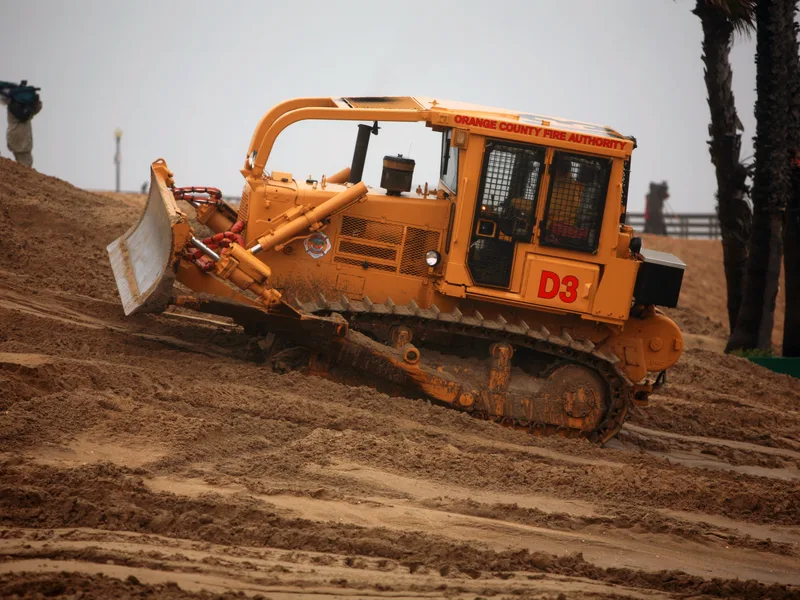
The season does most of the shaping. A short working year compresses the hours, so machines run hard inside a narrow window and then sit for months, often wherever the last job left them rather than in a yard somebody drives past. That produces a distinct pattern: heavy in-season wear on undercarriage and final drives, then off-season exposure to weather, wildlife and opportunists on a machine nobody has looked at since November. Transport is the second theme, since long moves between counties put the iron on a trailer far more than in a compact state. On the ground itself, western clay goes slick under rain and then sets like pavement, which is unkind to both traction and blade edges, while the eastern basins keep water on a site instead of taking it away.
Common South Dakota dozer claims we see
- Runoff into a closed basin or wetland. No outlet means no dilution, and the material stays exactly where it is least welcome.
- A machine damaged or stripped during a long off-season. Months of standing still on a remote site is its own peril class.
- Undercarriage failure far from a service point. The repair is ordinary; the downtime and recovery around it are not.
- Trailer and tie-down damage on long interstate moves. Wind, distance and repetition rather than a single dramatic event.
- Sediment onto a county road after a storm nobody was there for. The gap between the rain and the response is the whole loss.
Why South Dakota dozer owners choose Equipment Guard Insurance
Placing a dozer well in a state like this is mostly about being honest concerning what the schedule does and does not reach. We write equipment as a standalone line, so the machine can be valued properly, listed by serial number, and covered while it sits through a winter on a site four counties from home — none of which requires anyone to reopen the rest of your program. And we say directly that the acreage exposure is a different policy doing a different job, which is the sentence most often left unsaid when a dozer is dropped into a package. We place through markets — named on our homepage — that read remote earthmoving as its own risk rather than a rural discount.
Major South Dakota dozer markets
- Sioux Falls. The state’s commercial and industrial engine, with the most continuous site-development work and the shortest distance to support.
- Rapid City. Hill country work on steep, rocky ground where grade and erosion control arrive on the same job.
- Aberdeen. Farm-county infrastructure and pad work across flat glacial ground full of shallow basins.
- Brookings. University and light-industrial expansion, close-in sites with established neighbors watching them.
- Watertown. Lakes-country work where a receiving water is usually within sight of the open ground.
- Mitchell. Highway and agricultural-industrial projects, with long hauls out to jobs and back again.
Related
- Dozer insurance — the machine physics that hold in every state.
- Skid Steer insurance in South Dakota — the smallest machine on the job and the easiest one to lose from a site nobody drives past at night.
- All equipment insurance in South Dakota — the state hub.
- Equipment floater · Rented & leased equipment
Primary sources
- General Permit Authorizing Stormwater Discharges Associated with Construction Activities Under the South Dakota Surface Water Discharge System, Permit Number SDR100000 (effective November 1, 2023; expires October 31, 2028) — South Dakota Department of Agriculture and Natural Resources (DANR) (stormwater and land disturbance)
South Dakota dozer insurance FAQs
Who administers construction stormwater here, and why is that agency unusual?
A single state department covering agriculture and natural resources together, rather than a standalone environmental agency. That pairing is not cosmetic. The same department that authorizes a construction discharge also carries the state’s agricultural water-quality responsibilities, so when a site sits between cropland and a receiving water — which in this state is most of them — the regulator already understands both halves of the picture and has been looking at that watershed long before your project appeared in it.
How does distance change the actual risk on a job?
It lengthens every response. A control measure that fails on a Friday in a county with no yard nearby stays failed until somebody drives out, and driving out here is a real fraction of a day. The same applies mechanically: a track chain that comes off within reach of a shop is an inconvenience, and the same failure four hours from one is a stalled job with a machine sitting exposed in an open field. Planning for that is not caution, it is arithmetic.
What is different about the ground east and west of the river?
They are close to being two states. East of the Missouri, glacial deposits left a landscape of shallow closed basins and wetlands that hold water rather than route it onward, so a disturbed area often drains into something with no outlet and no dilution. West of the river the ground sheds fast: steeper relief, thinner soils over rock, and clay that turns slick and then sets hard. A crew that grades comfortably in one half can be surprised by the other.
Does a stormwater penalty get paid by an insurance policy?
It does not, and the distinction is worth keeping straight before you need it. A penalty is a regulatory result — the state deciding your controls were inadequate — and no equipment or liability wording answers for the fine itself. What is insurable is physical harm to other people’s property: material off your site into a neighbor’s pasture or crop, onto a county road, or into a wetland or stream. That is third-party damage arising out of your work, and it belongs to liability and pollution coverage rather than to the floater.
What actually wears out a dozer working in this state?
A short, hard season and long moves. The working year closes early and opens late, so the hours get compressed into fewer months and the machine runs harder inside them. Between jobs it spends serious time on a trailer crossing the state, which is where a meaningful share of damage happens. And it overwinters wherever the last job was as often as not, which is a different exposure from a machine that sleeps in a yard every night.
Will scheduling the dozer separately complicate my other coverage?
It should simplify it. Equipment Guard Insurance writes equipment on its own, so a South Dakota dozer is valued and scheduled without anyone touching arrangements that are already working. What we will not pretend is that a well-built schedule covers the ground. The machine and the acreage are two different exposures answering to two different wordings, and knowing which is which before the season starts is worth more than any endorsement bought afterward.