
Nearly every state answers the question “does this job need a stormwater permit?” with a number of acres. Virginia answers it with a number of acres and a map, and on a great deal of its most valuable ground the map wins. Inside designated Bay Act areas the threshold falls far below the familiar one.
That reframes the first decision on a coastal job. It is not how much you are disturbing; it is where the disturbance sits, and that is a determination made by a locality against a boundary rather than by a crew against a tape. The sections below set out who administers the program, what the two thresholds are, and where the commercial exposure lands afterward. For the machine itself, the dozer insurance pillar holds in every state.
What dozer insurance costs in Virginia
No premium appears here, because a dozer rate follows the work rather than the model. What moves a Virginia number is where you operate — tidewater against Piedmont against mountain — how much of your work falls inside designated areas with their lower trigger, the acreage you keep open at one time, the machine’s hours, age and undercarriage condition, transport frequency along a long east-west state, and your record. It is worth being clear about the asymmetry on this class, since it is the opposite of what buyers expect: the machine is the cheaper half of the risk, and the ground behind it is the expensive half.
Virginia dozer regulations: stormwater and land disturbance
Virginia administers its own discharge permitting rather than leaving construction sites to the federal agency. The authority is Virginia Department of Environmental Quality, the instrument is the VAR10 — VPDES General Permit for Discharges of Stormwater from Construction Activities, and the reach is stated in two parts: one acre or more, or less than one acre where part of a larger common plan of development. Alongside that sits something most states do not have — a genuine statewide contractor license issued in three classes graded by the value of work each class permits.
The two-part threshold is where this page earns its keep, because it inverts the usual intuition twice. First, a smaller job is not a safer job. The threshold drops in Bay Act areas precisely because the receiving water there is close, tidal and sensitive, so the sites the lower figure captures are the ones where a control failure travels fastest — and a crew that has internalized “under an acre, no permit” will keep being wrong in exactly the places where being wrong costs the most. Second, and more important commercially, the trigger never governed liability in the first place. A permit threshold decides when the state requires you inside its program. It does not decide when you owe a neighbor anything. That is why the boundary here is worth stating flatly: a penalty for inadequate controls is a regulatory matter your company absorbs, uninsured by design, whereas sediment on somebody else’s lot, in a tidal creek, or across a public road is third-party property damage arising out of your work, answerable under liability and pollution wordings — and it is answerable whether the job was above the acre, below it, or inside a designated area where the acre never applied at all.
Common dozer risks in Virginia
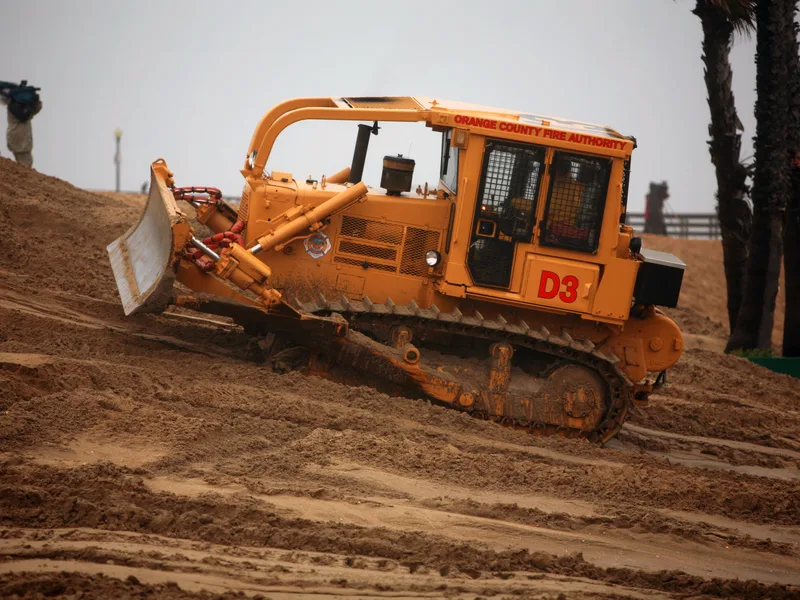
Virginia hands a dozer three distinct working environments. Tidewater is flat, sandy and wet, with a water table close enough that dewatering is routine and stability is poor once ground is opened; the distance between a site and a creek is often trivial. The Piedmont is clay over saprolite, which grades well and then behaves badly when saturated, and it carries most of the corridor’s subdivision and commercial growth. The mountains are grade, rock and narrow access. Across all three the machine’s own losses are the usual ones — overturn on a slope or spoil edge, undercarriage wear mistaken for a covered peril, fire, and damage during transport — but the exposure that actually distinguishes this state is proximity: a great deal of Virginia earthmoving happens within a very short distance of water that people care about.
Common Virginia dozer claims we see
- Sediment into a tidal creek from a small coastal job. Frequently a site the crew assumed was too small to be regulated at all.
- Instability after opening saturated coastal-plain ground. A high water table turns a routine cut into a slump with very little warning.
- Runoff off a Piedmont clay slope after a tropical remnant. The rainfall is seasonal, heavy, and lands on whatever happened to be open.
- Overturn on a mountain bench or narrow cut. Steep ground and limited working width leave no room to correct a mistake.
- Transport damage on long moves across the state. Repeated loading and tie-down on a machine that never travels under its own power.
Why Virginia dozer owners choose Equipment Guard Insurance
Placing this machine well in Virginia means knowing which side of a boundary your work sits on, and then being honest about what insurance does once you are there. We write equipment as a standalone line, so the dozer is scheduled at its own value with its attachments listed properly, and none of that requires reopening a program built around the rest of your business. Then we separate the land-disturbance exposure and talk about it as its own item, because on coastal work it is the larger number and the one least likely to have been considered by whoever wrote the package. We place through markets — named on our homepage — that read grading and site work as a class rather than as a line item.
Major Virginia dozer markets
- Virginia Beach. Flat, sandy, close to water everywhere, and largely inside designated areas — the market where the lower trigger is the working assumption.
- Norfolk. Port, naval and infrastructure site work on made ground with a water table near the surface.
- Chesapeake. Mixed industrial and residential growth over wetlands and drainage canals rather than natural creeks.
- Richmond. Piedmont clay, steady commercial and residential development, and a fall-line change in ground behavior within a single metro.
- Newport News. Industrial and shipyard-adjacent site preparation on constrained peninsula parcels.
- Roanoke. Mountain-valley work where grade, rock and narrow access replace the coastal problems entirely.
Related
- Dozer insurance — the machine physics that hold in every state.
- Skid Steer insurance in Virginia — the machine whose lien filing goes to the Commonwealth’s corporation commission rather than to a secretary of state.
- All equipment insurance in Virginia — the state hub.
- Equipment floater · Rented & leased equipment
Primary sources
- Stormwater Construction | Virginia Department of Environmental Quality — Virginia Department of Environmental Quality (stormwater and land disturbance)
- Board for Contractors — Virginia Department of Professional and Occupational Regulation (contractor licensing)
Virginia dozer insurance FAQs
Does the one-acre threshold really not apply on the coast?
Not as the only threshold. Statewide, a land disturbance at or above an acre brings a site under the general permit in the ordinary way. Inside designated Chesapeake Bay Preservation Act areas a far smaller disturbance is enough, so a small pad, a driveway cut or a modest regrade can be regulated work in a place where the same job would not be an hour inland. The size of the machine has nothing to do with it and neither, in truth, does the size of the job.
How do I know whether a site sits inside a designated area?
By checking the locality, not by looking at the ground. Designation is a mapped, locally administered determination, so two sites that look identical can fall on opposite sides of it, and there is no feature an operator can see from the seat that reliably signals which is which. That is the practical trap on this rule: the answer is knowable in advance and almost never knowable improvisationally, which means it belongs in the estimate rather than in a conversation on the first morning.
Which agency administers the permit, and what else affects me here?
The state environmental quality department runs the discharge permitting program under Virginia’s own state-badged system. Separately, this is one of the states with a genuine statewide contractor license rather than a local patchwork: the state professional regulation board issues licenses in three classes distinguished by the value of work you are allowed to contract for. That has nothing to do with stormwater and everything to do with whether you are eligible for the job in the first place.
Does a smaller trigger mean a smaller exposure?
The reverse, generally. The threshold moves down in Bay Act areas precisely because the receiving water there is sensitive and close, so the sites captured by the lower figure tend to be the ones where a failure travels fastest and matters most. A regulated half-acre job beside tidal water can produce a worse outcome than a fully permitted large site well inland, and the ease of the paperwork on a small job is a poor guide to the seriousness of what happens if control measures fail on it.
Is a violation the same thing as a claim?
No, and this state makes the distinction unusually easy to see. Liability was never acreage-based to begin with. The permit threshold decides when the state requires you to hold coverage under its program; it has never decided when you owe somebody money. Sediment onto a neighbor’s lot, into a tidal creek or across a public road is third-party property damage arising out of your work whether the job was above the trigger or below it — a liability and pollution question, not something the equipment floater was written to answer.
Will putting the dozer on its own policy disturb anything else?
No — separating it is the point. Equipment Guard Insurance writes equipment monoline, so a Virginia dozer is scheduled on its own value and its own terms, and the rest of your program stays where it is. What we insist on saying is that the schedule stops at the machine. The ground you opened, and where the tide takes what came off it, sits in a different section of a different policy, and on coastal work that is the half worth the most attention.