
Almost everything unusual about running a dozer in Wyoming comes back to distance. The job is a long way from the yard, further still from a dealer, and further again from anyone whose job it is to look at what you left behind. Ground stays open longer here simply because getting back to it costs a day.
So this page is less about the filing and more about what the filing assumes: controls that hold without supervision, a season short enough to compress the whole year’s earthmoving, and consequences that travel by wind as readily as by water. The machine itself — how a blade loads, what an undercarriage tolerates, how the unit travels — is the same everywhere and belongs to the dozer insurance pillar.
What dozer insurance costs in Wyoming
No premium is published on this page, and on a Wyoming schedule a figure without context would be actively misleading. What moves the number is how far the iron works from its home base and how it gets there, whether it overnights on remote pads or comes in, the season you compress the year’s work into, elevation and access on the routes you use, hours and undercarriage condition, the valuation basis, and your own record. Two contractors with matching machine lists price differently the moment one of them works four hours from a parts counter and the other works forty minutes from one.
Wyoming dozer regulations: stormwater and land disturbance
Wyoming took delegation of the national discharge permit program and administers it through Wyoming Department of Environmental Quality (DEQ), under a state identifier of its own, with construction split into two general permits by size of disturbance. The requirement attaches at one acre or more (Small CGP covers one to under five acres).
What that framework quietly assumes is a level of attention that Wyoming geography makes expensive. A stormwater plan is a promise about a site’s condition over time, and out here time passes between visits — a check dam settles, a berm gets cut by one heavy storm, a stockpile loses its cover to a wind event, and none of it is noticed for weeks because nobody is there. That is the practical management problem, and it is a bigger determinant of outcomes than any question about which of the two permits you filed under. The commercial boundary underneath it is firm and worth stating without hedging. An enforcement penalty is a matter between your company and the state; the equipment policy does not reach it and never did. What can become a claim is physical damage suffered by someone else — sediment into an irrigation ditch, a reservoir or a stock-water source, material across a county road or a highway, fines blown onto a neighboring operation. Water in this state is allocated, recorded and defended, so the party downstream of you is rarely indifferent. That exposure is answered by liability and pollution wordings, not by the floater that repairs the dozer, and it is entirely capable of being the larger number.
Common dozer risks in Wyoming
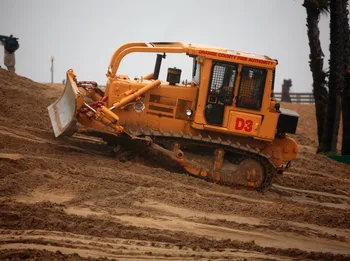
On the iron, the ordinary perils are ordinary: overturn on a slope or a spoil edge, fire in dry vegetation, transport damage, and undercarriage wear that is a running cost rather than a loss. Wyoming changes their consequences rather than their frequency, because every one of them takes longer to fix and costs more to reach. Add wind that works on anything left exposed, a freeze that arrives early and leaves late, and elevation that punishes cooling systems and access roads alike. Then there is the land-disturbance exposure, which behaves as it does everywhere — created by the work going well — but which here is left to develop unwatched between the days anyone is on site.
Common Wyoming dozer claims we see
- Sediment into an irrigation ditch or stock-water source. The downstream party has a recorded right and a direct interest, which makes this a third-party matter rather than a floater one.
- Wind loss off an exposed stockpile or pad. Material leaves the site without a drop of rain, and the first complaint is often about visibility on a road.
- Machine disabled on a remote pad. The repair may be routine; the recovery, the travel and the downtime rarely are.
- Overturn on basin or foothill terrain. Loose surface material over firm ground gives very little warning to an operator working a new line.
- Transport damage on a long haul. Distance, grade and weather each add their own opportunity between the yard and the job.
Why Wyoming dozer owners choose Equipment Guard Insurance
Distance is the thing most equipment placements underprice, in both directions — they miss what it does to a downtime claim, and they miss what it does to how long a disturbed acre goes unsupervised. We would rather ask those questions at the quoting stage than infer the answers afterwards. Equipment monoline keeps the machine on its own schedule at a value we can defend, without touching arrangements a Wyoming owner has already assembled across county and municipal desks, and the markets behind us — listed on the homepage — are ones that will actually write a fleet that works four hours from its yard.
Major Wyoming dozer markets
- Cheyenne. Commercial, institutional and industrial development on the high plains, with the state’s own offices in the same city.
- Casper. The energy-services center of the state, with yards here and the work spread out across the basin around it.
- Gillette. Powder River Basin earthmoving and reclamation — the largest sustained volume of moved ground anywhere in Wyoming.
- Rock Springs. Southwest industrial and extraction country: hard material, long hauls and very exposed sites.
- Sheridan. Foothill and ranch-adjacent work where the party downstream of a disturbed acre is a named water user.
- Jackson. Tight, high-value mountain sites with severe access, a short building season and no tolerance for a machine that has to be recovered.
Related
- Dozer insurance — the machine physics that hold in every state.
- Backhoe insurance in Wyoming — the county registration class that self-propelled machinery falls into once it works a public road here.
- All equipment insurance in Wyoming — the state hub.
- Equipment floater · Rented & leased equipment
Primary sources
- Licensing - Electrical Safety, Wyoming State Fire Marshal's Office — Local city/county governments (general contractors); Wyoming Department of Fire Prevention and Electrical Safety (electricians) (contractor licensing)
We do not link a Wyoming stormwater permit document here. The land-disturbance threshold and permit class described above follow Wyoming’s own record as our data layer holds it; where the state publishes a document that states it directly, this page links it.
Wyoming dozer insurance FAQs
Which construction permit applies to a Wyoming dozer job?
The state runs two, separated by how much ground the job opens: WYPDES Small Construction General Permit (WYR10A000, one to under five acres) and Large Construction General Permit (WYR10-0000, five or more acres). The obligation begins at a land disturbance of one acre or more (Small CGP covers one to under five acres). Where crews get caught is on projects that are small in footprint but strung out — an access road, a series of pads, a pipeline right of way — because the total disturbance can add up to more than any single piece of it looks like.
My site is two hours from anywhere. Does the state really come out?
Sometimes, and the honest point is that it does not matter much either way. Wyoming Department of Environmental Quality (DEQ) has a very large state and a finite number of people in it, but the duty is not conditional on being observed, and inspection is not the mechanism that usually creates a problem out here. What creates the problem is that a control installed in May goes unlooked-at until August while wind, frost heave and a couple of hard storms work on it. Distance does not reduce the exposure; it removes the chance to notice it early.
Wind moves more material here than water. Does that count?
It counts commercially even where the permit’s focus is on discharge to water. A stripped surface on the high plains gives up fine material to wind steadily and invisibly, and that material lands on somebody: a highway with a visibility problem, a rancher’s water source, a neighboring operation with equipment of its own. It also strips the fines out of the surface you were building, which is a quality issue before it is anything else. Dust control on an open Wyoming pad is not housekeeping.
If the state fines us, is that a claim?
No. A penalty is enforcement aimed at the company and no equipment policy responds to it. The insurable question is separate and, in this state, often more consequential than people expect: water here is allocated and closely held, so the ditch, reservoir or stock water below your site very likely belongs to somebody with a right to it and a strong view about its condition. Silt reaching it is third-party damage arising from your work — liability and pollution territory, not the equipment schedule.
What does remoteness do to a machine loss?
It multiplies it. The repair itself may be ordinary; getting a technician and a part to a basin pad, or getting a disabled tracked machine onto a trailer and back to a shop, is not. Downtime runs longer than the same failure would anywhere else, replacement iron is not sitting on a lot down the road, and the recovery move is itself a loss opportunity. When we ask where the machine works and how it gets there, that is the number we are trying to understand.
Can the dozer be scheduled on its own here?
Yes, and Wyoming makes that easy to want. General contracting is licensed by cities and counties rather than by the state, and self-propelled machinery is registered through its own county scheme, so an owner’s obligations are already scattered across several desks. Equipment Guard Insurance writes equipment monoline, which keeps the iron on one schedule at one honest value without pulling the rest of that arrangement apart.