

Very little of what an excavator hits in this state was put there by anyone still living. Water, gas, drainage, steam, signal and fiber went in across four centuries under streets that were laid out before any of it, and the paper record starts partway through the story.
So the interesting question here is not how many days of warning the law wants. It is that the law asks you to describe your own dig, on the ground, before the warning even begins — and then hands you back a set of marks that are only as good as the record behind them. For the parts that do not change at a state line — reach and swing geometry, undercarriage wear, breakers and thumbs and grapples on the schedule — the excavator insurance pillar is the place to start.
What excavator insurance costs in Massachusetts
No honest page prints a rate for this machine, and on an excavator the reason is unusually stark: the largest single input is not the iron but what you point it at. Depth, how much of your work is in a live street against how much is open ground, whether you take on gas and fiber corridors, the size and age of the unit, the attachments riding with it, where it sits on the nights between jobs, and your own claim record all move the number. In a state this dense, the same excavator earns a very different rate depending on whether its week is spent on utility replacement downtown or on a septic and drainage job an hour west.
Massachusetts excavator regulations: dig notice and the one-call duty
Excavator must premark the proposed excavation (not more than 500 feet) before giving initial notice to the system.
That premark duty is set out in the general law governing excavation near underground facilities, and it is worth pausing on how unusual it is. Elsewhere the sequence is call, wait, dig. Here it is paint, call, wait, dig — and because a premark run is capped at 500 feet, a long trench is a series of described segments rather than one blanket request. The waiting period runs at least 72 hours with weekends and legal holidays excluded, and the ticket may not be pulled more than 30 days ahead. What arrives at the end of all that is an obligation discharged by the facility owners, not a warranty: the marks cover what those owners know about, and the abandoned service, the unrecorded lateral and the line that predates anyone’s drawings stay entirely yours. Which is why the underground side of this account is placed on purpose rather than assumed into the equipment schedule.
Common excavator risks in Massachusetts
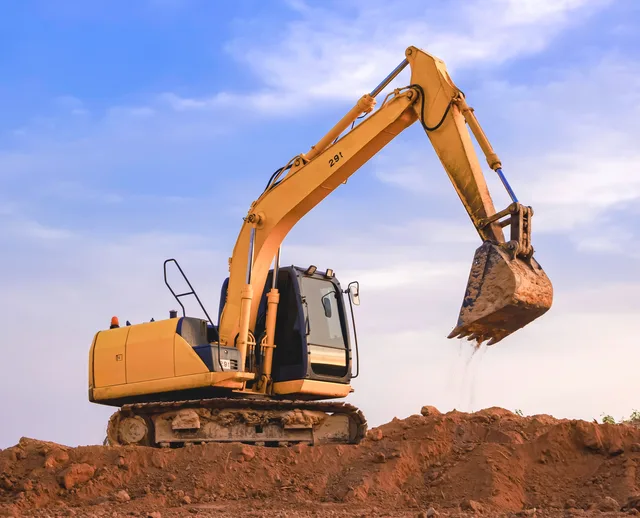
The signature loss on this machine is the one where the excavator walks away undamaged and the file runs for a year. Cut a gas main, a water main or a fiber trunk in a built-up street and the physical repair is the smallest line on the statement — restoration, service lost to everyone downstream, an idle crew, a closed road and a site that cannot restart until several owners agree it is safe. Age sharpens all of that here: brick sewer, cast iron, abandoned services left in place and lines laid under fill that has been disturbed a dozen times since. Underneath the strike sit the machine’s ordinary habits — the slide at an undercut trench edge, the counterweight swinging into something the operator cannot see — and both get worse on lots where there is no room to stand the machine anywhere except close to a wall.
Common Massachusetts excavator claims we see
- Cut on a line nobody had recorded. The premark was right, the locate was right, and the ground held something that predates the drawings.
- Third-party interruption behind a single strike. Businesses and residences downstream of a severed service, which is where the number stops being about the machine.
- Collapse at an undercut trench face. Old fill, spoil placed too near the lip, and no room on the lot to place it anywhere else.
- Counterweight contact in a narrow street. Parked vehicles, stoops and building faces sitting inside the tail swing on work that cannot be closed off any wider.
- Damage during a short move. Jobs sit close together and yard space barely exists, so the machine loads and unloads far more often than its hours suggest.
Why Massachusetts excavator owners choose Equipment Guard Insurance
Placing the equipment on its own is what lets us take the rest of the conversation seriously. Plenty of brokers will schedule the iron in ten minutes and treat what happens at the end of the boom as a different department’s problem; we would rather ask how deep you go, how close you work to live service, and how much of your year is spent in a street that was opened and closed a dozen times before you got there — then put the machine and that exposure in front of markets that read excavation work on its own merits. Those markets are named on our homepage. Nothing in this requires you to disturb the liability or comp you already carry.
Major Massachusetts excavator markets
- Boston. The deepest accumulation of buried service in the state, much of it under made ground, where opening a street means negotiating with several owners before the bucket moves.
- Cambridge. Campus and laboratory work where a cut service can take research or life-safety systems down with it, so the interruption side of a strike dominates the claim.
- Worcester. A central base for crews working the whole state, with grade, ledge and a mix of replacement and new construction on the same week’s schedule.
- Lowell and Brockton. Mill-era fabric and municipal replacement, the classic setting for abandoned lines that were left in the ground rather than removed.
- Quincy. Waterfront and infill work on soft, saturated ground where the trench face behaves differently than the same job does inland.
- New Bedford. Harbor and industrial ground with legacy service and salt in the air, at the far end of a long approach from most contractor yards.
Related
- Excavator insurance — the machine physics that hold in every state.
- Backhoe insurance in Massachusetts — the same crew’s other machine, judged by how it behaves on the pavement instead of beneath it.
- All equipment insurance in Massachusetts — the state hub.
- Equipment floater · Rented & leased equipment
Primary sources
- General Law - Part I, Title XIV, Chapter 82, Section 40A — Dig Safe System, Inc. (dig notice and one-call)
- Construction Supervisor Licensing | Mass.gov — Massachusetts Board of Building Regulations and Standards / Office of Public Safety and Inspections (CSL); Office of Consumer Affairs and Business Regulation (HIC) (contractor licensing)
Massachusetts excavator insurance FAQs
What does Massachusetts make me do before I am even allowed to give notice?
Premark the proposed excavation on the ground, in a run of no more than 500 feet, and do it before the initial notice goes to the system. That is a working obligation rather than a formality: the paint you lay down is the description the locators will work to, so a vague or over-generous premark buys you marks that answer a question you did not really ask. A long linear job becomes a sequence of premarked segments and a sequence of notices, not one call that covers a mile of trench.
How far ahead does the notice run, and how long does the ticket stay good?
At least 72 hours ahead, counted without Saturdays, Sundays or legal holidays, and no more than 30 days ahead. The generous outer limit is the one that catches people. A month is long enough for a site to change hands, for another trade to open and close the same ground, and for paint to be scrubbed off by weather or traffic — so an old but technically live ticket can describe conditions that no longer exist.
Why is a strike here worse than the same strike somewhere newer?
Because of what sits above and below it. Work in these downtowns runs through utility built in layers over generations, in streets too narrow to open widely, with a dense population downstream of whatever gets cut. The same nicked line that costs a rural crew an afternoon can shut off service to a block of businesses, close a street the city cannot easily detour, and put a crew on hold while several facility owners argue about sequencing.
Does a valid ticket mean the strike is somebody else’s problem?
It does not. The notice compels the facility owners to mark what they know about. It says nothing about the lines nobody recorded, it does not certify the marks as complete, and it does not excuse careless work around them. In a state where a fair amount of what is underground was laid before the record-keeping that would have captured it, the gap between "marked" and "everything that is down there" is wide, and it belongs to the contractor.
Is the machine insured while it moves between jobs?
Yes — the equipment floater follows the machine rather than a scheduled address, so the excavator is on coverage on the trailer and on the job alike. The item worth reading closely is the transit limit against what actually rides on the deck: a mid-size unit plus a breaker or a thumb can carry more value than a limit somebody set years ago for a smaller machine, and in this state the trailer works hard because the jobs are close together and nobody has yard space.
Do I have to move my other policies to get the excavator placed?
No. Equipment Guard Insurance writes equipment as a standalone line here, so the machine and its attachments go on their own schedule. The underground question gets handled beside it, and whatever liability and comp you already run stays exactly where it is.