

Most states give an excavating contractor somewhere to learn on — a subdivision on open farmland, a pad in a field, ground nobody has touched. Rhode Island largely does not. The work here is reconstruction, and reconstruction means the interesting things are already in the hole before you start.
What follows is about that condition: the marking obligation your notice creates and the limits sitting on the far side of it, why the state registers every contractor and subcontractor and what that means for the file you hand an owner, and how tidal groundwater and salt shape the machine’s working life. For the excavator considered purely as a machine — boom and swing, undercarriage, attachments — see the excavator insurance pillar.
What excavator insurance costs in Rhode Island
We do not print premium figures, and on this class the reason is straightforward: the number follows the work far more than the machine. How much of your year is spent opening street rather than shaping site, how close the routine job sits to live gas and communications, how deep the cuts are, how often you are working below the water table, the size and age of the unit, the attachments scheduled with it, where it sleeps and what your history looks like — those are the levers. A firm doing bay-front foundation work and a firm replacing sewer lateral in a dense neighborhood share a machine type and very little else.
Rhode Island excavator regulations: dig notice and the one-call duty
Operators must mark the approximate location of underground facilities within 72 hours (excl. weekends/holidays) of receipt of the notice.
The rule sits at R.I. Gen. Laws § 39-1.2-5, administered through the notification association under the Public Utilities Commission. Two clocks run: yours, which requires the notice to be in well ahead of the work and not more than a month early, and the operators’, which requires them to mark approximate locations within seventy-two hours of receipt, weekends and holidays excluded. Where this state departs from the pattern is in what the marks are being laid over. In a place with almost no undisturbed ground, a mark is placed on top of earlier street reconstruction, mill-era service, abandoned pipe and private laterals running from main to building — none of which the participating operators own or record. So the ticket answers a narrower question here than it appears to. It tells you where the live, recorded, member-owned facilities are thought to be. It does not describe the ground, it does not survey anything, and it leaves the whole consequence of the cut with the contractor who made it.
Common excavator risks in Rhode Island
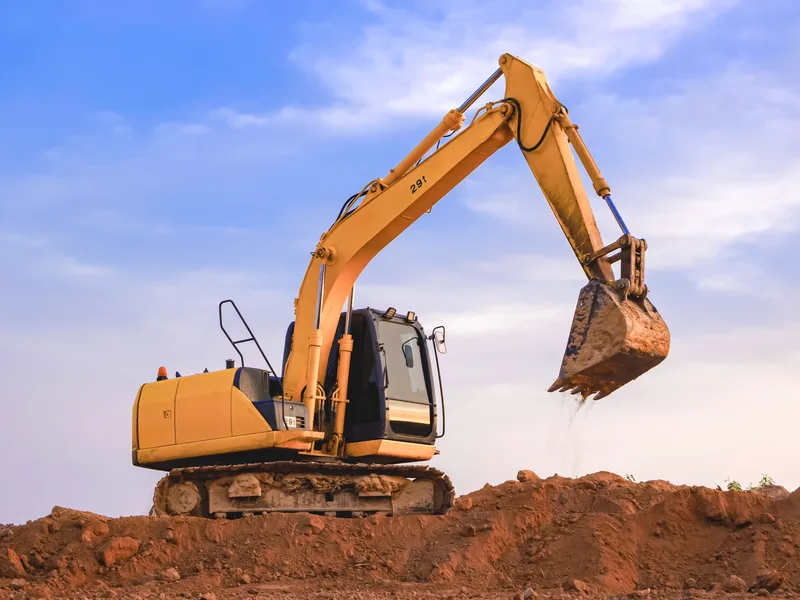
The strike dominates, and in dense reconstruction it arrives more often through the things nobody owns than through the things everybody marked: a lateral to a building, a line abandoned in place decades ago, a duct bank from a rebuild that predates the current records. The consequence follows the usual pattern — restoration billed by the facility owner, service lost across a neighborhood, a crew standing down, and on gas or fiber a set of downstream claims larger than the machine by a wide margin. Physical exposure then concentrates in the site itself. Constrained lots leave no swing clearance, so counterweight contact with a structure or a parked vehicle is a routine loss rather than a rare one. Trench walls in wet coastal soils fail quickly once groundwater arrives. And salt-influenced air works steadily on pins, rams and electrical connections, so machines here age in a way that shows up as component failure.
Common Rhode Island excavator claims we see
- Strike on a private lateral or an abandoned line. The characteristic loss in continuously rebuilt ground — nobody owned it, so nobody marked it.
- Service interruption across a dense block. One cut that takes out a whole street rather than a single customer, with the claim scaled accordingly.
- Counterweight contact on a constrained lot. A swing radius that overlaps a porch, a fence or a parked car because there was nowhere else to put the machine.
- Trench failure below the water table. Coastal and bayside walls that stand until groundwater reaches them, then do not.
- Corrosion-driven component loss. Salt air and salted winter streets working on pins, cylinders and connectors over a machine’s life.
Why Rhode Island excavator owners choose Equipment Guard Insurance
In a state that registers everybody, the thing that distinguishes one excavating contractor from another is the quality of the file, and that includes how the equipment is placed. We write the machine on its own so the questions are asked properly — what proportion of the year is street work, how often you are below the water table, how much of your exposure is downstream of a cut rather than in the machine — and then take the schedule and the underground question to markets, named on our homepage, that underwrite excavation as its own trade. None of it requires moving the liability or comp you already carry.
Major Rhode Island excavator markets
- Providence. The deepest and most layered subsurface in the state, where street work runs through several eras of infrastructure at once.
- Warwick. Airport, commercial and shoreline work, so tidal groundwater and live corridors show up on the same job.
- Cranston. Mixed residential and industrial reconstruction, with a lot of private laterals crossing between the main and the building.
- Pawtucket. Mill-era ground where earlier industrial service was laid, altered and abandoned in place across a very long period.
- East Providence. Waterfront redevelopment on made and filled land, which behaves unpredictably once a cut is open.
- Woonsocket. Blackstone valley work — older municipal networks, tight riverside sites and constrained access for floats.
Related
- Excavator insurance — the machine physics that hold in every state.
- Backhoe insurance in Rhode Island — the machine that has to be legal on the street it is parked in, not just on the site.
- All equipment insurance in Rhode Island — the state hub.
- Equipment floater · Rented & leased equipment
Primary sources
- R.I. Gen. Laws § 39-1.2-5 — Notice of excavation — Dig Safe System, Inc. (dig notice and one-call)
- General Contractor Registration — Rhode Island Contractors’ Registration and Licensing Board (contractor licensing)
Rhode Island excavator insurance FAQs
What has to happen after I file the notice, and on whose clock?
The obligation flips to the facility operators. Once the notice reaches them they have seventy-two hours, counted without weekends or holidays, to put approximate marks on the ground for what they own. Your own restraint is the other half: nothing starts before that period has run, and the notice cannot be given more than a month ahead. On a small state where crews often line up a week of short jobs at once, the front-loaded ticket that quietly ages out is a real and recurring problem.
Why does an ordinary job here feel like urban work?
Because functionally it is. Rhode Island has been continuously built for a very long time and has essentially no greenfield left in its populated half, so an excavation is almost always a return visit to ground that already carries water, sewer, gas, electric and communications, often laid in different eras by different methods. The site constraints follow: no room to stage, no room to swing, spoil that has to be trucked rather than stockpiled, and abutters close enough that a mistake is somebody’s driveway.
Does Rhode Island register the contractor doing this work?
It does, and more broadly than most of the Northeast. The Contractors’ Registration and Licensing Board requires statewide registration of general contractors and subcontractors alike for building and repair work, so the person hiring you can check a state record before they read anything else. That cuts both ways for a specialty excavating firm: your standing is verifiable, and so is any gap in it. Keeping registration and certificates consistent is part of being hireable here, not paperwork after the fact.
Does the water table change how the machine is exposed?
Considerably, in the coastal and bayside half of the state. Working close to tidal influence means groundwater arrives in a trench faster than the plan assumed, walls lose cohesion once they are wet, and dewatering becomes part of the excavation rather than a contingency. Salt in the air and in the ground is also unkind to pins, cylinders and electrical connections over the life of a machine, which shows up as component failure rather than as an incident anyone can point to.
If the marks were correct and the bucket still found something, where does that land?
With the excavating contractor, in most cases. Marks are approximate locations for facilities the participating operators own and have recorded — they are not a survey, they do not account for private service lines running from a main to a building, and they do not describe abandoned pipe from the mill era or from earlier street reconstruction. The question that decides the claim is how the digging was done around the marks that existed. That is why the underground liability is arranged as its own subject and not left to trail behind the machine schedule.
Can the excavator be written on its own?
Yes. Equipment Guard Insurance writes equipment monoline in Rhode Island, so the machine and its attachments sit on their own schedule and the strike exposure is addressed alongside them, without touching liability or comp you already have arranged.