
Ask a crew to name the dangerous machine on a tight urban job and nobody says the telehandler. It sets block, feeds a roof, lifts a bundle over a sidewalk shed and gets treated as furniture — until the day it puts something down where nothing was supposed to be.
What makes this state worth reading carefully is a jurisdictional line rather than a rule. There is an approved state safety plan here, and it stops at the public payroll, which means the answer to “who regulates my operators” is not the answer most people give. For the physics that hold regardless — load charts, reach against capacity, ground bearing, the forward-tip pattern — see the forklift insurance pillar.
What forklift insurance costs in Massachusetts
Nobody can print a number for this class honestly, because the rating conversation is about operators and documentation before it is about iron. What moves it here is how many people are qualified to run the machine and whether that qualification is written down for the specific unit, whether you are on a fixed-mast truck or a telehandler placing loads at reach, how close your typical site sits to occupied buildings, where the machine is kept between jobs, and your own loss history. The value of the unit itself is one of the least interesting inputs in the whole exercise.
Massachusetts forklift regulations: who enforces operator safety
Massachusetts runs an OSHA-approved State Plan that covers only state and local government employees; a private equipment contractor here is under federal OSHA, including the powered-industrial-truck standard.
Read that twice, because the two halves point in opposite directions and owners routinely keep only the first. Yes, there is an approved plan in this state — anyone glancing at a map of plan states will see Massachusetts marked and stop reading there. Its reach ends at government employment. The crew a town sends to the same renovation is inside that program; yours is not, and no amount of working on public property moves you into it. So on a municipal job one site can carry two enforcement regimes at once, and after your telehandler drops a load the inspector is federal, the citation is federal, and the appeal runs through a federal process. The error that costs money is assuming the state plan shelters you, because that assumption produces a training file assembled for a reader who is never going to ask for it. The error that merely embarrasses is assuming there is no program here at all. Getting the line right is free before an incident and expensive afterward.
Common forklift risks in Massachusetts
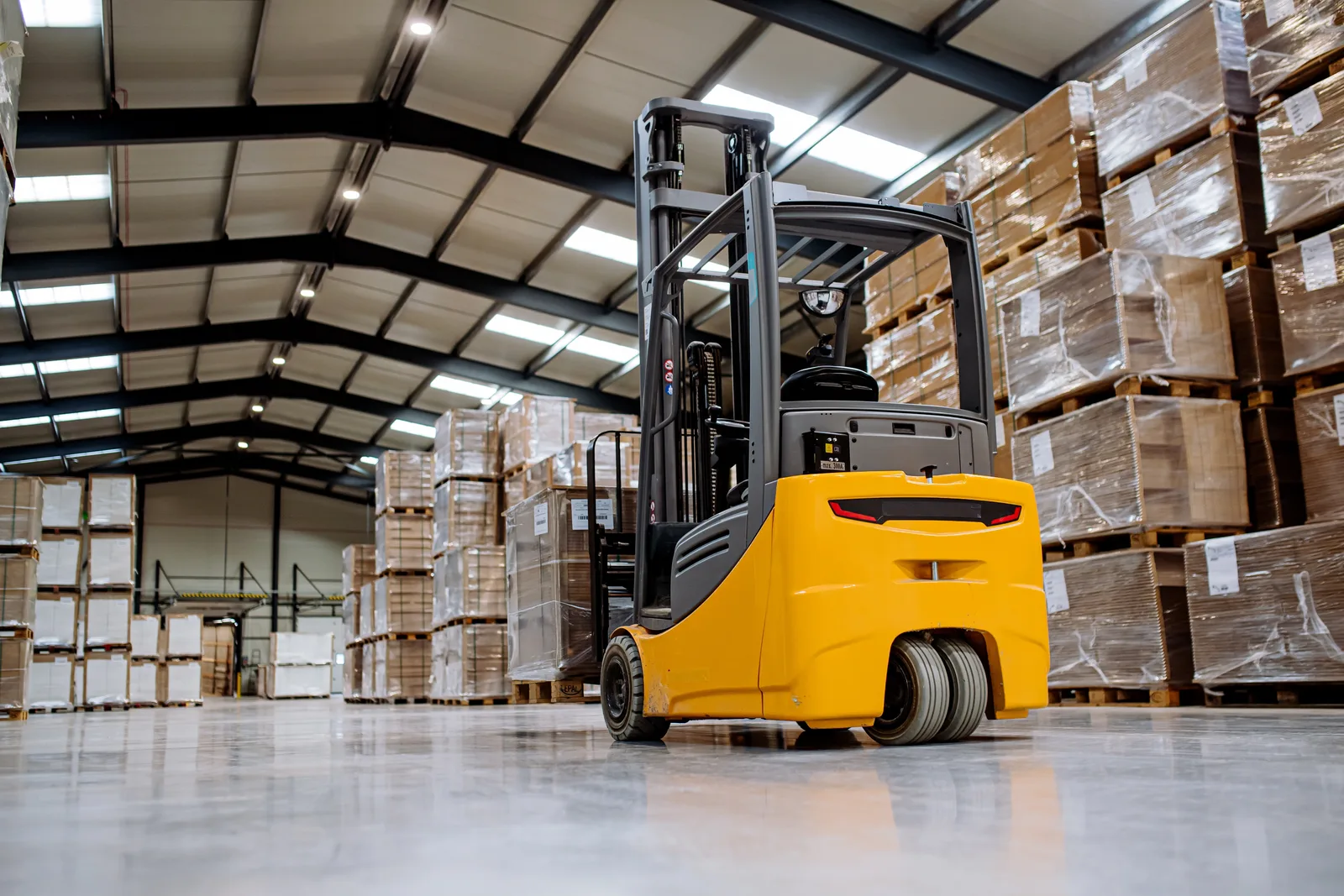
The machine is rarely the loss. A telehandler that tips forward or releases a load usually needs an inspection and a day of downtime, while the material, the structure it was reaching into and the person standing beneath it carry the claim. Two habits sit behind most of it: reach spends capacity, so a load the machine lifted comfortably at the mast becomes a load it cannot hold at full extension, and ground that looks solid is often fill, utility trench backfill or a sidewalk vault nobody mapped. Sites in this state compound both, because the work is squeezed between older structures with no room to reposition and the winter keeps rearranging what the outriggers were set on.
Common Massachusetts forklift claims we see
- Material released mid-placement. What it lands on decides the number, and on an infill site that is usually somebody else’s finished work.
- Contact with a neighboring facade. Old masonry and a swinging boom in a space with nowhere to back up.
- Forward tip at extension. Capacity drains as reach grows, and the load chart is the document nobody rereads.
- Struck-by injury to a worker on the ground. A liability and workers compensation event, and the most expensive thing this machine does.
- Outrigger through a vault or soft trench line. Common where streets have been opened and closed for a century.
Why Massachusetts forklift owners choose Equipment Guard Insurance
Plenty of brokers price a telehandler as a large loader and move on. We would rather say plainly that the floater is the cheap half of this account: the year that goes badly is decided by the operator and the person under the load, and that lands in liability and workers compensation. Writing the equipment monoline lets us schedule the machine properly without disturbing a program you have built around work in this state, and we place through markets — named on our homepage — that read a jobsite lifting exposure as jobsite work rather than as indoor equipment on rough tires.
Major Massachusetts forklift markets
- Boston. Infill and institutional work on sites with no lay-down area, where every placement happens over something occupied.
- Cambridge. Lab and campus construction with heavy material handling on constrained blocks and strict site logistics.
- Worcester. Mill conversions and regional commercial build-out where reach machines work around brick that predates them.
- Springfield. Western-corridor industrial and public projects with longer hauls and more open staging than the east.
- Lowell. Dense redevelopment along the canals, with narrow approaches and load placements over water and rail.
- New Bedford. Waterfront and marine-adjacent site work where wind off the harbor reaches a suspended load first.
Related
- Forklift insurance — the machine physics that hold in every state.
- Excavator insurance in Massachusetts — the machine whose obligation starts days before the bucket does.
- All equipment insurance in Massachusetts — the state hub.
- Equipment floater · Rented & leased equipment
Primary sources
- State Plans — Occupational Safety and Health Administration (operator safety)
- Construction Supervisor Licensing | Mass.gov — Massachusetts Board of Building Regulations and Standards / Office of Public Safety and Inspections (CSL); Office of Consumer Affairs and Business Regulation (HIC) (contractor licensing)
Massachusetts forklift insurance FAQs
Massachusetts has its own safety plan — does it govern my operators?
No, and this is the single most misread fact in this state. The approved plan here extends to state and local government employees only. A private equipment contractor is under federal OSHA, so the powered-industrial-truck training and evaluation duties that apply to your telehandler operators are the federal ones, enforced federally. The plan is real; it simply is not yours.
Then why should a contractor here care that the plan exists at all?
Because you will work beside it. On a school, a water-department project or any municipal site, the city or town crew standing near your machine sits inside the state program while your operators sit outside it. One site, one incident, two different authorities with two different files. Nobody on the job announces where that line runs, and a project manager who assumes everyone present is under the same regime is the person who gets the paperwork wrong afterward.
Who actually shows up after a telehandler drops a load on a Boston job?
A federal inspector, with a federal citation and a federal appeal path, on private work anywhere in the Commonwealth. There is no Massachusetts safety office in that chain for a private employer to call, which surprises owners who have watched the state legislate energetically on almost every other aspect of construction.
Does my Construction Supervisor License cover operator qualification?
It does not, and the two are easy to conflate because both are called credentials. Massachusetts runs a two-track contractor system — a Construction Supervisor License to supervise structural construction, and a separate Home Improvement Contractor registration for work on one-to-four family homes. Neither says anything about who may run a rough-terrain forklift. That qualification lives in a federal standard and is proved by a training and evaluation record you keep yourself.
What is different about running a reach machine on sites in this state?
Space, mostly, and age. Infill work here happens between buildings that were finished long before anyone imagined a boom swinging beside them, on streets too narrow to stage material properly, with masonry facades that do not forgive contact. A machine that would be unremarkable on an open pad becomes a placement problem, and the cost of a mistake is the neighboring structure rather than the load.
Can the machine go on its own policy without moving anything else?
Yes. Equipment Guard Insurance writes equipment monoline in Massachusetts, so the telehandler and its attachments are scheduled on their own without reopening the rest of your program. Given how the enforcement line falls here, we would rather walk the boundary with you than let you find it during an investigation.