
Every crew has a machine nobody argues about. The telehandler lands trusses, feeds block, drags a pallet of tile across a wet pad and never comes up in a safety meeting — which is precisely why the day it puts a load somewhere unplanned catches everyone flat.
Missouri’s contribution is a gap rather than a rule. No state agency stands between this machine and the federal standard, and no state agency licenses the contractor running it either, so the question of who is actually checking has a surprising answer. For the physics that never change — capacity against reach, boom geometry, ground bearing, the forward-tip pattern — see the forklift insurance pillar.
What forklift insurance costs in Missouri
No page should put a premium on this class, because the drivers sit with the crew rather than with the equipment. Here the inputs that move it are the number of operators and whether each has an evaluation recorded against the specific unit, whether you are running a fixed-mast truck or a telehandler working at extension, which municipalities your jobs sit in and what those owners demand at the gate, where the machine spends the winter, and your own history. Iron value is the smallest of those terms by a wide margin.
Missouri forklift regulations: who enforces operator safety
Missouri is under federal OSHA for private-sector employers, so the powered-industrial-truck operator training and evaluation requirements are the federal standard applied directly.
The interesting part is what is missing on either side of that sentence. Most states put something of their own between a contractor and Washington — a safety program, a licensing board, an examination. Missouri does neither for this trade. There is no state safety agency covering private employers, and there is no statewide general-contractor license at all; the authority to work is granted city by city, so a company bidding in Kansas City, St. Louis and Springfield is holding three separate municipal credentials and nothing that says Missouri on it. The result is a hollow middle, and the pressure that would normally come from a state office has migrated to private parties. General contractors here prequalify hard, public owners write operator documentation into their own site rules, and an adjuster reading a file after a dropped load is often the first person who ever asked to see it. None of those readers issue citations; they decide whether you get the next job and whether a claim is defended comfortably. That is a worse audience to be unprepared for than an inspector, and it is the reason a training and evaluation record matters more in a state that never asks for one, not less.
Common forklift risks in Missouri
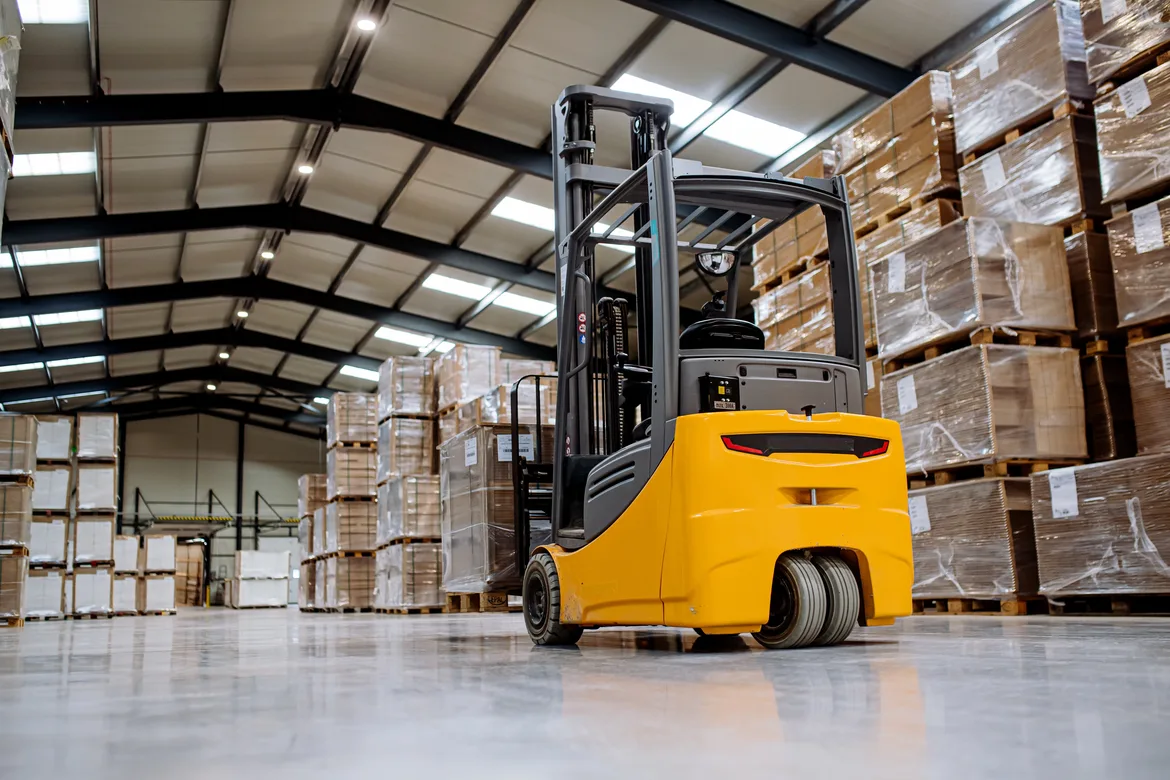
The unit is almost never the expensive part of a bad day. A telehandler that tips forward or lets go of a load tends to need an inspection and a repair, while the material it was carrying, the structure it was reaching into and any worker below it produce the real numbers. The mechanism is dull and reliable: capacity bleeds away as the boom extends, and the surface under a stabilizer pad is usually less competent than the operator believes. Missouri contributes river-bottom fill in both big metros and a genuine freeze-thaw cycle, so ground that carried a machine in November is a different material in March, on the same site, under the same load.
Common Missouri forklift claims we see
- Load released at height. The bundle and whatever it lands on set the loss; the machine is usually the cheapest item involved.
- Forward tip with the boom out. Reach spends rated capacity, and the chart is the document least often consulted.
- Struck-by injury to a worker below. A liability and workers compensation matter that the equipment policy never touches.
- Stabilizer sinking into alluvial or thawing ground. A seasonal certainty here rather than an occasional surprise.
- Damage to finished work during placement. Reaching into a completed building puts the machine against something already paid for.
Why Missouri forklift owners choose Equipment Guard Insurance
A lot of brokers schedule this machine and consider the job done. We would rather tell you that the floater is the inexpensive half: what turns a year bad on a telehandler is the operator and the person standing under the load, and that sits in liability and workers compensation. Writing the equipment monoline means we can schedule the unit properly without disturbing arrangements you have built around municipal requirements that vary from job to job, and we place through markets — named on our homepage — that read a jobsite lifting exposure honestly instead of rating it as light plant.
Major Missouri forklift markets
- St. Louis. Riverfront redevelopment and institutional work on old fill, with placements over occupied streets.
- Kansas City. Bi-state build-out where a single crew crosses licensing jurisdictions inside one week.
- Springfield. Southwest regional commercial and healthcare construction with long trailer moves into the Ozarks.
- Columbia. University and medical projects staged around buildings that never close for the work.
- Jefferson City. Public and capitol-adjacent projects where operator documentation is checked before a machine is admitted.
- St. Joseph. Agricultural-industrial and river-corridor work with open pads and long unsupervised days.
Related
- Forklift insurance — the machine physics that hold in every state.
- Backhoe insurance in Missouri — the machine this state names by category in its own definition of special mobile equipment.
- All equipment insurance in Missouri — the state hub.
- Equipment floater · Rented & leased equipment
Primary sources
- State Plans — Occupational Safety and Health Administration (operator safety)
Missouri forklift insurance FAQs
Which agency governs forklift operators in Missouri?
Federal OSHA. No approved state plan reaches private-sector employers here, so the powered-industrial-truck training and evaluation duties are the federal standard applied directly, and the inspector, the citation and the appeal are all federal. There is no Missouri safety office in that chain, which contractors moving in from a plan state notice immediately when they go looking for one.
So who does regulate a contractor in this state?
City hall, in practice. Missouri issues no statewide general-contractor license — licensing is handled entirely by local jurisdictions, with Kansas City, St. Louis city and county, Springfield and Columbia each running their own, and the state division of professional registration handling only particular trades such as electrical. A company working across the state is answering to several municipal systems and to no state one, which is the opposite of how most contractors assume the hierarchy works.
If nobody at the state level checks operator training, does it still matter?
More, not less. When there is no state office asking, the checking moves to the parties with money at stake: the general contractor prequalifying a subcontractor, the owner requiring documentation before a machine comes through the gate, and the adjuster reading the file after a load comes down. Those readers are less predictable than an inspector and considerably less forgiving, because they are deciding whether you work again rather than issuing a citation.
Do the two big metros complicate this?
They complicate scheduling more than safety. Both major markets here sit on state lines, so a crew can start the week on one side of a river and finish it on the other, with different municipal licensing, different permit desks and different inspection calendars — while the federal safety standard behind the machine does not change at all. The paperwork moves; the operator qualification does not.
What does the ground do to a rough-terrain machine here?
It varies more than the flat middle of the country suggests. Riverfront and bottomland work sits on alluvial material and old fill that compresses under a concentrated point load, while freeze and thaw work through a full winter and leave a pad in spring that is not the pad from autumn. An outrigger set without a mat on either surface is a claim waiting for the right load.
Can you write the machine on its own?
Yes. Equipment Guard Insurance places equipment monoline in Missouri, so the telehandler and its attachments are scheduled by themselves without disturbing anything else you carry. Where a state layer is missing, we would rather help you build the documentation that other people will ask for than assume somebody else has already required it.