
On a small crew the reach machine is the least discussed and most used piece on site. It lands a bundle, feeds a wall, moves a pallet across ground a truck cannot cross, and asks for nothing — right up to the moment it puts a load down through something, or onto someone.
South Dakota’s contribution is a very thin state layer and a lot of open country between you and help. No state safety authority stands behind this machine, and the only statewide credential you hold is a tax one. For the mechanics that hold everywhere — reach against rated capacity, boom geometry, ground bearing, the forward-tip pattern — see the forklift insurance pillar.
What forklift insurance costs in South Dakota
A quoted premium on a page would be a guess, because the drivers of this class are people, distance and documentation. What actually moves it here is how many operators run the unit and whether each evaluation is recorded on that model, whether it is a fixed-mast truck or a telehandler working at extension, how far your machines sit from any supervision on a normal week, where they winter, and the losses behind you. The value of the machine is a modest line in a rating built mostly out of everything else.
South Dakota forklift regulations: who enforces operator safety
South Dakota is under federal OSHA for private-sector employers, so the powered-industrial-truck operator training and evaluation requirements are the federal standard applied directly.
Set that beside the only credential this state does issue and the shape of the risk becomes clear. A person contracting for construction here holds a contractor’s excise tax license from the Department of Revenue, and that is the whole of it — no competency board for general construction, no examination, no classification, with only specialty trades such as electrical and plumbing licensed separately. So the state knows your company as a taxpayer and in no other capacity, and it has no interest in and no machinery for asking who was cleared to run a telehandler. That is not a loophole to enjoy; it is a transfer of the question to parties with sharper teeth. Larger prime contractors, hospital and school owners, and work touching federal or tribal land all impose their own documentation rules, and an adjuster reconstructing a dropped load will ask for the same record with the benefit of hindsight. Add the distances involved — a unit can be several hours from anyone who would notice a problem — and the honest position is that in this state your own paperwork and your own habits are the entire control environment. Nothing external is going to correct a drift before it costs you.
Common forklift risks in South Dakota
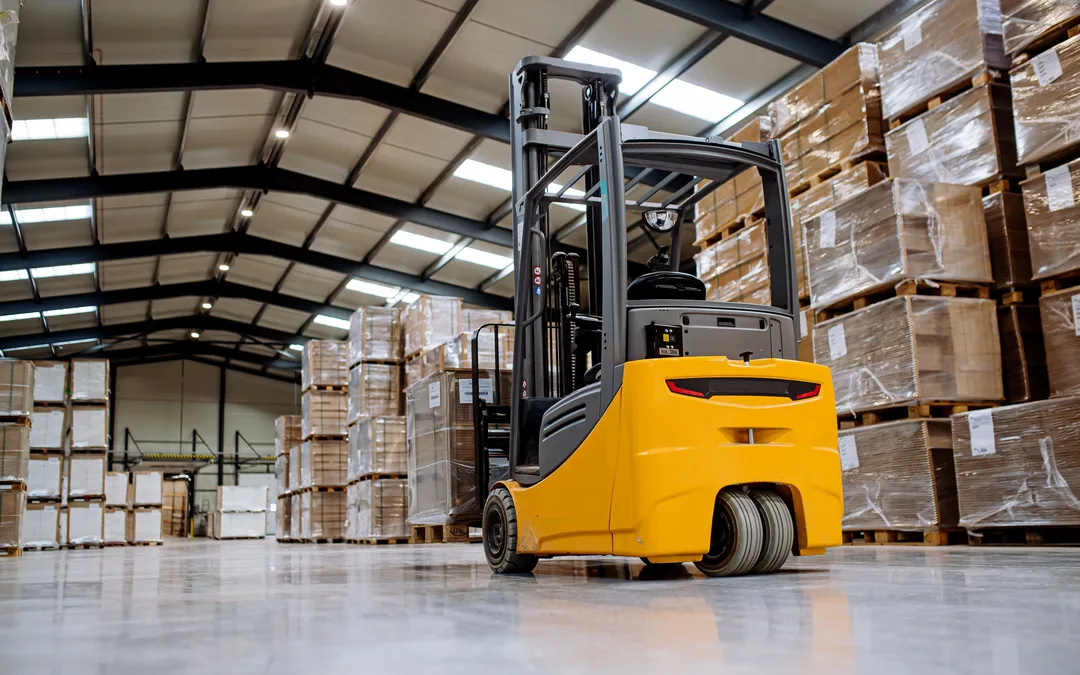
The machine is seldom the casualty. A forward tip or a released load usually leaves a unit that can be checked and put back to work, while the material, the structure and the person standing below produce the claim. Rated capacity draining away as the boom extends is the mechanical constant, and the surface under a stabilizer is the environmental one. This state gives that second problem two faces: cropland and glacial till in the east that hold poorly once wet, and rock, grade and benched pads in the west where nothing sits level. A hard frost cycle rearranges both every spring, and a machine working far from the yard tends to get inspected on a schedule set by convenience rather than by condition.
Common South Dakota forklift claims we see
- Load released at extension. What it lands on writes the number; the unit is rarely the costly part.
- Forward tip on a benched or sloping pad. Grade and reach compound, and the load chart goes unread.
- Struck-by injury far from a hospital. The severity of this one is set by geography as much as by the impact.
- Stabilizer sinking in saturated till. An eastern spring problem that arrives every year on schedule.
- Damage to completed work during placement. Reaching into finished construction puts the machine against paid-for work.
Why South Dakota forklift owners choose Equipment Guard Insurance
We are not going to tell you the equipment policy is the clever part of this account. The floater repairs a machine that generally survived; what decides a bad year on a telehandler is the operator and the person under the load, and that sits in liability and workers compensation. Writing equipment monoline lets us schedule the unit properly without disturbing arrangements built around long distances and a short season, and we place through markets — named on our homepage — willing to underwrite a rough-ground lifting exposure rather than rate it off an indoor assumption.
Major South Dakota forklift markets
- Sioux Falls. The busiest commercial, medical and industrial build-out in the state, with the tightest downtown staging.
- Rapid City. Hills-side work with grade, rock and benched pads that decide where a machine can set up at all.
- Aberdeen. Northern agricultural processing and bin construction, with lifts beside live facilities.
- Brookings. University and research projects staged around buildings that stay occupied through the work.
- Watertown. Regional industrial and food-processing construction with long open pads and winter schedules.
- Yankton. River-corridor and rural commercial work where a crew may be the only supervision for days.
Related
- Forklift insurance — the machine physics that hold in every state.
- Skid Steer insurance in South Dakota — the unit most likely to be stolen off a site nobody drives past at night.
- All equipment insurance in South Dakota — the state hub.
- Equipment floater · Rented & leased equipment
Primary sources
- State Plans — Occupational Safety and Health Administration (operator safety)
South Dakota forklift insurance FAQs
Does South Dakota have its own workplace safety program?
Not one that reaches a private equipment contractor. There is no approved state plan covering private-sector employers, so the powered-industrial-truck training and evaluation requirements are the federal standard applied directly, and the investigation, the citation and the appeal are all federal. Contractors arriving from a plan state find there is simply no state counterpart to call.
What does the state issue a contractor, then?
A tax instrument. Anyone contracting for construction here must hold a contractor’s excise tax license from the Department of Revenue, and only specialty trades such as electrical and plumbing are separately licensed. There is no statewide competency board for general construction, which means the state’s entire record of your company is a revenue record. It establishes that you pay; it says nothing at all about who is qualified to run a machine.
If nobody asks, why keep operator evaluation records?
Because the people who eventually ask have more leverage than an inspector. Prime contractors on larger projects, tribal and federal-adjacent work, hospital and school owners, and the adjuster reconstructing a dropped load all want the same document, and they want it after the fact rather than before. A record created retrospectively is worth very little; one dated before the lift is worth a great deal.
How much does distance actually matter to this exposure?
More than in almost any state east of here. A machine working two hundred miles from the yard is a machine nobody senior has looked at in a week, and a worker injured under a load on a rural site waits longer for transport than one hurt in a city. Neither fact changes the standard, but both change outcomes — the severity of an injury claim and the condition a unit is in when it finally gets inspected.
Do the eastern and western halves of the state behave differently underfoot?
Considerably. Eastern ground is glacial till and cropland that turns soft and stays soft after a wet spell, while the Black Hills side adds grade, rock and benched pads where a machine is never quite level. A crew that has learned to trust a stabilizer pad on one side of the state is working from the wrong assumption on the other, and the winter frost cycle resets both every year.
Will you write just the machine?
Yes. Equipment Guard Insurance places equipment monoline in South Dakota, so the telehandler and its attachments sit on their own schedule without anything else being reopened. In a state with no safety agency asking questions, we would rather help build the file that private parties will demand than assume somebody already required it.