
A compact loader is what makes a Wyoming crew of two or three able to bid work at all. It handles pad and access prep on energy sites, utility and drainage repair in small towns, backfill and grading behind residential builds, and snow for a season that does not end early. It fits where a big machine cannot go and rides on a trailer behind the truck already headed that direction. The trouble is that this is also the easiest serious machine in the state to steal, and the hardest place in the country to notice quickly that it is gone.
What follows is specific to Wyoming: a licensing landscape that resets at each municipal line with one statewide exception, working markets defined by energy development and resort construction, and distances that turn an ordinary theft into a cold trail. The mechanics of the machine itself — what attachments turn it into, why the steering method chews finished ground, what makes it pitch forward — belong on the skid steer insurance pillar.
What skid steer insurance costs in Wyoming
We do not quote a premium in print, because a number that stands up is built out of the machine in front of us and the way it is kept. In Wyoming the lever that moves furthest is exposure time: how many nights a year the loader sits on a site nobody is watching, and whether anything about that site slows a person with a trailer down. After that come attachment values on the schedule, the valuation basis you choose, whether a tracking unit is fitted, and your own loss history. A loader that comes back to a lit yard in Cheyenne every evening and one that overwinters on a remote pad are nowhere near the same risk.
Wyoming skid steer regulations: title, lien and ownership
A skid steer is untitled construction equipment; a lender perfects its lien by filing a UCC-1 financing statement with the Wyoming Secretary of State.
What follows from that is ordinary and worth being precise about anyway. No certificate of ownership is ever issued for the machine, so the financing statement and the serial number are the ownership record. A lender on a financed loader goes onto the policy as a loss payee against the scheduled unit, meaning a loss payment is issued jointly, and the two records have to stay in step — a lienholder still named against a machine you paid off is the clearest sign the schedule needs a look. One layer up sits the credential question, and Wyoming answers it unusually. There is no statewide general-contractor license at all: general, plumbing and mechanical licensing is a matter for individual cities and counties, so the obligation you carry is a local one that changes as the work moves. Electrical work is the single exception, licensed at the state level and therefore portable. None of it reaches the loader; it reaches which entity may hold the contract — which matters at the moment a general contractor compares the name on your certificate of insurance against the name on a local registration and finds they do not match.
Common skid steer risks in Wyoming
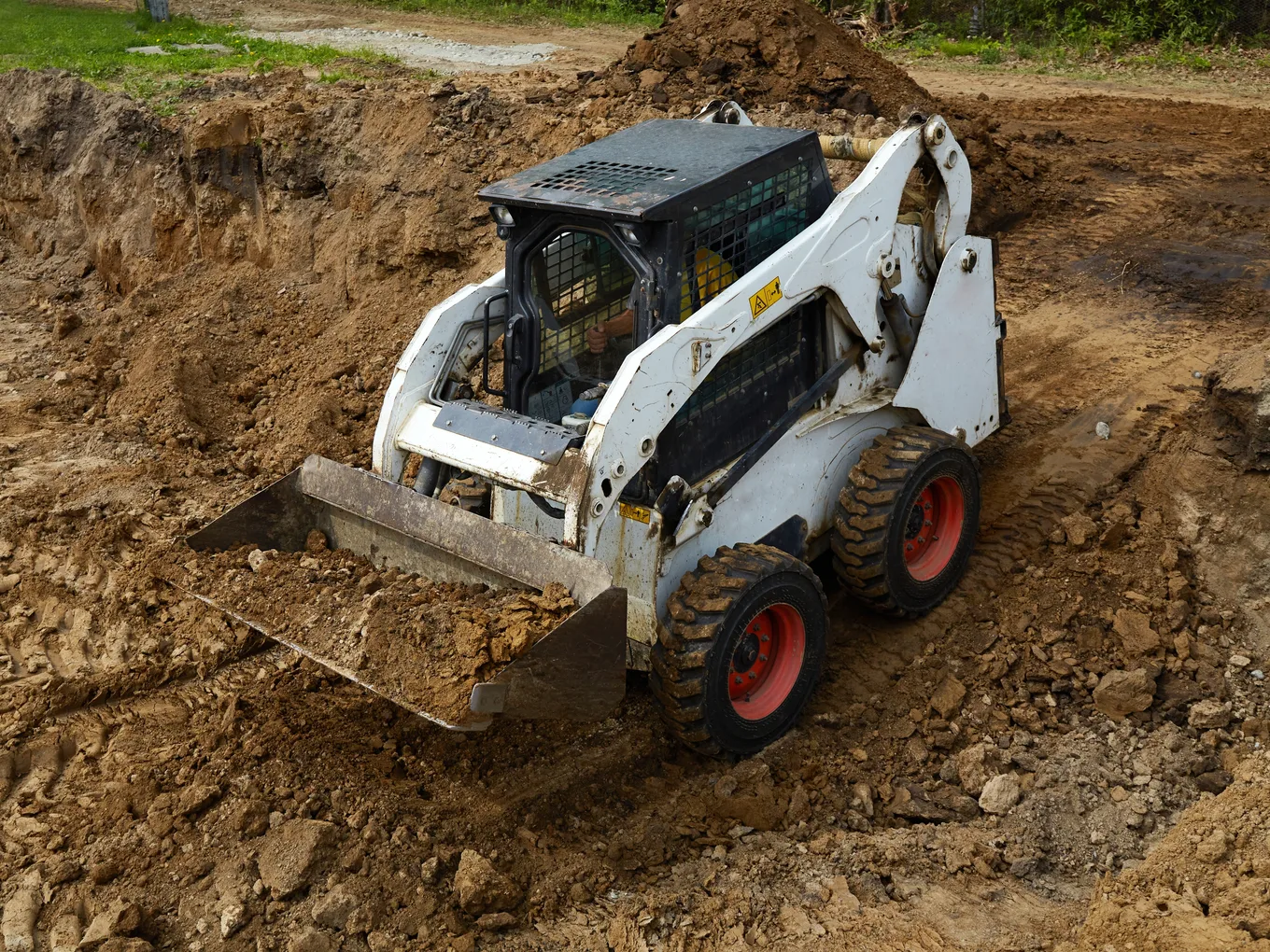
Theft is the exposure that defines this class in Wyoming, and it works differently from a metro state. Compact loaders are taken far more often than large tracked machines because one person can load one — but the aggravating factor here is not corridor access, it is discovery time. A machine on a remote site may have been gone for days before anyone knows, which is long enough to reach any of several state lines. Wind and cold form the second exposure and neither is seasonal in the usual sense: sustained wind is a working condition that puts debris in the air and makes elevated loads a judgment call, and the cold season is long enough to matter to hydraulics, hoses and glass on any machine left standing. Rough access roads and unimproved ground contribute a third group of losses, mostly recovery and undercarriage damage. The forward tip and loading damage account for most of the remainder.
Common Wyoming skid steer claims we see
- Theft discovered days late. The signature claim of this state, where the loss date itself is uncertain and the serial record is the only thing anyone can act on because no ownership certificate exists.
- Wind-driven damage on an exposed site. Doors, glass and mirrors, and debris strikes on a machine that had nothing standing between it and the weather.
- Cold-season hydraulic and hose failure. On a loader that sat through a long stretch of hard cold on a remote pad rather than in a shop.
- Attachment taken from a staging area. A breaker, grapple or snow pusher lifted off a rack, then found to sit under a blanket per-item sublimit rather than scheduled by name.
- Damage on an unimproved access road. Undercarriage, tire and hydraulic damage from getting to the work rather than from doing it.
Why Wyoming skid steer owners choose Equipment Guard Insurance
We write equipment monoline, and in Wyoming that solves a problem the market creates: a crew here often carries general liability arranged to satisfy an energy operator or a particular town, and being told to move the whole program to get one loader scheduled properly is a reason to keep putting it off. We do not ask for that. We schedule attachments by name as a matter of course, and we place through markets named on our homepage that will read a Wyoming equipment schedule on its own merits.
Major Wyoming skid steer markets
- Cheyenne. The state’s largest jobsite market and the one likeliest to give a loader a fenced, lit place to sleep — also the market with the shortest run to a state line.
- Casper. The central hub for energy-service and industrial site work, with the deepest rental market in the state, so rented-in loaders and rental-house certificates are routine here.
- Gillette. Energy-development country in the northeast, where machines work pads and access roads well away from town and stay out for stretches at a time.
- Laramie. Institutional and residential work at altitude, with the hardest winter conditions among the state’s population centers.
- Rock Springs. Industrial and utility work across wide, sparsely settled country in the southwest, where routine travel between jobs is measured in hours.
- Jackson. High-value resort and residential construction on tight, difficult sites, where machine and attachment values run above the state norm and finished-surface damage drives the non-theft claims.
Related
- Skid steer insurance — the machine physics that hold in every state.
- Backhoe insurance in Wyoming — the machine a county registration scheme actually names.
- All equipment insurance in Wyoming — the state hub.
- Equipment floater · Rented & leased equipment
Primary sources
- Licensing - Electrical Safety, Wyoming State Fire Marshal's Office — Local city/county governments (general contractors); Wyoming Department of Fire Prevention and Electrical Safety (electricians) (contractor licensing)
We do not link a Wyoming filing document here. The ownership and lien rules described above follow Article 9 as Wyoming has adopted it; where a state publishes a document that states the rule directly, this page links it.
Wyoming skid steer insurance FAQs
Is a skid steer titled or registered in Wyoming?
No. It is untitled construction equipment rather than a titled vehicle, so nothing is issued for the loader and nothing is signed over at a county counter when it sells. Its identity is the serial plate, the bill of sale and the financing record. Out here that record does more work than in most states: when a machine goes missing from a site far from anywhere, the serial number is often the only fact anyone has to act on for days.
Do I need a Wyoming contractor license to run a skid steer?
There is no statewide general-contractor license to hold. Licensing for general, plumbing and mechanical contractors is handled locally, city by city and county by county, so the requirement genuinely changes as the work moves — and a crew bidding in two towns in the same month can face two different sets of paperwork. Electrical work is the exception: it is licensed at the state level, so an electrical credential travels with you in a way a general one does not. None of it says anything about the loader, which is why the serial record has to.
Why does remoteness matter so much on this class here?
Because the thing that defeats recovery is time, not distance. In a dense metro a stolen loader is usually missed within hours. On a Wyoming site — an energy pad, a rural utility job, a subdivision at the edge of a small town — nobody may be due back for days, and by then the machine has a long head start with several state lines to choose from. It is the strongest possible argument for a tracking unit and a schedule that already carries serial numbers.
How do wind and cold change the underwriting?
They dominate the non-theft half of the claim file. Sustained high wind is an ordinary condition here rather than a storm event: it puts debris in motion, works on doors and glass, and makes lifting at height a judgment call. Cold does the rest — hard starts, cold hydraulics and hoses, and a season long enough that a machine left on a remote site sits through weeks of it. Where the loader spends the winter is a real underwriting question here.
Are attachments covered on a Wyoming skid steer policy?
Only the ones that are scheduled. Buckets, augers, breakers, grapples and snow pushers usually sit under a blanket limit with a per-item sublimit, and the heads worth real money exceed it. Attachments also disappear on their own, taken from a rack while the loader stays put. Heads left at a remote site are exposed for the same long stretch the loader is, so anything above the sublimit belongs on the schedule by name.
Can I insure just the skid steer, without a package policy?
Yes. Equipment Guard Insurance writes equipment monoline in Wyoming, so the iron and its attachments can carry a schedule of their own. Any general liability already in force stays exactly where it sits.