
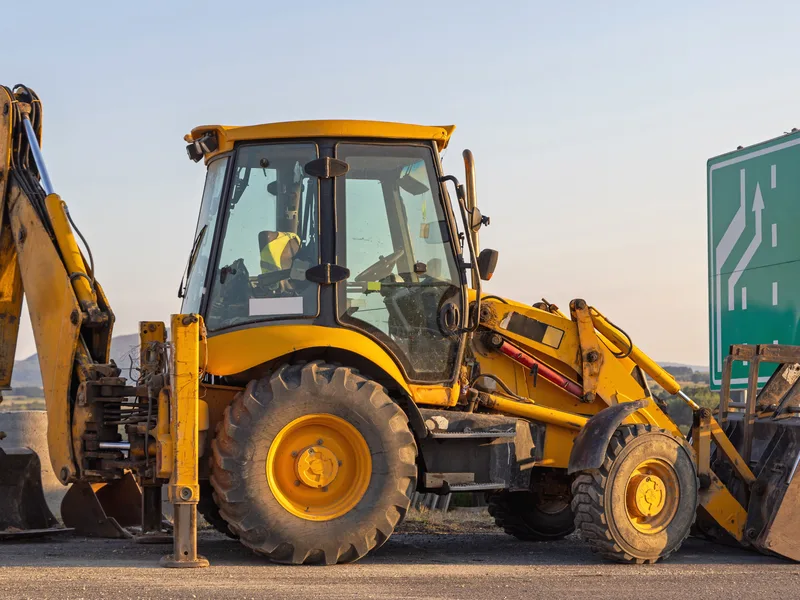

A backhoe is priced around the fact that it moves itself. It works, it drives, it rides a trailer, and each of those changes which policy is answering. Where the machine happens to be at any given moment does far more to the exposure than its horsepower or its model year ever will.
Before the shift: where the machine spends the night
Start with the hours nobody bills. A loader-backhoe is most often lost when it is doing nothing — parked at the edge of a job between phases, left on a shoulder overnight because tomorrow’s work starts there, or standing in an unfenced lot behind the shop. Underwriters ask where each machine sleeps because it is one of the few schedule facts an owner can actually change.
The answers that help are ordinary. A gated yard rather than an open site. Keys stored away from the machine rather than under the seat. A tracking unit fitted to the machine itself rather than to the trailer that usually hauls it. And a storage answer on the application that matches what the crew genuinely does, not what the office intends.
Storage answers also have a seasonal shape. A winter shutdown concentrates machines in one place for months, which reduces the number of unattended sites and raises the accumulation at whichever yard holds everything. Both facts are worth stating rather than leaving an underwriter to assume the summer pattern runs all year.
The equipment floater is the form carrying the machine through all of this, and the serial number on it does the work a license plate would do for a truck. Construction equipment is not titled, so the schedule is a proof-of-ownership document as much as a rating one.
Under its own power: what the vehicle codes call this machine
The moment a backhoe pulls onto a public road it enters a legal category most owners have never read. State vehicle codes almost universally treat it as special mobile equipment — machinery built for work rather than for transporting people or property — and carve it out of the definitions that trigger registration and titling.
The wording differs but the shape repeats. Cal. Veh. Code § 565 defines special mobile equipment as machinery not designed or used primarily for the transportation of persons or property on a highway. K.S.A. 8-1467 and Md. Transp. § 11-159 reach the same place through their own language, Minn. Stat. § 168.002 sets its definitions in the registration chapter itself, and RCW 46.04.552 does the same for Washington.
Two practical questions follow from that classification. The first is who is permitted at the controls once the machine leaves private ground, which is a licensing question answered locally rather than an equipment one. The second is distance. Several states tolerate incidental highway travel between adjacent jobs and treat a machine that regularly covers real mileage as something else entirely, so a contractor whose crews routinely drive machines across town is describing a road exposure whatever the schedule calls it.
Why an insurance buyer should care: that classification is the reason the machine belongs on an equipment schedule rather than on the vehicle schedule, and the reason a road move is not automatically an auto claim. The exclusion from registration is not an exemption from liability. Lighting, marking and escort rules still bind, and they are set locally.
On the trailer: the same machine, a different answer
Most backhoe road travel is short and self-propelled, but the long moves ride. That is a handoff, and handoffs are where programs leak.
The truck and the trailer are vehicles, and commercial auto answers for them. The machine on the deck is not a vehicle in use — it is scheduled equipment in transit, and transit and trailer transport is the part that answers for it while it is chained down, and during the loading and unloading either side of the haul. A meaningful share of equipment damage happens on a ramp rather than in a trench.
Contractors who assume the auto policy follows the load are describing a gap, not a coverage. Read the haul pattern honestly: how far, how often, whose truck, and who is at the controls when the machine goes up the ramp.
Real-World Scenario: A crew finishes a water-service tie-in early and decides to move the machine to tomorrow’s address rather than trailer it back to the yard. The route is two miles of county road at dusk. The operator is experienced, the machine is fully scheduled, and neither fact matters when a following driver misjudges the closing speed of something moving at a fraction of the posted limit. The conversation afterward is about lighting, markings and who was responsible for the move — not about the backhoe.
At the front: the loader half of the day
The loader end works fast, at height, and close to everything. It carries material across a site, loads trucks, backfills, and lifts things it was never asked to lift. The losses it produces are contact losses: a struck parked vehicle, a clipped downspout, a pallet dropped through finished work.
Those are liability claims rather than equipment claims, and they run through general liability. They are also frequency claims, and frequency is what moves a renewal. Three small contact losses read worse to an underwriter than one larger, unluckier event, because frequency looks like a pattern and severity can look like weather.
At the back: the hoe half of the day
The hoe end produces fewer losses and larger ones. A bucket reaching below grade can find a service line, and a utility strike converts a routine trench into a liability file with an outage attached. The machine damage is the small half of that number.
Depth is the other variable underwriters ask about, and they ask for two reasons. Deeper trenches mean more time with a person below grade, which is a crew exposure rather than an equipment one. They also mean spoil piled higher beside the cut, and spoil placed hard against the edge is what turns a stable trench into an unstable one overnight. A machine parked beside its own spoil at the end of a shift is a routine sight and an avoidable one.
Every state runs a dig-notice system, and the timing rules are more particular than most crews assume — some states set both a floor and a ceiling on how early a ticket may be pulled, so a ticket that ages past a slipped start date is no ticket at all. Our Ohio cost guide works through one state’s notice mechanics in detail, and the backhoe overview sets out the road-and-trench pairing across the country.
Stabilizers down: the surface underneath
Setting up is its own exposure and it produces claims that never touch the machine. Stabilizers concentrate the whole weight of a backhoe into four small footprints, and those footprints come down on driveways, sidewalks, irrigation heads, buried service boxes and septic lids.
Pads help. So does a habit of looking down before the outriggers do. Underwriters rarely ask about this directly, but it shows up in the loss run as a run of small third-party repairs, and a run of small anything is the most expensive pattern a schedule can carry.
After the shift: hours, wear and the settlement basis
Owners expect age to dominate and it rarely does. A ten-year-old machine with documented service intervals is a more predictable risk than a young one run hard across three crews with no maintenance log behind it. Age is a proxy for condition, and a proxy loses to the real thing whenever the real thing is available.
What age genuinely changes is settlement. Older machines sit better on an agreed or actual-cash-value footing than on a replacement basis, and that belongs on the schedule as a decision rather than a default. Hour meters matter for the same reason: they describe use, and use predicts failure better than a model year does. Crews are the other half — operator training records run through workers compensation and the liability layer at once.
Where the renewal actually moves
Loss frequency first, schedule accuracy second, and the road answer third — how many miles this machine covers under its own power, on whose roads, at what hour. Rented machines are the quiet fourth: an owned schedule answers for nothing you do not own, which is what rented and leased equipment coverage exists to fix.
None of those is a market condition, which is the useful part. Send a current machine list through the quote form and we will work it against the day described above. The California and Washington pages carry the road-operation rules state by state, and our companion guide on what drives skid steer insurance cost takes the same question from the compact end of the yard.