
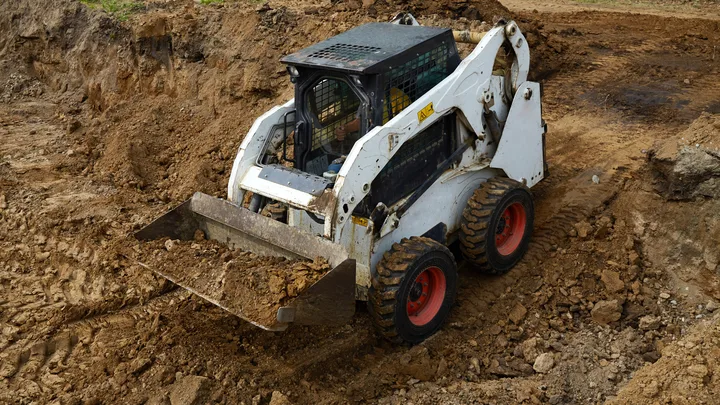

The rig is rarely the expensive part. Horizontal drilling puts a modest machine beside assets belonging to other people — buried lines, public pavement, private ground and finished work — and the exposure follows those assets rather than the equipment. Price this class by asking whose asset is at risk at each stage.
The machine is the small number in a drilling loss
Every other equipment class scales roughly with itself. A larger machine is a larger exposure, and the schedule and the risk move together. Drilling breaks that relationship. A compact rig working a residential easement can create a loss out of all proportion to anything on the schedule, because the damage happens to things that were already in the ground when the crew arrived.
That is why the underwriting questions run toward the work rather than the iron: what depth, in what soil, near which utilities, under whose road, for which customer. The equipment floater still matters and still needs to be accurate, but on this class it is the smaller half of the file.
Scale is a poor guide here as well. A short residential service bore and a long utility crossing use different rigs and produce claims of much the same shape, because both cross ground somebody else owns and both rely on records made by third parties. The exposure follows the crossing rather than the length of the shot.
The rest of this guide is organized by counterparty — the ladder of people whose assets a bore can reach, from your own gear outward. That ordering is not editorial. It is roughly the order in which a bad day escalates.
First party: the rig, the rods and the locating gear
Start with what you own, because the schedule is where owners are most often short. The rig itself is usually listed. Drill rods, reamers, transmitters, mud mixing systems, vacuum excavation units and the support trailer frequently are not, and collectively they can rival the machine.
Locating equipment is the sharpest case. Walkover receivers, sondes and tracking gear travel in a truck rather than on the rig, are worth taking, and are the one component a crew genuinely cannot work without. Schedule them by serial number as items in their own right. The general principle here matches every untitled equipment class — proof of ownership rests on purchase records and serials rather than on a title — and the mechanics are set out with the state filing rules in our guide on what drives compactor insurance cost and the compact-machine guide it points to.
Transport is the other first-party exposure. Rigs and support trailers move constantly between short jobs, and the machine on a deck is answered by transit and trailer transport rather than by the auto policy.
The utility owner: what a bore finds underground
This is the exposure the trade is defined by. A bore that contacts an existing line converts a routine crossing into a liability claim with an outage, an emergency repair crew and often a regulatory report attached. Fiber is the modern worst case, because the repair is quick and the consequential claims behind it are not.
Every state runs a dig-notice system, and the timing rules are law rather than custom — some states set both a minimum notice period and a limit on how far ahead a ticket may be pulled, so a ticket that ages past a delayed start is no protection at all. Our Ohio cost guide works through one state’s notice mechanics with the statute in hand, and the backhoe cost guide covers the same underground exposure from the trenching side.
Unmapped and abandoned lines are the recurring complication. Older neighborhoods carry services installed before records were kept, and abandoned lines that appear on no drawing at all, and neither shows up reliably in a locate. Potholing at the crossings is the only dependable answer, and it is the habit that most separates clean loss records from poor ones.
What underwriters look for is documentary discipline: ticket numbers retained, marks photographed before work starts, potholing where the marks are ambiguous, and field notes written the same day. That file is the entire defense when the marks turn out to have been wrong.
The road authority: pavement, right-of-way and the bore path
Boring under a road is the reason the technique exists, and it introduces a counterparty with its own rules. Permits, depth requirements, restoration standards and bond requirements vary by jurisdiction, and a bore that surfaces early, deviates from the permitted path or leaves a settled patch behind becomes the authority’s problem and then yours.
Settlement is the slow version of this claim. A bore path that consolidates under a travel lane over the following season produces a depression that nobody links to the crew that left months earlier — until the records are pulled. The exposure sits in general liability and, once the crew has demobilized, in its completed-operations wording specifically.
The adjacent landowner: where drilling fluid goes when it does not come back
Drilling fluid takes the easiest path available, and the easiest path is not always the borehole. A fracture in the soil, an old excavation, a utility trench backfilled with loose material or a shallow bore in the wrong ground can vent fluid to the surface.
Where it surfaces determines the size of the problem. A lawn is a cleanup. A basement is a habitability claim. A waterway is a regulatory event with an agency involved and a timeline that starts immediately. None of that touches the rig, and all of it lands on the liability layer.
Response planning is what separates a contained event from a reported one. A crew that carries containment materials on the truck, knows who to call before it needs to, and photographs the surface before and after is running a cleanup. A crew improvising for two hours is generating an agency file.
Real-World Scenario: A crew is pulling a service line under a residential street on a wet spring morning and the returns go quiet halfway through the shot. The operator carries on, because pressure is normal and the bore is tracking. Two doors down, a homeowner comes out to say there is grey fluid coming up through the seam where the driveway meets the garage slab. The bore is fine, the rig is undamaged, and the next four hours are spent on containment, cleanup and a conversation with a homeowner who is not interested in how directional drilling works.
The customer: the work you were hired to leave behind
A drilling contractor is hired to leave something in the ground and to leave the surface as it was found. Both halves can fail after the crew has gone. Restoration that settles, a casing that shifts, a line that fails at a coupling — these arrive as claims about your work rather than about your operations, and the wording that answers is the completed-operations part of the liability layer.
Contract terms matter here more than on most equipment classes. Indemnity language, additional-insured requirements and warranty periods are negotiated before the first bore and read after the first failure, and contractors carrying several such agreements at once usually find an umbrella layer is the cheapest part of the answer.
The crew: the people between the rig and the bore
Electrical strike is the exposure that makes this trade different from every other earthmoving class. A rod string is a conductor, the ground around a strike is energized, and the people at risk are standing on it. That is why locating discipline is a safety control before it is a liability control.
Confined-space work belongs alongside it. Receiving pits, vaults and manholes are entered routinely on utility jobs, and the entry procedures that govern them are documented obligations an underwriter will ask to see after any injury near a bore exit.
The injury side runs through workers compensation, and the training records that support it are the same documents an underwriter asks to see. Hired machines belong in the same conversation — a short-term rig or vacuum unit sits under rented and leased equipment rather than the owned schedule, and the limit belongs at the size of what you might actually take.
What the ladder means at renewal
Work backwards through the counterparties and the priorities sort themselves. Notice discipline first, because it governs the largest exposure. Fluid-response planning second, because the first hour decides the size. Contract review third. Schedule accuracy fourth — important, but on this class it is the smallest of the four.
Send the machine list and a description of the work through the quote form and we will read it against the ladder above. The directional drill overview covers the class, and the excavator pillar carries the open-cut side of the same underground exposure.