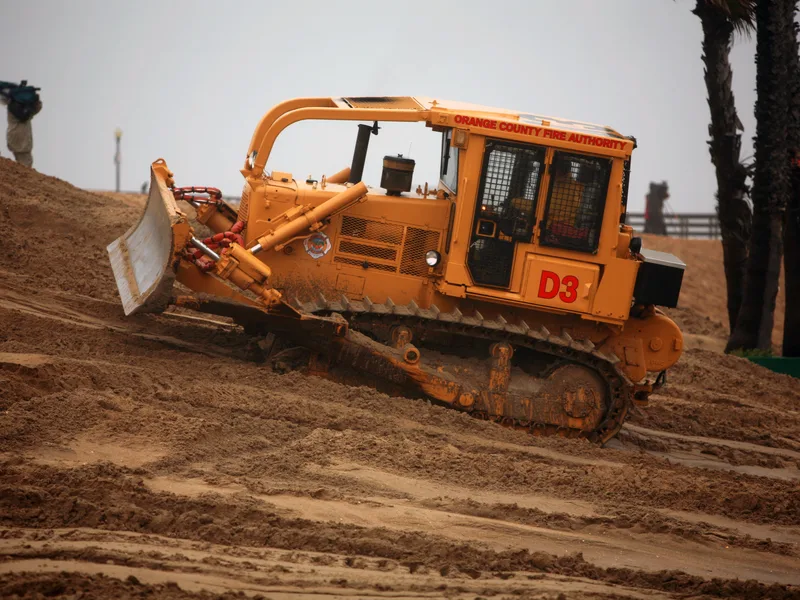

Read a dozer schedule and you learn very little. Read the site the machine is standing on and you learn most of it. Opened ground, the direction water leaves, the slope being cut, and how many months the machine will occupy that job explain more about the number than any specification sheet does.
The exposure belongs to the site, not the schedule line
Two identical tracked machines can present completely different risks depending on where they are working. One is on a subdivision pad in a dry county, moving between phases every few weeks. The other has been sitting on a river-adjacent linear project since spring, working saturated ground beside water it must not disturb. The line on the equipment floater looks the same for both.
This is why the application questions run toward the job rather than the iron: what kind of work, on what ground, for how long, and what is downhill. An underwriter is not being nosy. Site character is the only available proxy for the loss causes that dominate this machine class, none of which are about the machine.
Work type is the coarse version of the same question. Pad and subdivision grading, linear utility corridors, pond and levee construction, land clearing and reclamation all use the same machines and produce visibly different loss profiles, and an underwriter who knows which of those you actually do can price it rather than averaging across all five.
The practical version for an owner is that the honest answer beats the flattering one. A schedule describing suburban pad work while the machine spends its year on pond and levee jobs is a schedule that will disagree with the first claim file.
Ground that has been opened stays open
A dozer’s job is to move earth, and moved earth behaves differently from earth that has never been touched. It absorbs less, it moves when it rains, and it stays exposed until something is planted or paved over it. Every state runs a construction stormwater permitting program to manage exactly that, delegated from the federal program and administered by its own agency.
The structures are recognizable across states while the details are local. Georgia handles it through the Environmental Protection Division’s construction stormwater general permits; Texas through the state commission on environmental quality; Pennsylvania through its department of environmental protection; Oregon through the department of environmental quality’s construction program; and North Carolina through its environmental quality construction program.
None of that is an insurance obligation, and no equipment form rates off it. It belongs in a cost guide because permit coverage marks a threshold in the character of the work. Sites large enough to need it run longer, hold more machines between phases, and leave bare ground waiting on weather.
Water is the loss cause nobody schedules for
Ask a contractor what threatens a tracked machine and the answer is rarely water. Ask a claims file and it frequently is. Low ground floods. Detention basins fill faster than the crew expects. Access roads soften until a lowboy cannot reach the machine parked at the far end of the site.
Water also produces the losses that look like operator error and are not. A machine working a saturated slope loses traction as a function of moisture content, not skill. Recovery — one machine pulling another out — is its own damage event, and it happens after hours, off the record, by people trying to fix a problem quickly.
There is a schedule consequence as well. Machines that spend a season on wet ground age differently — undercarriage components wear faster, seals fail earlier, and the maintenance record starts to matter more than the model year does. Owners who work saturated sites regularly should expect more questions about service intervals, and should be able to answer them from records rather than from memory.
Underwriters read drainage indirectly, through the questions about site type and duration. Owners can read it directly, by knowing where the machine parks relative to the low point of the job.
Slope, spoil and the edge that gives way
Sidehill work is the exposure that takes an operator with it. A heavy tracked machine on a cut slope, working near a spoil edge or an undercut face, is in a position where the ground decides the outcome. Rollover protection and a worn seatbelt are the difference between an equipment claim and something worse, which means this exposure lands on workers compensation and the liability layer at the same time.
Real-World Scenario: A crew is finishing a pad late in the week and pushes spoil to the outside edge to keep the working surface clear. Rain arrives over the weekend and nobody visits the site. On Monday the pile has slumped and the edge it was resting on has moved with it, so the first pass of the morning is over ground that is no longer where the operator remembers leaving it. The machine goes over onto its side, slowly, and the operator walks away only because the belt was fastened. Everything after that is a conversation about weekend rain and where spoil was placed on Friday.
The long occupancy problem
Dozers stay. Where a compact machine visits a site for two days, a dozer often occupies one job for a season, and every unattended night is an exposure the schedule never sees. Fuel is siphoned, batteries walk, and undercarriage components have a resale market of their own.
Vandalism belongs in the same paragraph and is frequently the worse half. A machine too large to remove is still a machine that can have its glass broken, its wiring cut and its hydraulic lines opened by someone who was never going to steal it. Those losses are modest individually and relentless on sites that stay open through a season, and relentlessness is exactly what a loss run makes visible.
Long occupancy also means the machine becomes predictable to anyone watching. The controls that work are unglamorous — parking machines together rather than scattered, blocking access with the least-portable unit, removing keys, and fitting tracking to the machine itself. Where several machines sit on one site through a season, the accumulation is worth checking against the limits, and an umbrella layer over the primary liability limits usually costs less than owners assume.
Fire, fuel and the undercarriage
Clearing and grubbing work packs dry vegetation into the exact places that get hot. Engine bays, belly pans and undercarriage cavities collect shredded material while turbochargers and exhaust components run at temperature for hours, and a dozer working dry brush in late summer is carrying both halves of a fire at once.
Season matters more than geography here. The same crew that worked wet ground in spring is working cured fuel by late summer, so the fire exposure moves with the calendar rather than with the state line, and a schedule that describes only the annual average describes neither half well.
The controls are known and cheap: blow the machine down at shift end, keep a serviceable extinguisher mounted rather than in the truck, and refuel with the engine cold. Underwriters ask about vegetation work specifically because the loss is total when it happens, and because the frequency is seasonal and predictable.
Machines that are not yours, and machines in motion
Peak-season fleets are mixed fleets. A rented tracked machine sits on your site under an agreement that makes you responsible from delivery through return, and an owned schedule answers for none of it — rented and leased equipment is the part that does, with the limit set against the largest unit you might take rather than the usual one.
Movement is the mirror image. Because dozers move rarely, the moves are unfamiliar to the crew doing them, and loading a wide tracked machine onto a lowboy is the least routine thing a crew does all quarter. Transit and trailer transport answers for the machine on the deck and during loading, which the auto policy does not.
What the site tells an underwriter at renewal
Duration first — how long the machines sit and how many sit together. Ground second, because slope and drainage explain the losses that look random. Then work type: clearing, mass excavation and pond work fail differently from pad grading. Then the controls, which are the only part fully inside an owner’s hands.
Send a current schedule and an honest description of the jobs through the quote form and we will read it against the site profile above. The dozer overview covers the machine class, the Texas and Oregon pages carry the state-specific land-disturbance rules, contractors comparing markets can start from the Georgia location page, and our backhoe cost guide covers the machine that leaves the site every day instead.