
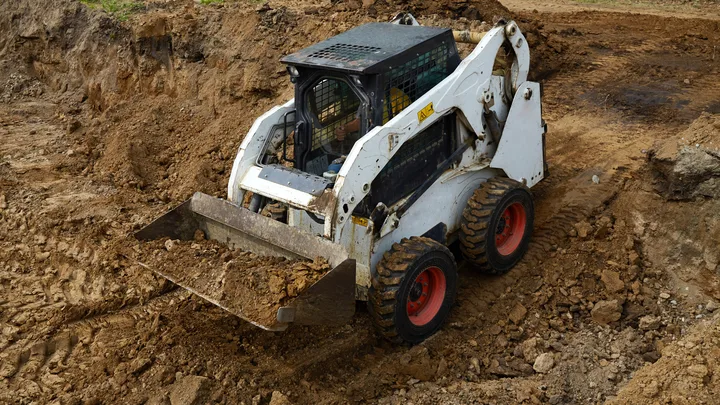

Equipment claims in Maine rarely fail inside a policy. They fail between two of them — where the owned schedule stops and the rental contract starts, where the machine ends and the trailer begins, where the dig ends and the utility begins. What a program costs here follows the seams a contractor has actually closed.
Seam one: the machines you own and the machines you rented
Nearly every mixed fleet in the state runs through this join at some point in a season, because owning enough iron for a peak week means owning too much iron for the rest of the year.
The equipment floater answers for the machines on its schedule. It does not answer for a unit that arrived on a rental agreement, and the agreement itself is usually written the other way — the renter is responsible from delivery through return, for physical damage, for theft, and frequently for loss-of-use charges while the machine is off the rental line rather than earning. Rented and leased equipment coverage exists precisely for that, and the limit belongs at the size of the largest machine a busy month might bring in, not the size of the one that arrives most often.
There is a second-order fact worth knowing. On mixed fleets the rented unit is disproportionately the one that gets damaged, because it is the machine the crew has spent the least time in. Underwriters ask about rental habits for that reason and not out of curiosity — a contractor who rents twice a season and one who rents continuously are running different operations even when the owned schedules look identical.
The seam widens further when a rental runs long. A unit taken for two weeks and kept for two months stops behaving like a rental in every respect except the paperwork: it sits in the yard overnight, it gets hauled between sites, and it collects the same exposures an owned machine collects — under a contract that still hands the whole of it to the renter.
Real-World Scenario: A site contractor rents a mid-size excavator for a two-week culvert job because the owned machine is committed elsewhere. On the last morning the operator catches a track on the trailer ramp while loading out, and the boom takes the impact. The owned-equipment schedule does not answer for the machine because it was never owned; the auto policy does not answer for it because it is not a vehicle; the rental company invoices for repair and for the days the unit is out of service. Nothing about the loss was unusual, and every argument afterward is about which document was supposed to catch it.
Seam two: the machine and the truck underneath it
Self-propelled construction machinery is generally treated as special mobile equipment that is not registered as an ordinary motor vehicle and is only incidentally operated on public roads. No cleared Maine document is available to us for that treatment, so it is stated here as the operating principle it is, with no link attached — the Maine backhoe page carries the road-operation material in state terms.
The consequence is a three-part boundary that has to be assembled deliberately. The machine sits on the equipment schedule. The tractor and trailer sit on commercial auto. The machine while it is loaded, chained, hauled and unloaded belongs to transit and trailer transport. In a state where a working radius routinely means hours rather than minutes, that middle stage is not an occasional exposure — it is a weekly one, and loading and unloading is where a meaningful share of equipment damage actually happens.
Seam three: the machine and the ground it opened
The third seam is the one that turns a small physical-damage event into a large liability one. Under 23 M.R.S. § 3360-A, notice goes to the regional notification system at least three business days before excavation and not more than thirty calendar days before it, and work may not commence until the facilities are marked or three business days have passed from notification, whichever occurs earlier.
The outer edge is where tickets die. A phase that slips behind weather, a permit or a delivery can push a start past the window without anybody re-checking, and a crew arriving on an expired ticket is digging unnotified regardless of how careful the operator is.
What follows a strike is not an equipment claim. The machine is usually fine; the outage, the emergency repair and the third-party consequences run through general liability, which is why these two lines have to be read as one exposure rather than bought as two products. The Maine excavator page works through the notice mechanics.
Seam four: your crew and everybody else on the site
Maine runs an approved State Plan that covers state and local government employees only. A private equipment contractor here answers to federal inspectors instead, including on the powered-industrial-truck operator training and evaluation standard.
That distinction is itself a seam, and contractors fall into it by assuming the state program is theirs. It isn’t, and the practical answer is the same either way: qualification files, evaluation dates and refresher records are what an underwriter asks for after an injury shows up in a loss run, and what a defense rests on afterward.
The injury seam runs deeper than the paperwork. A crew member hurt around a machine is a workers compensation matter; anybody else hurt by the same event is a liability matter, and the two are settled on entirely different terms. Where several crews run several machines, an umbrella layer sitting over both primaries is usually a shorter conversation than contractors expect. The Maine forklift page sets out the standard.
Seam five: the job and the water that leaves it
The fifth seam separates what is insured from what is merely required. The state environmental department administers a delegated construction general permit, with authorization triggered when land disturbance reaches one acre or more, and larger earth-disturbing sites can draw separate development-law review on top of it.
No underwriter prices either one. They matter to an equipment buyer as markers of what the work has become: sites that cross those thresholds run longer, hold more machines standing between phases and leave graded ground open through a weather season that does not negotiate. Duration and accumulation are the quiet drivers on an earthmoving schedule, and the Maine dozer page works through the permit structure.
Seam six: the machine and its own paperwork
The narrowest seam is between a machine and the proof that it was yours. Construction equipment is untitled, so a theft claim is settled on the purchase record, the serial number carried on the schedule and any financing statement filed against the machine. None of the vehicle paperwork a contractor is used to exists here.
Maine carries no cleared state document for that mechanic, so nothing is cited for it and no figure is offered in its place. The sourced treatment lives in our companion guide on what drives skid steer insurance cost, which works the same question from the machine side. The Maine skid steer page takes it to the state level.
The seam that is not a policy: what Maine licenses
Maine currently issues no statewide general contractor license. Specialty trades — electricians, plumbers, fuel technicians — are licensed through the state office that publishes the professions and occupations roster, and a residential contractor licensing act has been enacted but has not yet taken effect.
For an equipment underwriter that means no credential stands in as a proxy for vetting, so the questions land on the operation: how long it has run, what the work actually consists of, who runs the machines, and what has gone wrong before. That is the absence of a shortcut rather than extra scrutiny, and it is why the seams above carry so much of the weight. The Maine location page sets out the wider framing.
Closing the seams before the renewal
Every seam here closes with a document rather than a limit: a rental log, an updated schedule, a haul practice, a training file, a ticket record. None of them is a market condition and all of them sit inside the business, which is the useful part of framing a program this way.
It is also the reason shopping rarely produces what contractors hope it will. A different market reads the same seams and asks the same questions, and the answers do not improve because the letterhead changed. Closing one seam properly moves a renewal further than moving the whole file ever does.
Send a current machine and attachment list through the quote form and we will read it against the joins above rather than against the machines.