
New Jersey contractors rarely lose money on equipment coverage through carelessness. They lose it through assumptions that are perfectly reasonable, widely shared, and wrong in a specific way. Eight of them account for most of what goes badly, and each one can be checked in an afternoon.
“The truck policy covers the machine while we haul it”
It usually does not. The auto policy answers for the tractor, the trailer and the liability of operating them on the road. Physical damage to the machine riding on the deck sits in a different place, and so does the machine while it is being winched, chained, driven up ramps or dropped at the far end.
That is the whole reason transit and trailer transport exists as a separate section from commercial auto. In a state where a crew may touch three sites in a day, the distinction gets tested constantly. New Jersey also treats self-propelled construction machinery as road machinery exempt from ordinary vehicle registration while it is used in construction and only incidentally moved on public roads — we have no cleared document to link for that here, so we state it plainly and leave the detail to the New Jersey backhoe page.
“We are licensed, so the underwriter has what they need”
New Jersey issues no statewide general contractor license. There is a registration regime for home-improvement work and a separate registration for new-home builders, and site and earthwork firms fall outside both as a credential an underwriter could read.
The effect is indirect but real. In states with a general credential, an underwriter can treat it as a rough proxy for vetting. Here there is nothing to point at, so the questions land on operating history, on documented controls and on whether the machine list matches the yard. Contractors sometimes read the extra questions as suspicion. It is the absence of a shortcut.
The useful response is to supply the missing proxy yourself. Years in business, the kind of work actually performed, the names of the people who run the machines and how long they have been doing it, and a short description of how the fleet is stored — none of that is required by anyone, and all of it answers questions a credential would otherwise have answered. Firms that volunteer it get read as organized, which is worth more here than it would be in a licensing state.
“The rental is fine, we carry equipment coverage”
An owned-equipment schedule answers for the machines on it. A rental agreement, signed at a counter and folded into a cab, normally makes the renter responsible from delivery through return for damage and theft, and often for loss-of-use charges while the unit waits on parts rather than earning.
The gap opens precisely when a contractor is busiest, which is also when the least familiar machine is on site with the least familiar operator. Rented and leased equipment coverage answers it, and the limit belongs at the size of the largest unit a peak month might require.
The waiver offered at the rental counter is a related assumption worth its own sentence. It is a contractual arrangement with the rental company rather than insurance, its exclusions are the rental company’s exclusions, and it stops where the contract says it stops. Some contractors take it deliberately and price it into the job. Others take it because it was offered at the moment they were trying to get a machine onto a truck, which is a different decision wearing the same clothes.
“We are a state-plan state, so state rules apply to us”
This is the assumption with a documented answer, and the answer is no. New Jersey runs an OSHA-approved state plan that covers only state and local government employees. A private equipment contractor here is under federal OSHA, including the powered-industrial-truck operator training and evaluation standard.
The practical consequence is narrow but worth having straight: the standard that applies to a lift truck in a contractor’s yard is the federal one, and the qualification file an underwriter asks for is measured against it. That file reaches both workers compensation and the liability layer, and the New Jersey forklift page sets out the arrangement in full.
“Our sites are too small to trigger anything”
New Jersey layers a district-level soil erosion and sediment control framework over its state construction stormwater permitting, and the two regimes reach different work. Neither is cleared for citation here, so we describe rather than quantify them — but the direction of the surprise is consistent, and it runs toward more paperwork rather than less.
Neither obligation is an insurance one. Both are useful signals, because a site inside them stays open longer, holds more machines between phases, and leaves graded ground standing through weather. The New Jersey dozer page covers the permitting structure.
“We called before we dug, so we are covered”
Calling is necessary and not sufficient. New Jersey’s notification regime runs through the state one-call system under utility regulation, with a window that has both a floor and a ceiling. We have no cleared document to link for the timing and will not state a figure we cannot source — the New Jersey excavator page carries the mechanics.
What belongs here is the consequence. A ticket pulled against a schedule that later slips is not protection, and a strike on an unnotified dig is overwhelmingly a third-party event: outage, restoration, disruption downstream. It lands on general liability rather than on the machine line, which is why the two have to be bought as one conversation.
“The loader is on the schedule, so the loader is covered”
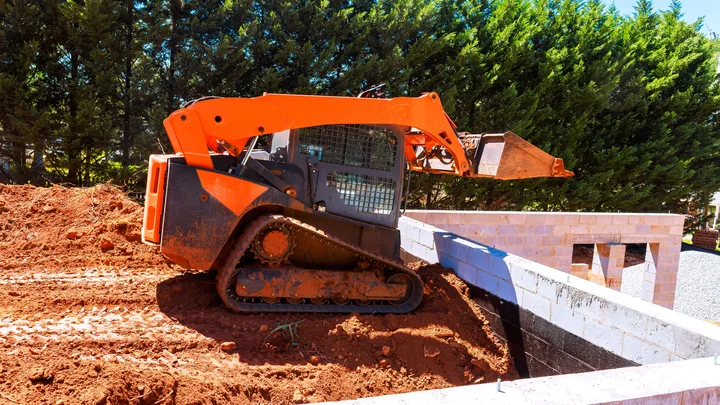
The carrier machine is covered. The tools that do the work frequently are not. Buckets, breakers, augers, grapples and forks move between machines and crews and are the items most often missing when a loss is added up — and on a compact loader the attachment can be worth more than the unit carrying it.
There is a second half to this one. Construction equipment is untitled, so proof of ownership after a theft rests on purchase records, the serial number and any financing filing rather than a state record. The sourced version of those mechanics is in our guide to what drives skid steer insurance cost; the equipment floater schedule is where the fix is applied.
“It is at the yard, so it is secure”
Real-World Scenario: A contractor working the Newark and Elizabeth corridor keeps two machines on a leased corner of a larger industrial yard, because dedicated space near the work is scarce and expensive. The gate is somebody else’s gate, the lighting is somebody else’s lighting, and the last person out on a Friday is rarely the contractor’s own. A unit is gone by Monday. The schedule is accurate to the serial number, and the difficulty is not the machine — it is that the application described secured overnight storage and nobody had ever checked what that meant here.
Shared yard space is a legitimate answer to a dense state with almost no cheap land. It is not a legitimate answer to an application question unless the description matches what is actually there.
The fix is a conversation with whoever runs the yard, held before it matters. Who locks the gate, who has keys, whether the cameras record or only watch, and whether anything in the arrangement is written down. Contractors who ask these questions usually find the answers are better than they feared and vaguer than they assumed, and the vagueness is the part worth putting right — because a storage answer that turns out to be aspirational is the fastest way to complicate an otherwise simple theft claim.
What is actually true
Every assumption above is reasonable, and every one of them is checkable before anyone needs it to be true. Read the haul pattern against the transit section. Read the rental contracts against the schedule. Read the storage description against the yard. None of it takes long.
What ties the eight together is that each one was true at some point, or true somewhere else, or true of a smaller version of the business. Assumptions are not invented; they are inherited from a firm with two machines and one yard and no subcontractors, and they stop being accurate quietly rather than obviously. That is why the useful review is annual and structural rather than triggered by a loss.
It is also why the answer is rarely more coverage. In most New Jersey files the corrections cost nothing at all — a rental agreement forwarded, a storage description rewritten, a locate record kept properly, a lift-truck evaluation dated. The coverage that follows a set of accurate answers is a better product than the coverage bought to cover for inaccurate ones.
Send a current machine and attachment list through the quote form and we will work through the list with you. Contractors comparing across state lines can start from the New Jersey location page.