
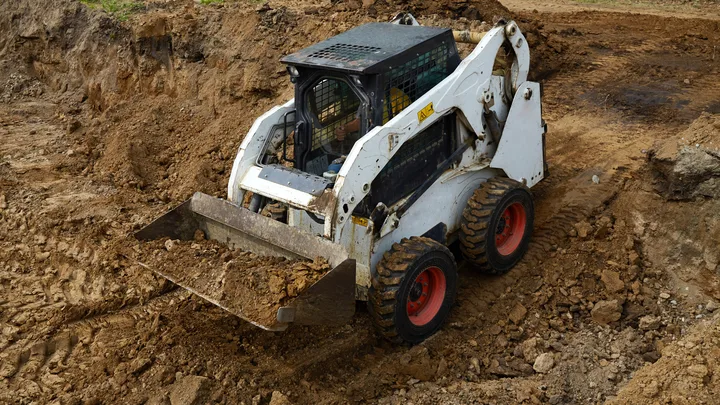

Nothing about heavy equipment pricing in Alabama scales smoothly. A one-machine operation and a four-crew site contractor are asked different questions, watched by different regulators and priced on different evidence — and most of the surprises at renewal happen in the year a business crosses from one tier into the next without the file noticing.
One machine, one trailer, one operator
At the smallest scale the exposure is concentrated rather than small. A single machine carries the entire operation with nothing to average it against, one loss is the whole loss history, and the owner is usually also the operator, the hauler and the person who locks the gate.
That concentration cuts both ways in a placement. There is very little to explain, which makes the file quick to read, but there is also nothing to smooth a bad year. The equipment floater is the whole program at this tier, and the two decisions that matter are the value basis chosen at binding — agreed, replacement or actual cash value — and whether the attachments that came with the machine were listed as their own items rather than assumed into it.
The other early mistake is treating the trailer as part of the machine. It is not, and neither is the truck. At one machine that distinction feels academic, since the same person owns all three and hauls them together every week. It stops feeling academic the first time something happens on a ramp.
The second and third machine: the schedule becomes a document
Somewhere around the second or third unit, an informal list stops working. A schedule that lists each machine by serial number, year, make and insured value is what an underwriter actually prices, and at this tier it starts to diverge from reality faster than anyone expects — a unit sold, an attachment bought at auction, a value carried forward out of habit.
Serial accuracy earns its keep here. Construction equipment is not titled the way a truck is, so after a theft ownership is established from the purchase record, the serial number and any financing filing against the machine. No Alabama document has been cleared for that mechanic, so nothing is linked for it here rather than a citation being invented; the sourced treatment sits in our guide on what drives skid steer insurance cost.
Storage changes at this tier too. One machine goes home with the owner; three need a yard, and a yard with a gate, a light and keys kept somewhere other than the cab is the control most directly tied to the dominant loss cause across the Birmingham, Huntsville, Mobile and Tuscaloosa markets.
The threshold where the state starts to care
Alabama splits contractor oversight between two bodies rather than one. The Licensing Board for General Contractors licenses nonresidential and commercial general contractors working at larger project scales, while residential builders answer to a separate board on separate terms.
The practical effect for an equipment buyer is that the credential question depends on the work rather than on the iron. A contractor who has always run residential site work and takes a first commercial job has changed regulators without changing a single machine — and the application question about licensing now has a different correct answer than it had last year. Neither board conditions an equipment placement, but a question that cannot be answered cleanly slows a file down and invites others. The Alabama location page carries the wider state framing.
Crews instead of operators
The tier that changes a program most is the first real crew, because a second policy enters the picture the day somebody else runs a machine.
Alabama is under federal OSHA for private-sector employers, so powered-industrial-truck operator training and evaluation requirements apply as the federal standard applied directly, without a state overlay to reconcile. What an underwriter asks for is documentary: qualification files, evaluation dates, refresher records. A crew trained well and recorded nowhere is indistinguishable on paper from a crew never trained at all.
The exposure itself splits in two. A crew member hurt around a machine is a workers compensation matter; anybody else hurt by the same event is a liability matter, settled on entirely different terms. Once several crews run several machines, an excess layer over both primaries is a shorter conversation than most owners anticipate. The Alabama forklift page sets out the standard.
Hiring pace is what an underwriter is really asking about behind all of this. An operation that adds one person a year and one that adds six in a quarter are not the same risk, because the second has outrun whatever informal vetting it used to rely on. That is a tier change nobody records anywhere, and it doesn’t show up on a schedule at all.
Real-World Scenario: A grading contractor who has run two machines for years wins a subdivision package and doubles the crew inside a month. Operators are hired quickly because the schedule demands it, and the informal way the owner used to check people out — riding along for a morning — does not scale past the first two hires. When a ground-crew injury occurs late in the season, the machines are all scheduled, the coverage is all in force, and the only document anybody wants to see is the one the growth outran.
When a site needs a plan, not just a permit
Scale eventually changes the ground itself. Coverage under the state construction general permit is triggered at one acre or more of land disturbance, and also where a smaller site sits within a common plan of development totaling one acre or more. Alabama also requires the construction plans to be prepared by a credentialed professional, which is a scheduling constraint rather than a formality.
None of that is priced by an underwriter. It belongs in a cost discussion because of what it signals about the work: jobs above that line run longer, hold more machines standing between phases and leave graded ground open through storm season. Duration and accumulation are the quiet drivers on an earthmoving schedule. The Alabama dozer page works through the permit structure.
Digging is the same exposure at every tier
One exposure refuses to scale, and it is the one most likely to produce a large claim on a small operation. Excavation notice obligations run to the statewide notification center on a defined window before work begins, and a ticket pulled for a phase that later slips can expire before the machine reaches the ground.
Alabama carries no cleared state document for that requirement in our source set, so no statute link is offered here and no notice period is asserted in place of one. The state mechanics are set out on the Alabama excavator page, and our Kansas cost guide shows how a notice window works as an underwriting fact with its statute attached.
What is worth saying plainly at any tier is that a strike is not really an equipment claim. The machine usually survives; the outage, the emergency repair and the third-party consequences run through general liability.
Growing past what you own
Every growth year runs through rented iron, because capacity arrives before the payback on buying does. An owned-equipment schedule answers for the machines on it and nothing else, while a rental contract normally makes the renter responsible from delivery through return, including loss-of-use charges. Rented and leased equipment coverage answers that, with a limit set against the largest unit a peak month might bring in.
Growth also puts more machines on the road. The machine belongs to the schedule; the truck and trailer belong to commercial auto; the machine while it is loaded, hauled and unloaded belongs to transit and trailer transport. That treatment rests on the ordinary classification of self-propelled construction machinery as special mobile equipment rather than a registered highway vehicle, which we state here without a citation because no cleared Alabama document supports it in our set. The Alabama backhoe page carries the road-operation material.
What scale does not change
Loss frequency leads at every tier, and it leads by a distance — several small claims read worse than one large one, because frequency looks like a pattern. Schedule accuracy comes next, since a stale list weakens every other answer on an application. Then storage and key discipline. Then the training file.
None of those four is a market condition, and none of them gets easier by growing. Send a current machine and attachment list through the quote form and we will read it against the tier the operation is actually in today.