

Arizona equipment pricing is easiest to understand as a sequence rather than a list. Walk one job from the bid through closeout and the drivers appear in the order an underwriter would meet them — the credential, the haul, the first cut, the crew, the permit file, and the week the machines come home. Each stage carries its own question.
Before the bid: the classification is the first underwriting fact
Arizona is a licensing state, and that changes the opening move. Contractors are credentialed by classification — commercial, residential and dual building classes alongside engineering and specialty categories — with experience and examination requirements set out at A.R.S. § 32-1122.
For an equipment buyer the classification is not a price. It is a shortcut. A market reading a submission wants to know whether the work described on the application is the work you are actually qualified and equipped to perform, and a classification answers a large part of that in one line. In states with no statewide credential the same ground has to be covered by narrative. Start from the Arizona location page if you are comparing across state lines.
Mobilization: the machine gets priced twice on the way out
Nothing has been dug yet and there are already two policies in play. The machine belongs on the equipment floater; the truck and trailer moving it belong on commercial auto; and the machine while it is chained down, in motion, or being loaded and unloaded belongs to transit and trailer transport.
Arizona does not carry a clean statutory definition of special mobile equipment the way several states do, so the road-treatment question here rests on practice rather than on a section anybody can cite. We state that qualitatively and link nothing for it. The insurance boundary holds regardless: a self-propelled machine moved incidentally over a highway is scheduled equipment, and the vehicle underneath it is not. The Arizona backhoe page works through the road-operation side.
Breaking ground: Arizona will not let you start until the marks are done
Most dig statutes set a countdown. Arizona sets a condition. Under A.R.S. § 40-360.22 the statute fixes no advance-notice day count for the excavator; instead, facility operators must mark within two working days and the excavator may not begin until marking is complete. Marks then carry a validity period of fifteen working days, and a crew that intends to keep digging past it must renotify at least two working days before that period expires.
That structure rewards a different habit than a countdown does. The question on an Arizona site is never “has it been long enough” — it is “are the marks live right now”. Crews that treat locate status as a daily condition rather than a one-time errand generate a very different claims history, and utility strikes are one of the few losses that reach far past the general liability limit a contractor thought was generous. The Arizona excavator page sets out the notice mechanics.
On site: the safety program answering your crew is a state program
Arizona runs its own approved workplace-safety plan covering private-sector employers, which the federal state plans listing records. Operator training, evaluation and enforcement for powered industrial trucks therefore run through the state program rather than through federal inspectors.
The substance of the training requirement tracks the federal standard closely enough that most contractors notice no difference in what they teach. What differs is who arrives after an incident and whose expectations your files answer to. Operator qualification records, evaluation dates and refresher documentation sit at the intersection of workers compensation and the liability layer, and they are the first thing requested when a lift injury enters a loss run. The Arizona forklift page covers the state-plan structure.
Real-World Scenario: A lift truck clips a rack leg in a contractor supply yard during a night shift and a ground worker is hurt. The operator has run that machine for years and everyone on site says so. What nobody can produce is the evaluation record, because the last one happened verbally on a busy morning and was written down nowhere. The incident becomes an unmanaged-exposure story rather than a documented lapse, and it reads that way on the loss run for years afterward.
Mid-job: heat, dust and the machines that sit
No underwriter rates the weather, but Arizona conditions shape the loss run that does get rated. Sustained heat pushes hydraulic and cooling failures. Dust accelerates filter and seal wear. Crews respond by starting early and finishing before the afternoon, which leaves machines standing on open sites for long stretches of daylight and darkness.
Standing machines are the exposure. A unit that works six hours and sits eighteen is not a lower risk than one that works twelve — it is a different one, weighted toward theft, vandalism and the kind of damage nobody witnesses. Where a schedule carries several machines across several crews, an umbrella layer over the primary limits is usually a shorter conversation than contractors expect.
Earth-moving at scale: the permit file opens with the first blade cut
Once land disturbance reaches one acre — or less, where the work belongs to a common plan of development reaching that size — the job enters the state construction stormwater program. The current construction general permit is administered by the state environmental agency.
This is an environmental obligation and it never appears on a rating worksheet. It earns a place here because it marks a threshold in the character of the work: longer durations, more machines held on site between phases, and graded ground left open to weather and to whatever monsoon activity arrives. Duration and accumulation are two of the quieter drivers on a dozer-weighted schedule, and the Arizona dozer page works through the permit structure.
The change order: the stage that adds a machine nobody reported
Every job of any length changes shape once. A phase gets accelerated, a soils report comes back differently than expected, or an owner adds scope, and the fleet on site changes in a week. This is the stage where schedules and reality separate, and it separates quietly because everyone involved is busy solving the actual problem.
Two mechanisms usually cover the gap and neither covers it for long. Most equipment floaters carry a newly acquired provision that picks up a purchased machine automatically for a limited window, so a machine bought on a Tuesday is not uninsured on Wednesday. And a rented unit brought in for a phase is covered by whatever rental coverage part exists, at whatever limit was set when nobody was thinking about this particular machine. Both work exactly as intended. Both assume somebody reports the change inside the window.
The reporting habit is what actually holds. A contractor who sends an updated machine list at the end of every month never tests either provision, and a contractor who updates the list at renewal tests both constantly. Unscheduled machines are the single most common gap we find on Arizona accounts, and they are almost never the result of a decision — they are the residue of a busy month. A standing calendar reminder does more here than any endorsement.
Demobilization: the week machines go missing
The end of a phase is when compact machines disappear. The site is half struck, the fence is down, crews are split between the finishing work and the next mobilization, and nobody is quite sure who has the keys. It is the most predictable window in the job and the least supervised.
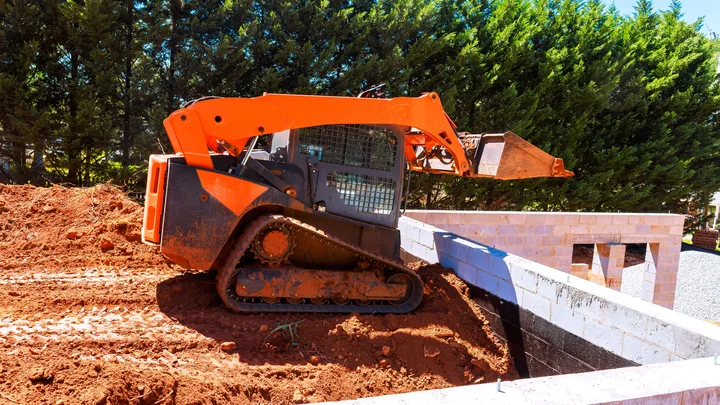
Arizona has no verified filing document in this source set for the ownership-proof question, so we describe it plainly and link nothing: a compact loader is not titled, and ownership after a theft rests on the bill of sale, the serial number and any financing record filed against the machine. The sourced treatment of that mechanism is in our guide to what drives skid steer insurance cost.
Closeout, and the renewal that follows it
Six moments, six answers. The classification you hold. The way machines travel. Whether locate status is a daily condition. Whether operator files exist. Whether the permit threshold was crossed and handled. Whether the schedule that came home matches the schedule that went out.
A renewal is mostly a test of whether those answers stay stable from one year to the next. Where they don’t, the instability itself is the finding — a market reads a moving description as an account it cannot yet price confidently, which is a slower and more expensive conversation than an unflattering but steady one. Send a current machine list through the quote form and we will work it against the sequence above rather than against a rate table.