
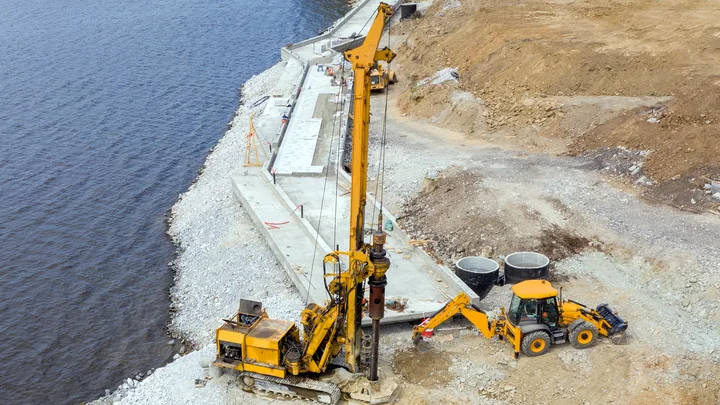

Connecticut equipment cover is decided by paperwork more than by machinery. A schedule, a registration, a dig ticket, a certificate, a rental agreement, an operator file and a permit registration each answer a different question, and a gap in any one of them tends to show up as cost long before it shows up as a claim.
The machine schedule
The first document is the one everything else hangs from. A schedule lists machines by serial number, year, make and insured value, and it is what an underwriter actually reads when a submission arrives. Two firms doing identical work in the Bridgeport and New Haven corridor can land in different places purely because one list was rebuilt this spring.
Two decisions sit inside it. Settlement basis is the first: actual cash value settles net of depreciation, while an agreed or replacement basis settles against a figure fixed at binding, and an older unit and a machine delivered last season rarely deserve the same treatment. Completeness is the second, and attachments are where completeness fails — buckets, breakers, augers and forks migrate between machines and between crews, so a list of carriers alone understates what is at risk. The equipment floater holds both decisions, and we place it standalone rather than folding it into a package.
The registration with Consumer Protection
Connecticut issues no statewide general or trade contractor license of the sort several neighboring states run. Home improvement contractors and new home construction contractors register with the Department of Consumer Protection, and individual trades carry their own credentials on top. The department maps the routes in its own guidance on what license or registration a contractor needs.
For pricing, a registration is a fact about standing rather than about capability. It confirms a firm is on the record and current; it does not describe crew size, work mix or discipline. What fills that space is everything else in the stack — history, schedule and loss runs. The Connecticut location page covers how we frame it on a submission.
The dig ticket
Every excavation in the state runs through one statewide clearinghouse rather than through individual utilities, which makes the ticket a single well-defined document. Notice must be given at least two full days excluding Saturdays, Sundays and holidays, and not more than thirty days before the work begins — the current provisions are published by the regulator as the Call Before You Dig requirements.
The upper edge is the interesting one for a careful contractor. Pulling tickets for a whole phase at the start of a job is good planning right up to the point where a section slips, and a machine arriving on an expired ticket is digging unnotified no matter how organized the office was. In dense right-of-way between Stamford, Norwalk and Danbury the consequences compound quickly.
A strike is not really an equipment loss. The machine keeps running and the damage lands on the general liability side as third-party property damage, interrupted service and emergency repair. The Connecticut excavator page sets out the notice mechanics in more depth.
The certificate of insurance
The certificate is the document a contractor issues least and worries about most. A general contractor asks for evidence naming a specific job and sometimes a specific machine, and the request quietly functions as an audit: it asks whether what the policy carries matches what is actually on site.
Real-World Scenario: A site contractor wins a package on a mixed-use build and the general contractor requests evidence of cover before mobilization, listing the machines expected on site. Everything matches except one mini excavator, bought at the end of the previous season to replace a unit that was traded. The trade was reported. The replacement never was. Work is held while the schedule is corrected and fresh evidence is issued, and the delay costs more attention than the endorsement ever would have.
Where a schedule carries several machines across several crews, an umbrella layer over the primary limits is usually a shorter conversation than contractors expect, and it is often the general contractor’s requirement rather than the owner’s preference that prompts it.
The rental agreement
Hired iron arrives with its own contract, and that contract rarely matches the policy anyone assumed would answer for it. A rental agreement generally makes the renter responsible from delivery until return — physical damage, theft, and loss-of-use charges while the unit sits off the rental line rather than earning.
An owned-machine schedule answers for the machines on it and nothing more. Rented and leased equipment coverage is the part that answers here, and the limit belongs at the size of the largest unit a peak month might bring in, not at the size of the one that turns up most weeks. In a state where jobs sit close together and rental yards are never far away, that limit gets tested more often than in places where hiring is an expedition.
The load ticket and the haul
Connecticut treats self-propelled construction machinery as special mobile equipment: built for a function other than carrying people or property, and only incidentally operated on public roads. It is therefore not registered as an ordinary vehicle. The statutory language behind that is not among this guide’s cleared sources, so the Connecticut backhoe page carries the road-operation detail with its citation.
Three documents follow from that one classification. The truck and trailer sit under commercial auto. The machine at work sits under the equipment line. The machine chained to a deck sits under transit and trailer transport. Short hauls make the middle document easy to forget, and short hauls are what this state has — a firm may load and unload the same machine several times in a week, and loading is where a real share of damage happens.
The operator file
Connecticut runs an approved State Plan, but it covers state and municipal employees only. A private equipment contractor answers to the federal standard directly, including the powered industrial truck operator training and evaluation requirements. The agency publishes the coverage of each program on its state plan directory.
The document that matters is the operator file: qualification, evaluation date, refresher record. It is the first thing requested when a lift injury reaches a loss run and the last thing available if nobody kept it. A crew that trains well and files nothing is indistinguishable on paper from one doing neither. The exposure runs through workers compensation and the liability layer at once, and the Connecticut forklift page sets the requirement out in full.
The permit registration
Land disturbance of one acre or more brings a job under the state construction stormwater general permit, which is registration-based and administered by the Department of Energy and Environmental Protection. The permit is published in full as the general permit for the discharge of stormwater from construction activities.
No equipment rating worksheet contains that permit. It belongs in this stack because it marks a change in the character of the work rather than a compliance box: above the line, jobs run longer, more iron stands on site between phases, and graded ground stays open to weather. Duration and accumulation are things an underwriter prices, and the Connecticut dozer page works through the permit structure.
The document that does not exist
There is no title for construction equipment. No certificate, no plate, no state vehicle record — which means that after a theft, ownership has to be reconstructed from the bill of sale, the serial number carried on the schedule and any financing statement a lender filed against the machine.
That absence is why serial accuracy earns its reputation. A transposed digit is a bookkeeping error on a quiet day and a proof problem on the worst one. The controls that change recovery odds are unglamorous: gated storage rather than an open site between phases, keys kept away from the machine, and a tracking unit fitted to the machine itself rather than to the trailer beneath it. Those mechanics are set out with citations in our guide to what drives skid steer insurance cost.
The file, read end to end
At renewal the stack gets read as one thing, and it is only as good as its weakest sheet. Loss frequency leads, because a pattern reads worse than a single bad day. Schedule accuracy follows, since a stale list undermines every other document beside it. Then the controls — storage, keys, tracking, notice discipline, operator records — because those are the items a contractor can change between now and the next anniversary.
None of that is a market condition, which is the useful part. Send a current machine and attachment list through the quote form and we will read it against the documents above rather than against a state average.