
Florida equipment insurance is best understood backwards, from the losses rather than from the quote. Wind, theft, overturn, damage in motion and buried-utility strikes are the columns that fill a Florida file, and every rating question an underwriter asks is a shortened way of asking how long each of those columns runs.
The ledger starts with wind
Nothing else about Florida equipment work is scheduled independently of storm season. It sets when large sites open, when they close down, where machines stage, and how quickly a yard can absorb a fleet that normally sleeps on the job.
Underwriters ask about staging directly, and the answer they are listening for is operational rather than aspirational. Where do the machines go when a system enters the forecast cone, how long does moving them take, who decides, and does the plan account for the units that are hardest to move rather than the ones that are easiest. A plan that only works for compact machines is a plan with a hole in it.
Coverage follows the same logic. The equipment floater responds to the machine wherever it sits, which is exactly why the staging answer matters — the policy does not care where the machine is, and the loss history very much does.
Real-World Scenario: A site crew finishing a coastal pad leaves two machines on the job over a weekend because the tie-in work resumes Monday and the haul back to the yard eats half a day. A system that had been forecast to turn instead brushes the coast, and the site takes water and debris rather than a direct hit. Both machines are recovered and repaired. What the file records afterward is not the weather — it is that the staging decision was made by whoever finished last on Friday, and the renewal conversation starts there.
Theft, and proving a machine was yours
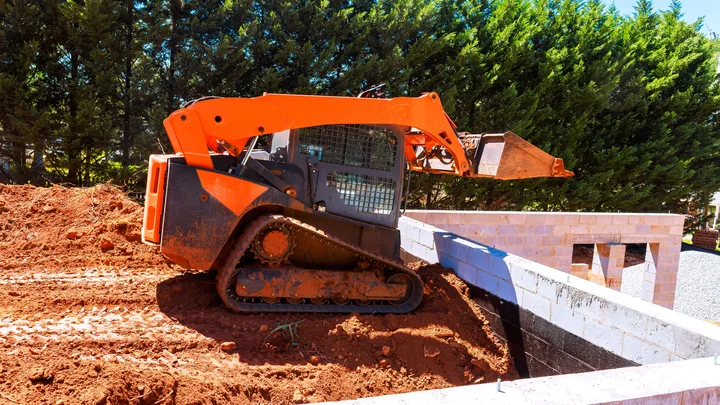
Compact machines are the most portable serious equipment on a Florida jobsite, and the metro corridors around Miami, Tampa, Orlando, Jacksonville and Fort Lauderdale carry the pressure that follows. The controls are unglamorous and they work: a secured yard rather than an open site between phases, keys stored away from the machine, a tracking unit fitted to the machine itself rather than to the trailer, and an accurate serial number on the list.
The serial number carries more weight than owners expect. A skid steer is untitled construction equipment, so after a theft ownership is established from purchase records, the serial and any financing statement filed against the machine. Florida sets its central filing office by statute at Fla. Stat. § 679.5011, and the registry it names is where a lender perfects. The Florida skid steer page works the ownership mechanics through in detail.
Overturn, soft ground and standing water
The second column is the one owners underestimate. Machines tip, slide, sink and drop loads, and in Florida the ground conditions that produce those losses are seasonal rather than exceptional. Saturated fill, a trench wall that will not hold, a pad that drains slower than the schedule assumed — none of it is dramatic and all of it is expensive.
Standing water deserves separate mention because it does not read as a peril until it is one. A machine that finishes a shift on ground that drains overnight is a different machine from one that finishes on ground that does not, and the damage that follows — to undercarriage, to electronics, to hydraulics that were never meant to sit submerged — arrives quietly and is often discovered days later. Late discovery is itself a claims problem, because the sequence of events is harder to establish after the site has dried.
There is no coverage feature that answers ground conditions. What answers them is the operator, the sequence of work, and whether the crew treats a wet site as the same site it was a week earlier. Underwriters read that through the loss run, which is why frequency is weighted so heavily: three modest overturns describe a working practice, while one large loss can be circumstance.
Losses that happen between jobs
Florida site work runs on short constant hauls, and every one of them is a transition. Loading and unloading produce a meaningful share of all equipment damage, and a machine on a trailer sits outside what many owners assume their policy covers.
Florida settles the classification question cleanly. A self-propelled backhoe is special mobile equipment under Fla. Stat. § 316.003 — not designed or used primarily to transport persons or property, and only incidentally operated over a highway — so it is not registered as an ordinary vehicle. The machine stays on the equipment list, the truck and trailer answer to commercial auto, and the machine in motion answers to transit and trailer transport. The Florida backhoe page covers the road-use boundary.
What is under the sand
The fifth column is the smallest by count and the largest by consequence. Under Fla. Stat. § 556.105, excavation notice must be given not less than two full business days before work begins, with a longer window for excavation beneath state waters, and the statute allows an excavator to proceed with reasonable care where a facility operator has not marked within forty-eight hours excluding non-business days.
That allowance is narrower than it reads. Proceeding with reasonable care is a standard you will be measured against afterward, not a release, and the strike itself is rarely an equipment claim in any meaningful sense — the outage, the emergency repair and the third-party losses run through general liability. Our Florida excavator page sets out the notice sequence.
People on the ground
The sixth column runs through two policies at once. Machines work close to crews on Florida sites, visibility from a cab is limited where it matters most, and the injuries that result are recorded in both the liability file and the workers compensation file.
Florida has no approved state plan for private-sector employers, so those employers answer to federal OSHA directly, as the agency’s list of state plans records. For powered industrial trucks that means the federal operator training and evaluation requirements apply as written. The documentation is the insurance-relevant half: a crew that trains well and records nothing is indistinguishable on paper from one that does neither, and the Florida forklift page sets the standard out.
Two tiers of credential, and why the tier is asked
Florida splits contractors into two classes under its construction licensing chapter, administered by the state business and professional regulation department through the construction industry program. A certified contractor holds a statewide certificate of competency. A registered contractor holds a local competency card and may work only in the jurisdiction that issued it.
An underwriter asks which one you hold for a reason that has nothing to do with vetting. The tier describes how far your work can legally travel, and operating radius is one of the few rating facts that changes the exposure profile outright. A contractor working one county and one working the peninsula are not the same risk with the same iron. The Florida location page sets out how the tiers divide.
Ground disturbance, and the permit that marks it
Florida administers construction stormwater through a state generic permit rule rather than a numbered order, run by the state environmental protection department and described on its construction activity page, at a disturbance trigger of an acre or more.
It is an environmental obligation and not a rating input. Its usefulness here is as a marker: jobs that cross the threshold run longer, hold more machines between phases, and leave open ground through a wet season. Duration and accumulation are genuine drivers, and the Florida dozer page works through the permit structure.
Reading the ledger back to a price
Add the columns and the picture is straightforward. Frequency across theft, transit and overturn does most of the work. Wind sets the shape of the year. Strikes are rare and heavy. Injuries sit across two policies. Everything an underwriter asks is aimed at one of those five. For the machine-side view of the theft column, the skid steer cost guide takes it apart in detail.
The rental line deserves its own mention because it is the most common uninsured exposure we find here. Peak-season demand pulls machines in from rental houses, the contract makes you responsible from delivery through return, and an owned-equipment list answers for none of it — rented and leased equipment coverage does, at a limit set against the largest unit you might take rather than the usual one. Send a current list through the quote form and we will read it against the columns above.