
Rhode Island compresses everything. The state is small enough that a contractor can work every metro in it from one yard, which shortens hauls, tightens sites, and puts the same crew in front of far more property lines per year than distance would allow anywhere else. That compression is what an equipment underwriter is pricing.
The registration nearly everyone here holds
Rhode Island sits in a small group of Northeast states that register contractors statewide. General contractors and subcontractors building or repairing structures must register with the Contractors’ Registration and Licensing Board, which gives an underwriter reading a submission from this state something a file from a registration-free state cannot supply: an external record that the business exists in the form it describes.
The record is thinner than it looks and more useful than contractors expect. It is registration rather than examination, so it certifies nothing about skill. What it certifies is continuity — a registration number carries a history, and history is precisely what an underwriter reaches for when the loss runs are short or the company is young. A contractor who has carried the same registration through several cycles has already answered a question that would otherwise be asked twice.
Every haul is short, and short hauls get treated casually
A machine here can leave the yard, work two sites and be back before dark. That convenience is real, and it produces the state’s most underrated exposure, because the discipline that a long trip forces is the discipline a short one invites you to skip. Ratchet straps get run loose. A machine gets walked up the ramps with the boom still out. Nobody circles the trailer because the destination is visible from the loading point.
The policy boundary does not move for short trips. The truck and trailer sit on commercial auto; the machine on the deck belongs to transit and trailer transport, which is also what answers during loading and unloading. In a state where a machine may make several of those transitions a week, transit is not an edge case in the program — it is one of the busiest parts of it.
Short hauls also change who does the loading. On a long move a machine is loaded once, by whoever is qualified to load it. On a route with several stops in a day it gets loaded by whoever happens to be standing there when it needs to move. Tie-down responsibility diffuses, and diffuse responsibility is what turns up in a loss description as nobody in particular having checked.
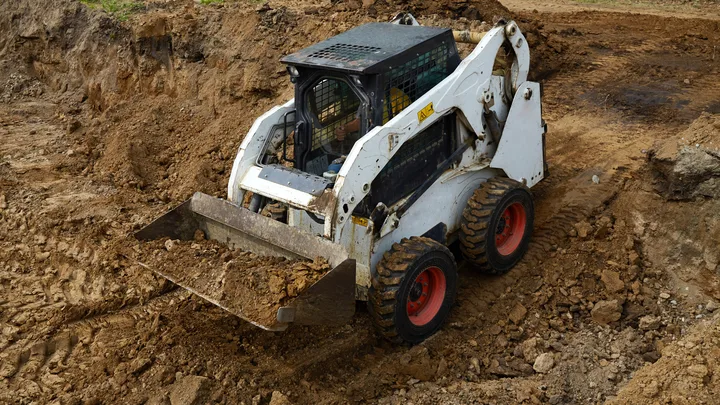
Real-World Scenario: A compact loader is moved a few blocks between two jobs on the same street grid, a trip short enough that the operator does not bother chaining the rear of the machine down. A car pulls out ahead of the truck, the driver brakes harder than the load expected, and the machine shifts on the deck. Nothing leaves the trailer and nobody is hurt. What follows is a conversation about which coverage part responds to a machine damaged in transit, and the answer is not the one most contractors assume when the trip was that short.
Tight sites put other people inside the swing radius
Density does to liability what it does to hauling. Work happens against occupied buildings, active sidewalks, parked vehicles and abutting parcels whose owners are home. A tail swing that would clear open ground clears nothing here, and spoil that would sit harmlessly on a rural shoulder is sitting on somebody’s walk.
That is why the general liability layer carries more weight on a Rhode Island schedule than the machine values alone would suggest. The equipment line answers for the iron; the third-party half of a dense-site loss is almost always the larger number, and it is the half a contractor has least control over once the machine is swinging.
Two consequences follow for a schedule. The first is that operating radius, which underwriters ask about directly everywhere, is not doing its usual sorting work here — every radius in this state is short, so what distinguishes one submission from another is the kind of site the machine works rather than how far it travels to reach it. The second is that access is a genuine cost driver. Machines that have to be walked through gaps, positioned against structures or worked from a street rather than an open lot spend more of their operating hours near something breakable, and contact that would be invisible on a green field is property damage here.
Notice runs through a regional center
Excavation notice in Rhode Island runs through Dig Safe under the Public Utilities Commission, and the timing is set by R.I. Gen. Laws § 39-1.2-5: notice at least seventy-two hours before excavation, excluding Saturdays, Sundays and holidays, and not more than thirty days ahead. Operators then have seventy-two hours from receipt to mark the approximate location of their facilities.
The outer limit is the part that catches schedulers. A ticket pulled while a permit is still pending, against a start date that then slips, is not protecting the crew that shows up on the strength of it. Our Rhode Island excavator page works through the mechanics in more detail, and the underground exposure it describes is the one that turns a routine trench into a claim with a service outage attached.
The road question this state does not settle in a cleared document
A self-propelled backhoe here is ordinarily handled as special mobile equipment — outside ordinary vehicle registration, on public roads only incidentally. We are stating that qualitatively and citing nothing for it, because no Rhode Island document on the point is cleared for citation on this site and we would rather leave a paragraph unsourced than attach it to a link we cannot support.
The practical consequence does not depend on the citation. The machine belongs on the equipment schedule; the truck and trailer belong on the auto policy. Our Rhode Island backhoe page covers the state-layer version, and the Ohio cost guide shows the same boundary drawn against a statute that is cleared, which is worth reading if you want to see how the definitional line is normally written.
An acre arrives sooner on a small parcel
The Department of Environmental Management administers the state construction stormwater general permit, and permit coverage is triggered at land disturbance of one acre or more.
On the parcel sizes common across Providence, Warwick, Cranston and Pawtucket, that threshold gets reached by jobs nobody would describe as large. A redevelopment on a single block can cross it. The obligation is environmental rather than an input to any rating worksheet, but crossing it changes how a job behaves: controls have to stay in place across phases, which means machines stay put across phases, which is the condition under which exposure accumulates instead of resetting nightly. The Rhode Island dozer page works through the permit structure.
Operator standards run on the federal book
There is no state OSHA plan covering private-sector employers here, so those employers answer to federal OSHA directly and the powered-industrial-truck training and evaluation requirements apply as written.
The insurance question is never whether the rule applies. It is whether the file exists. Qualification records, evaluation dates and refresher documentation are what get requested the moment a lift injury lands in a loss run, and they are what any defense is assembled from later. That exposure sits across workers compensation and the liability layer simultaneously.
One yard, and every job depends on it
The flip side of a short radius is concentration. Most contractors here run a single yard, which means one gate, one set of lights and one perimeter standing behind the entire schedule. A control failure at that yard is not a local problem the way it would be for a company with dispersed storage — it is the whole fleet at once.
Compact machines are the ones that leave. Nothing in this state titles them, so what proves ownership afterward is records rather than a registry, and the filing mechanics behind that sit in the skid steer guide rather than here, where the relevant state datum is not a cleared source. Rented units complicate the same picture, since a rental contract normally makes you answerable from delivery through return; rented and leased equipment coverage is what answers for those.
What compression gives you, and what it costs
Short hauls, low mileage, quick redeployment and one perimeter to defend are genuine advantages, and they show up in a submission as fewer moving parts. What they cost is margin for error: fewer places to spread a control failure, more transitions per machine per week, and property lines close enough that ordinary work reaches them.
An underwriter is pricing that trade rather than the state’s size. If you want a read on where your own schedule sits inside it, send the current list through the quote form, and the Rhode Island location page opens the rest of the state layer.