
Wyoming prices distance. The miles between the yard and the job, the hours a machine stands with nobody near it, the days between a loss and the moment somebody notices, and the gap between a crew and the record that proves it was trained — those spaces do more to an equipment number here than the machines standing in them.
From the yard to the job
Start with the haul, because in this state it is rarely short. Work that would sit inside one metro area elsewhere is spread across counties here, and machines cover real ground between jobs rather than crossing town.
Operating radius is asked about directly on nearly every submission, and long-radius fleets are a different risk rather than automatically a worse one. Long hauls are fewer, better planned and driven by people who do it regularly; short hops are frequent, improvised and handled by whoever is nearest the trailer. What both share is that the machine spends measurable time neither working nor parked, and that state belongs to transit and trailer transport rather than to the schedule or the auto policy. The truck and trailer themselves answer to commercial auto.
Loading and unloading is where a meaningful share of equipment damage happens anywhere. Add a two-hour drive to it, and the same event now also costs a day.
Distance changes repair economics as well, and this is the part contractors feel before they can name it. A machine down in a metro area waits for a technician; a machine down four hours from the nearest dealer waits for a technician, a truck and a window in somebody else’s schedule. Insurers are not pricing the inconvenience, but they are pricing the pattern behind it — the spare parts kept on hand, the tendency to keep an older backup unit on the schedule, and the fact that a fleet spread thin is a fleet where every unit matters more.
From the machine to the nearest person
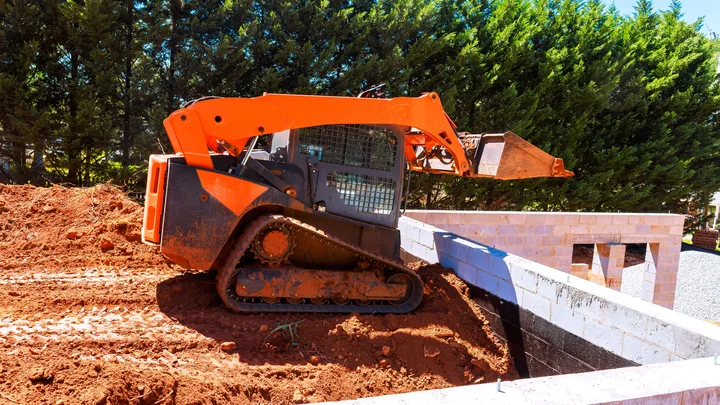
The second distance is the one that separates Wyoming from a dense state. A compact machine parked at a site outside Gillette on a Friday may not be seen again until Monday, or later if weather closes the access road.
Two things follow, and only one of them is obvious. Unattended hours drive theft opportunity, which every contractor already knows. They also drive discovery time, which is the half that quietly does more damage. A loss nobody notices for days arrives with a weaker report, colder evidence and worse recovery odds than the same loss found the next morning.
There is no cleared state document behind this, and this page will not invent one. The mechanics are general: construction equipment is untitled, so proof of ownership after a theft rests on the purchase record, the serial number on the schedule and any financing statement filed against the machine. Our skid steer cost guide carries the sourced version of that filing question.
Real-World Scenario: A grading contractor leaves a compact loader and a skid-mounted compressor at a county road job north of Casper over a long weekend, which is normal practice — the next phase starts Tuesday and moving iron twice costs more than leaving it. Snow closes the access road on Saturday and does not clear until Wednesday. When the crew finally reaches the site the loader has been taken, and nobody can say whether it left Friday night or Tuesday morning. The machine was insured, the serial was accurate and the schedule was current; what could not be produced was a timeline, and the entire response — reporting, recovery, the account of events — had to be built backwards from a four-day gap.
The cheapest control against that is not a purchase. It is a defined visit interval that somebody actually keeps.
From a call to a locate
Wyoming’s excavation-notice rule constrains both ends of the window and adds a third condition most states do not. Under W.S. 37-12-302(c), set out in Title 37 of the Wyoming Statutes, notice must be given at least two full business days but not more than fourteen business days before any excavation, and facility operators must respond within two full business days. Projects lasting longer than fourteen business days require renewed notice for each succeeding fourteen-business-day period.
That renewal requirement is the distance rule hiding inside a dig statute. A long linear job — a rural utility run, a county road rebuild — is exactly the kind of work that outlasts its own notice, and the crew working the far end of it in week four is operating on a ticket that expired while they were still in week two. A strike is a liability loss before it is an equipment loss, which is why the general liability layer and the machine schedule get read together. The Wyoming excavator page works through the notice mechanics.
From the county line to the licensing desk
Wyoming has no statewide general-contractor license. General, plumbing and mechanical licensing is handled by individual cities and counties, so the requirement depends on where the job sits rather than on the business. Electrical work is the exception and is licensed statewide through the state fire marshal’s electrical licensing program.
For an equipment buyer that produces a specific consequence. There is no single credential an underwriter can read as shorthand for vetting, so the questions land on the operating history, the loss record and the schedule instead. Contractors sometimes hear that as extra scrutiny. It is the absence of a shortcut. It also means a contractor working three counties may face three different local answers, which is a compliance question rather than a rating one but is worth settling before mobilization rather than after.
From the crew to the training record
Wyoming runs an approved State Plan covering private-sector employers, so powered-industrial-truck operator training, evaluation and enforcement run through the state program rather than through federal inspectors directly.
The obligation is not lighter. What distance changes is retrieval. On a remote site the person who holds the operator files is usually the person least likely to be there, and a record that takes two days to produce reads differently from one produced in an hour — not legally, but in every practical sense that follows an incident. That exposure runs through workers compensation and the liability layer simultaneously, and the Wyoming forklift page sets out the standard.
From open ground to running water
Earthmoving above a disturbance threshold pulls in state stormwater permitting administered by Wyoming’s environmental agency, with the permit tiered by the size of the disturbance. This page does not cite the permit documents or state their thresholds, because the document recording them is not among the sources cleared for this page — and a hand-typed citation is worse than an honest silence. The Wyoming dozer page carries the permit structure with its sourcing intact.
What the threshold does for an equipment buyer is mark a change in the shape of a job. Above it, work runs longer, holds more machines on site between phases and leaves graded ground open through a season of weather. Duration and accumulation are the quiet drivers on an earthmoving schedule, and in this state they arrive with distance attached.
The machine that is not a highway vehicle here
A self-propelled backhoe in Wyoming is treated as mobile machinery — self-propelled heavy equipment used primarily in construction and maintenance — and registered under a distinct county scheme rather than as an ordinary vehicle. That is the general position, stated here without a link because no cleared document backs it on this page; the Wyoming backhoe page is where the registration treatment belongs.
The coverage boundary it draws is the useful part. The machine belongs to the equipment floater, the truck and trailer to the auto policy, and anything you rented for a busy month to rented and leased equipment coverage — a rental contract normally holds you responsible from delivery to return, and an owned schedule answers for none of it.
What distance does to a renewal
Loss frequency still leads, as it does everywhere. After that, Wyoming renewals turn on the answers to distance: how long machines stand unattended, how quickly a loss is discovered, how far a haul runs, how fast a record can be produced. Every one of those is a habit rather than a purchase.
Send the current machine list through the quote form and we will read it against those spaces. Contractors comparing across state lines can start at the Wyoming location page.